
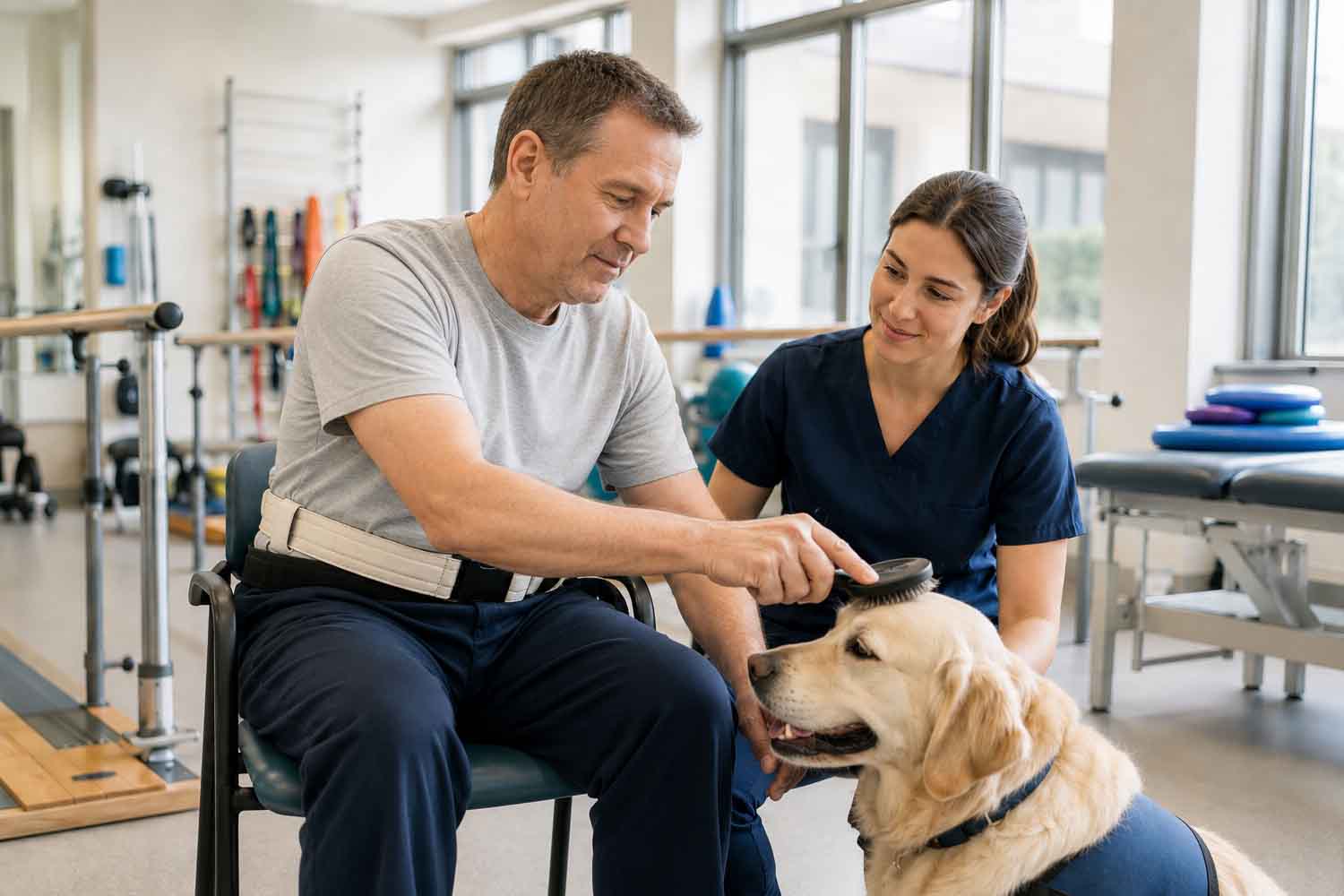
Brush a dog’s fur with the hand to be rehabilitated. Walk alongside him down a corridor. Throw him a ball and get some movement in the meantime. At the Mayo Clinic, some routine stroke rehabilitation sessions have been built around these activities. And the patients involved moved more, remained active longer and participated with greater involvement in the therapy compared to those who only followed the standard program. This is shown by a randomized trial published in Mayo Clinic Proceedings.
However, the result deserves precise measurement. The study concerns 50 people hospitalized after a stroke, followed in a single hospital program, and shows above all an effect on participation and activity during the sessions. It does not yet allow us to say that a dog recovers motor skills or autonomy more quickly in the long term. This will require larger studies and longer follow-up.
The dog enters into the exercises, it doesn’t simply keep company
The researchers randomly assigned the 50 patients to two groups. The first followed normal inpatient rehabilitation, which included physiotherapy, occupational therapy and speech therapy. In the second group, made up of 25 people, some sessions were carried out together with therapy dogs and their handlers. Participants could carry out between one and six sessions, lasting 30 minutes each and spread over a maximum of two weeks.
One detail changes the reading of the study a lot: the sessions with the dogs replaced some normal rehabilitation sessions, they were not simply added by increasing the hours of therapy. The difference observed, therefore, cannot be dismissed with a banal “they did more exercise because they spent more time in the gym”.
The dog became part of the exercise. You could walk alongside him, play fetch, caress him or brush him, adapting the activity to the rehabilitation goals of the individual patient. A repetitive movement remains a repetitive movement; if at its end there is a dog waiting for the ball, obviously the desire to do so can change a lot. The Mayo Clinic describes reduced motivation, low energy, loneliness and little interest in exercise as among the obstacles that can impact rehabilitation after a stroke.
More participation and more activities during sessions
The clearest difference concerns involvement. Patients in the dog group scored significantly higher on the Pittsburgh Rehabilitation Participation Scaleused by therapists to evaluate how actively a person participates in treatment. The statistical difference between groups had a value of p=0.0038.
Sensors used to measure movement also recorded more physical activity per minute in the dog-assisted therapy group, with p=0.023, and a greater percentage of time spent moving, with p=0.006. This is the concrete fact behind the idea of patients “walking more”: during those sessions they were actually more active and remained mobile for longer.
Differences also emerged in two parameters of heart rate variability, used as an indicator of the regulation of the autonomic nervous system. According to the authors, the changes observed are compatible with a better response to stress during the sessions. However, mood and other physiological parameters measured, including salivary oxytocin, did not show statistically significant differences between the two groups. In short, the dog did not perform hormonal miracles: above all it made the patients more involved and physically active.
The study is small and not enough to talk about faster recovery
The sample remains small. In the experimental group alone there were 25 people, 17 men and 8 women, with an average age of around 65 years; 19 identified themselves as white. The study took place at the Mayo Clinic in Rochester, Minnesota, between February 2023 and February 2024. These are characteristics that greatly restrict the possibility of automatically extending the results to all stroke patients.
Above all, among the indicators considered by the authors there were also quality of life, mood and functional recovery, while the statistically clearest effects published concern motivation, participation and quantity of movement during rehabilitation. It is an important distinction: being more involved in the treatment is certainly interesting, but it remains to be seen whether more frequent sessions or longer programs can transform this advantage into greater clinical recovery in the following weeks and months.
There is also an element to put on the table together with the results: the research was funded by Nestlé Purina PetCare Global Resources and conducted in collaboration with the company. The financing does not invalidate the data, of course, but it belongs to the information necessary to read them in their entirety and is declared by the authors themselves.
And how do dogs experience these sessions?
There is also the other half of the therapy, the one with four legs. The same research group had already published a prospective randomized study in 2025 on the well-being of 14 therapy dogs with their handlers involved in the stroke rehabilitation program. Heart rate, cardiac variability, tympanic temperature, cortisol and oxytocin in saliva, as well as stress-related behaviors, were monitored.
After the sessions the dogs showed a lower heart rate and greater cardiac variability; cortisol, oxytocin and stress-related behaviors did not present significant changes. The authors therefore concluded that, under the conditions studied and with selected animals and qualified handlers, the activities did not appear to produce measurable stress in the dogs. Some parameters even suggested a state of greater relaxation.
This is also what distinguishes a structured intervention from the simple idea of bringing a dog to the ward hoping that it will do good for everyone. Here the animals were trained, worked together with their handlers and the activities were integrated into therapeutic goals.
For now, the most solid result remains very concrete: during some rehabilitation sessions after a stroke, 50 patients were enough to observe that the presence of a dog can make work more engaging and, above all, make those who have to start doing it move more. To know if those half hours also leave a deeper mark on recovery will require the next step of the research. Meanwhile, the dog is already ready to bring the ball back.
