
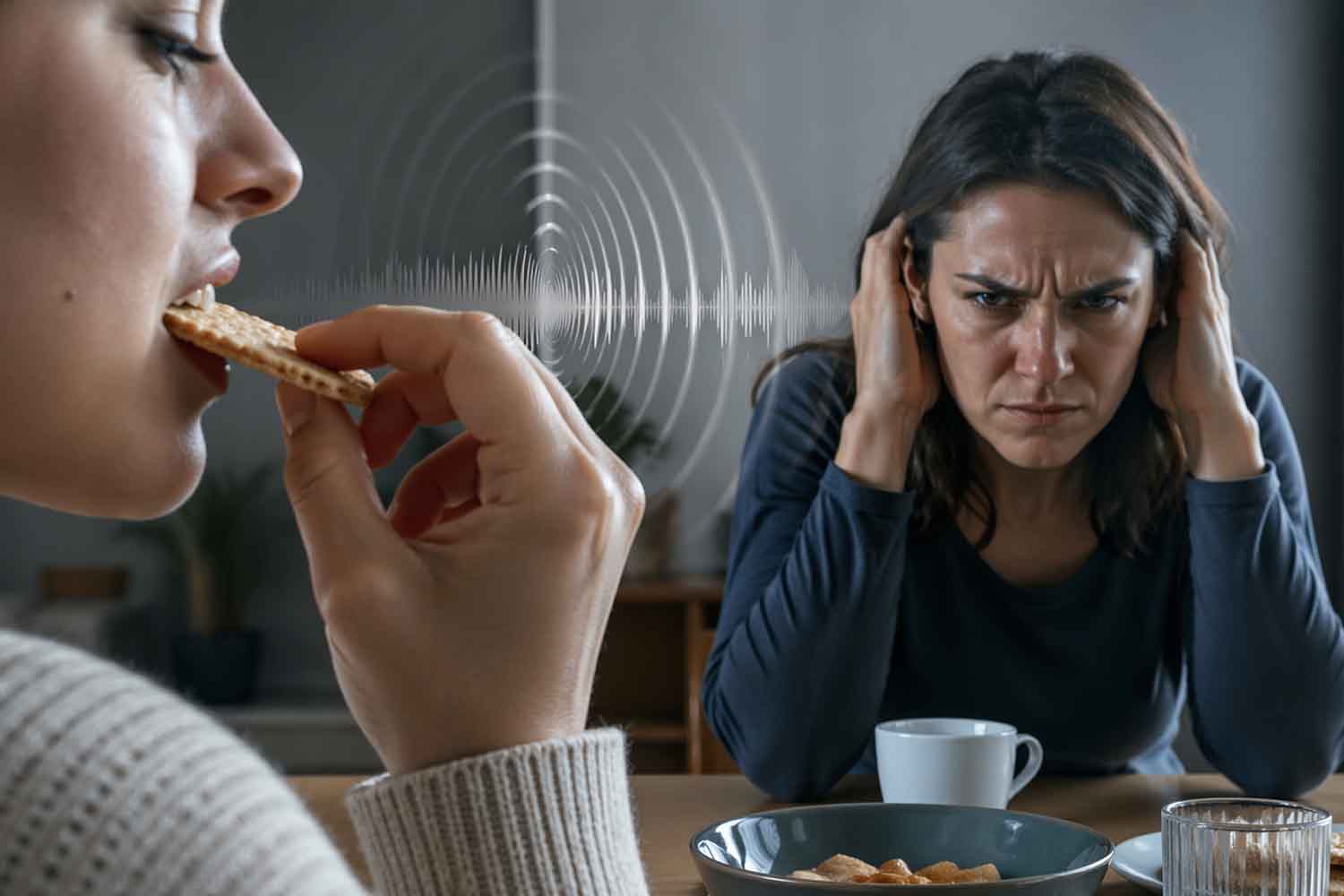
Nothing is enough at the table. A cracker broken between your teeth, the breathing of someone sitting next to you, the sharp click of a pen in a meeting. For many they are noises that slip away. For those who live with misophonia, however, they arrive like a shock: the heartbeat accelerates, the muscles stiffen, a sudden anger arises or the physical need to leave. In recent years, research has given clearer outlines to this experience: there is talk of a reduced tolerance towards specific sounds, or towards stimuli linked to those sounds, with emotional, physical and behavioral reactions disproportionate to what is really happening.
For a long time even the word was missing. In a representative UK sample published in 2023, 18.4% of people were above the threshold for clinically significant misophonia, but only 13.6% had heard the term before. Jane Gregory, a clinical psychologist at Oxford, explained that here we are not talking about simple annoyance: helplessness, entrapment, escape, shame for the way in which one reacts to sounds often produced by people close to one come into play. It is also for this reason that misophonia burrows into social life: lunches avoided, rooms left suddenly, relationships that are strained by noises that seem like nothing to others.
The issue that weighs the most today concerns mental health. A 2026 study of a representative sample of US adults found that 62.5% of people with misophonia reported at least one psychological diagnosis in their lifetime. The most frequent were depression, at 48.9%, and anxiety disorders, at 46.7%. The authors also found a higher probability of reporting current symptoms in the psychological and auditory-sensory areas compared to those without misophonia. The picture that emerges is that of a condition that is often intertwined with other disorders and which requires a much more serious interpretation than the usual “you are too sensitive”.
On the biological side, the work led by Dirk Smit in Amsterdam has added an important piece. The genetic study published in 2023 found correlations between a typical misophonic symptom, i.e. anger at chewing noises, and genetic profiles linked to post-traumatic stress disorder, major depression, generalized anxiety and tinnitus. In the same work, misophonia was grouped with traits such as neuroticism, guilt, irritability, tension and sensitivity. Translated out of technical language: the brain that explodes in front of an ordinary sound seems to share part of its vulnerability with psychological systems already known to the trauma and anxiety clinic.
In the brain the trigger weighs like a real threat
Neurobiology also goes in the same direction. In a neuroimaging study, audiovisual cues typical of misophonia, such as loud chewing or heavy breathing, ignited increased activity in patients in the insula, anterior cingulate cortex, and superior temporal areas, along with an increase in heart rate. They are areas involved in detecting what the brain considers salient, urgent, worthy of immediate attention. Seen from the inside, the response has little to do with mild irritation: more like an alarm that goes off too early and goes off too late.
From here we can also better understand that sense of imprisonment that many people describe. A work published between 2025 and 2026 links the severity of misophonia to more rumination and less cognitive flexibility: thinking gets stuck, struggles to change gear, keeps returning to the trigger and the emotion that that trigger ignited. The literature remains cautious about the direction of the link, because the most difficult question is still open: does the psychological vulnerability come first or does the chronic fatigue of living with this disorder come first? But one thing can be seen: the picture is becoming less blurry.
Autism, hyperacusis and tinnitus
One of the most surprising points concerns autism. For years, many clinicians and observers have imagined an almost natural overlap, given the frequency of sensory sensitivities on the autism spectrum. The genetic data collected by Smit’s group instead suggest a relative independence between the two conditions in terms of genomic variation, with a negative correlation that has surprised many researchers. This does not exclude the possibility that an autistic person may have very difficult sound experiences. However, it shifts the boundary: misophonia, at least within this type of analysis, follows its own trajectory.
The distinction with hyperacusis also deserves attention, because outside of clinics the two words often end up in the same drawer. In hyperacusis, the volume of the sound, perceived as too high or painful, is especially important. In misophonia, however, the pattern of the trigger weighs heavily, its meaning, its repetitive texture, often linked to the mouth, nose, fingers, small human gestures. A person can tolerate traffic, vacuum cleaners or loud music and lose control over something crunching just inches away. It is here that the condition shows its most unsettling side: everything starts from a minimal detail and that detail takes over the entire scene.
Tinnitus also enters this picture, with which misophonia shows some areas of contact. The Amsterdam genetic study found a significant correlation, and subsequent reviews have continued to describe points of overlap between altered salience, autonomic arousal, and psychological distress. The precise numbers change from study to study, so the ground remains shifting. The general direction, however, seems clear: the auditory and emotional chapters speak to each other much more than previously thought.
The most important part, perhaps, lies in what this new framework gives back to those who have been living with misophonia in silence for years. Research has already opened concrete therapeutic avenues, especially on the Cognitive-Behavioral Therapy front, with protocols that work on emotional regulation, attention, beliefs, avoidance strategies and the ability to stay in the body when the trigger arrives. The data is still young, the samples are often small, the clinical models are still being established. But one thing is already clear: the idea of character strangeness loses weight, while that of a real, measurable, treatable condition gains strength. For those who have only felt irritable, capricious or wrong for years, it changes a lot. Change the name of things. And sometimes the rest changes too.
You might also be interested in:
