
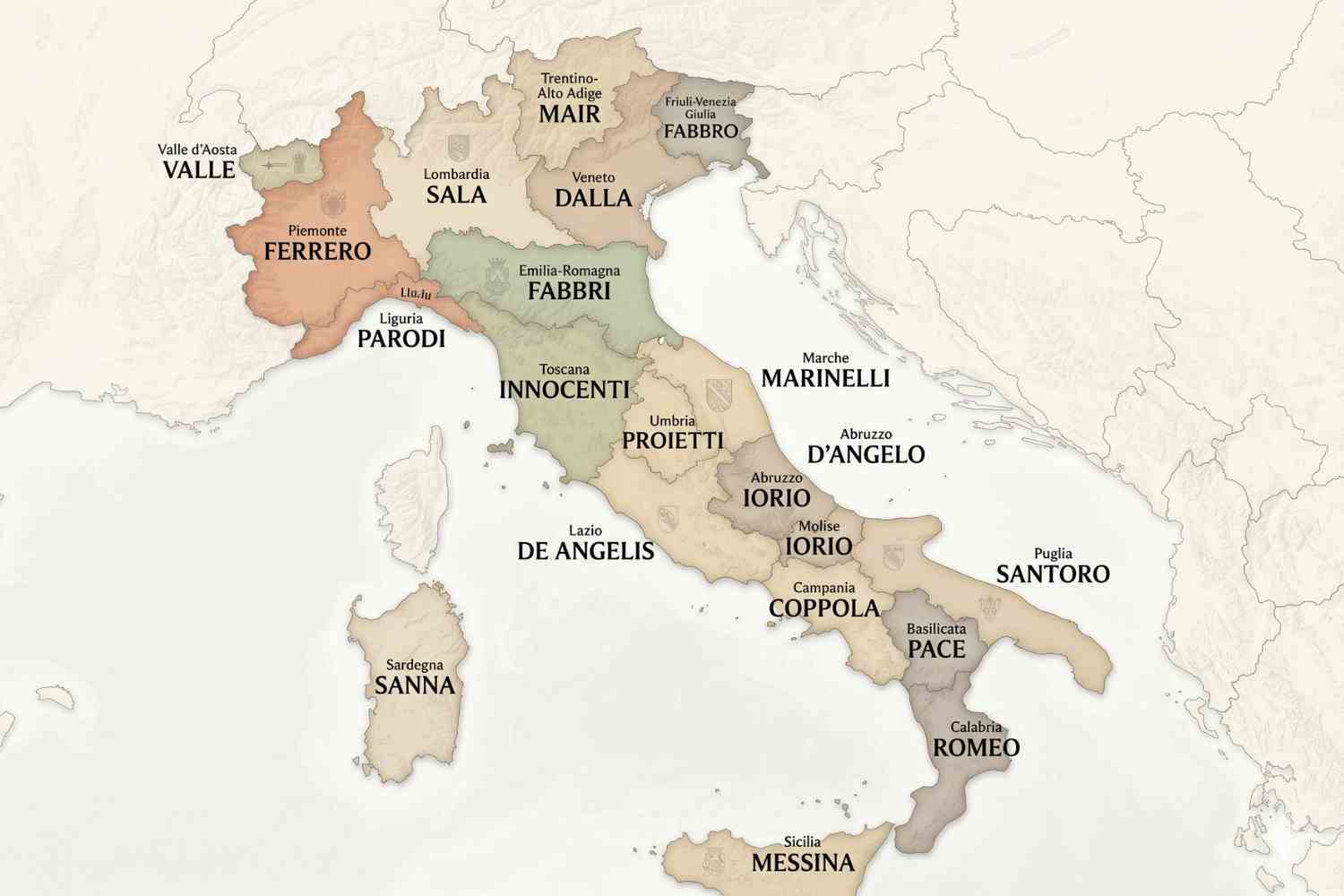
Behind a simple surname there is often a fascinating story, made up of ancient crafts, religious devotion, geographical origins and popular traditions handed down from generation to generation. It is precisely starting from this idea that the study carried out by Preply analyzed the most common surnames in our country, transforming them into a true snapshot of the Italian identity. What emerges is an extraordinary journey from North to South, in which each region tells something about itself through the words that families have carried with them for centuries.
Abruzzo
In Abruzzo the most common surnames are Felice, D’Alessandro and D’Angelo. Dominating the ranking is D’Angelo, a surname that has its roots in the ancient Greek anghelos, which means “messenger of God”. Its diffusion throughout Italy grew significantly starting from the 13th century, a period in which the cult of angels experienced a real flowering in popular devotion. In many cases, the surname was associated with families who had close ties with the Church or who were distinguished by a strong religiosity.
Basilicata
In Basilicata the most common surnames are Grieco, Colangelo and Pace. The most widespread of these is Pace, a surname that was born as a name of good wishes and immediately recalls the idea of harmony, serenity and peaceful coexistence. Some interpretations also connect it to the cult of the Madonna della Pace or San Paciano, figures venerated in the religious tradition of Southern Italy. An eloquent example of how faith has shaped not only the customs, but even the identities of Italian families.
Calabria
In Calabria Perri, Ferraro and Romeo lead the standings. The most common surname, Romeo, originates from the Greek rhomaios and originally indicated the pilgrim who set out towards Rome for reasons of religious devotion. A word, therefore, that tells of dusty streets traveled on foot, of deep faith and of a spiritual bond with the eternal city that crossed the entire peninsula. A surname that testifies to how much pilgrimages have marked the culture and history of Southern Italian families.
Campania
The most common surnames in Campania are Sorrentino, Ferrara and Coppola. The latter is perhaps the most characteristic and recognizable: it directly recalls the coppola, the flat cap that has become one of the most iconic symbols of southern tradition. A simple object, of daily use, which over the centuries has become part of the cultural identity of Southern Italy and which still today, through this surname, continues to live in Campania families.
Emilia-Romagna
In Emilia-Romagna Montanari, Barbieri and Fabbri occupy the first places. The most common is Fabbri, a surname that derives from the Latin faber and refers directly to the profession of the blacksmith. In the Middle Ages, the blacksmith was anything but a marginal figure: he was the craftsman who produced agricultural tools, weapons, horseshoes and tools essential for everyday life. His workshop was a point of reference for the entire community, and it is not surprising that his craft left such a lasting imprint on the toponymy of Italian surnames.
Friuli-Venezia Giulia
In Friuli-Venezia Giulia the most common surname is Fabbro, followed by Mauro and Furlan. Even in this region the theme of craft emerges strongly as the origin of the family surname, a common thread that connects Friuli to Emilia and which testifies to how central craftsmanship was in the identity of the medieval communities of Northern Italy.
Lazio
In Lazio the most common surnames are De Santis, Proietti and De Angelis. The latter, in its various variants, literally means “of the angels” and is deeply rooted in the Christian religious tradition. A surname which, together with D’Angelo in Abruzzo, shows how much the angelic cult has permeated Italian popular culture, leaving indelible traces even in the identity cards of its inhabitants.
Liguria
In Liguria, Pastorino, Bruzzone and Parodi dominate the rankings. The latter has a curious etymology: according to some interpretations it derives from the Latin paratus, meaning “ready” or “prepared”, and may have originally been a nickname attributed to a person known for his reliability and prompt action. A surname that tells of reputations built over time, in communities where words and behavior had enormous weight.
Lombardy
In Lombardy the most common surnames are Cattaneo, Riva and Sala. The most common is Sala, a surname with complex and fascinating origins: it could derive from a Lombard term which indicated a court or a stately building, or from ancient words linked to the marshy lands typical of the Po Valley. In both cases, it tells of the profound influence that the Germanic dominations had on the culture and language of Northern Italy.
Marche
In the Marche the most common surnames are Moretti, Vitali and Marinelli. The latter explicitly recalls the sea and the maritime culture of the Adriatic coast: it could derive from the Latin Marinus or from ancient local toponyms linked to the fishing villages that dotted the coast. A surname that brings with it the smell of salt and the memory of generations lived looking at the sea.
Molise
In Molise the most common surnames are Testa, Lombardi and Iorio. The latter has medieval origins and derives from Iorius, a variant of the name Giorgio, which in turn comes from the Greek gheorgòs, or “peasant” or “worker of the land”. An etymology that perfectly reflects the agricultural vocation of Molise, one of the most rural regions of Italy, where for centuries life has been marked by the rhythms of the earth.
Piedmont
In Piedmont Barbero, Ferraris and Ferrero lead the ranking. The most widespread is Ferrero, which derives from the Latin faber ferrarius and identifies the profession of the blacksmith, someone who specifically worked iron. Once again, surnames reveal themselves as a living archive of medieval society, in which artisan professions were so fundamental that they became part of people’s very names.
Puglia
In Puglia the most common surnames are Leo, Lorusso and Santoro. The latter has a strongly religious origin and is closely linked to the feast of All Saints, a deeply felt anniversary in the popular tradition of Southern Italy. The cult of saints has left deep traces in the southern cultural fabric, and surnames are perhaps the most daily and lasting testimony of this.
Sardinia
In Sardinia Piras, Pinna and Sanna occupy the first places. The surname Sanna derives from the Sardinian term sanna, which means “tusk” or “spike”, probably born as a nickname referring to a particular physical characteristic of the founder of the family. A surname that tells of an island culture with its own language and tradition, which have remained extraordinarily intact over the centuries.
Sicily
In Sicily the most common surnames are Caruso, Lombardo and Messina. The latter derives from the Sicilian city of the same name and has its roots in the Greek Messene, a term that recalls the “sickle” shape of the territory on which the city stands. A surname that brings with it millennia of history, testifying to the countless civilizations that have followed one another on this island in the center of the Mediterranean.
Tuscany
In Tuscany the most common surnames are Gori, Martini and Innocenti. The latter has a particularly touching history: it derives from the Latin Innocens, which means “he who does no harm”, but also recalls the Christian cult of the Holy Innocents. In the past, this surname was often assigned to abandoned children welcomed into religious institutions, a detail that makes us reflect on how much the social and economic history of an era can be hidden within such a common word.
Trentino-Alto Adige
In Trentino-Alto Adige Co, Pichler and Mair lead the ranking. The surname Mair is particularly interesting for its possible origins: it could derive from the Hebrew name Meir, which means “enlightened”, or from the German Mayer, historically linked to the figure of the factor or administrator of lands. A surname that reflects the plurilingual and pluricultural nature of this border region, where Italian, German and Ladin traditions have met and intertwined for centuries.
Umbria
In Umbria the most common surnames are Moretti, Rosati and Proietti. The latter has an origin that is surprising for its crudeness: it derives from the Latin proiectus, meaning “abandoned” or “thrown away”, and was traditionally assigned to children left at the doors of religious institutes in central Italy. As in the case of Innocenti in Tuscany, a surname that carries with it the weight of difficult stories and lives that began in abandonment.
Aosta Valley
In Valle d’Aosta Favre, Cerise and Valle dominate the rankings. The surname Valle derives from the Latin Valles and originally indicated people who lived in mountain or valley areas. An almost geographical etymology, in perfect harmony with the alpine landscape of the smallest region in Italy, where the valleys have always defined not only the territory, but also the identity of the communities that inhabit them.
Veneto
In Veneto the most common surnames are Trevisan, Sartori and Dalla. The latter comes from a prefix typical of the Venetian tradition, used to indicate origin from a specific place or belonging to a family lineage. An apparently small linguistic detail, but which tells a lot about the importance that territorial and family identity has always had in Venetian culture, a region in which the sense of belonging to one’s roots has remained extraordinarily alive over time.
