
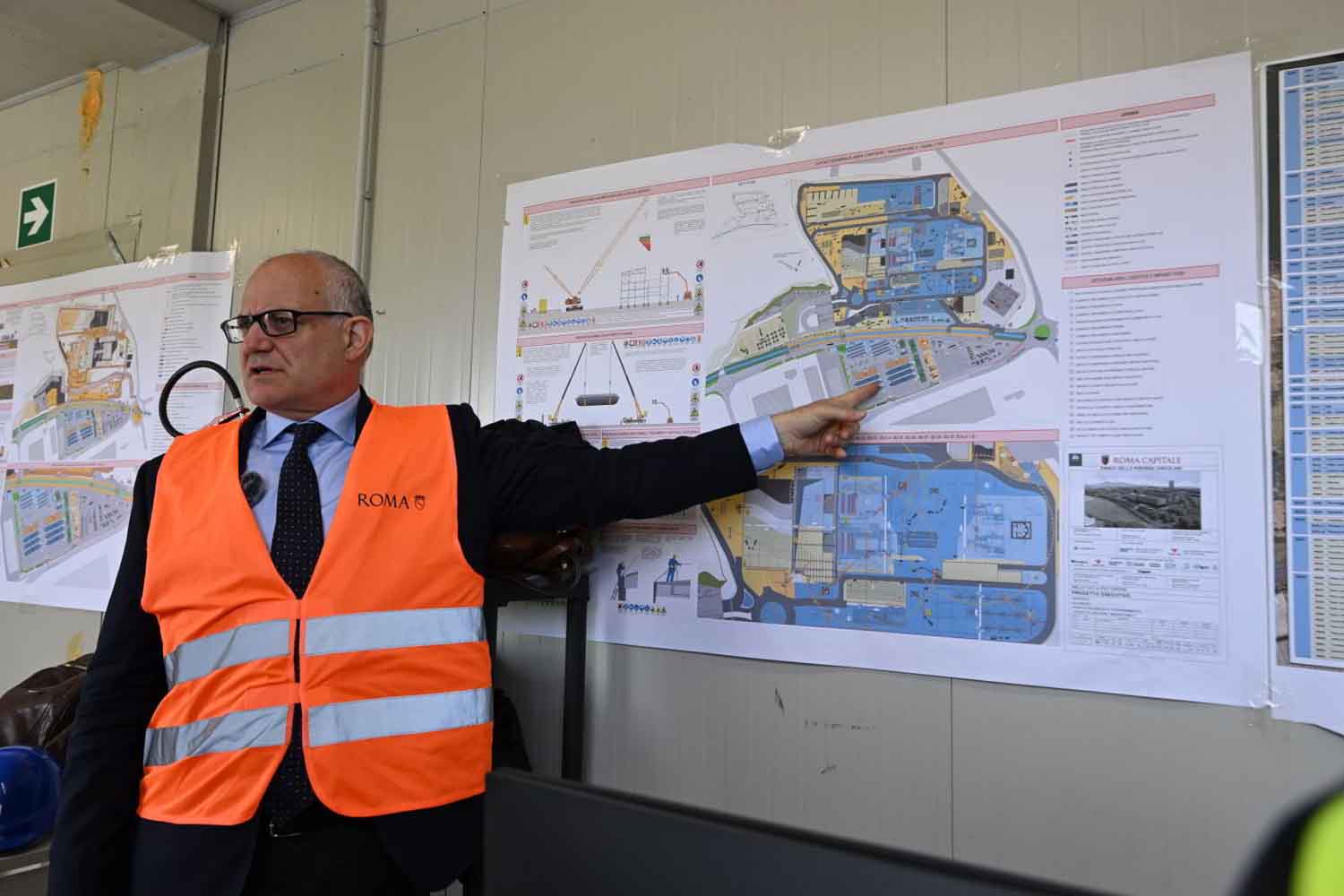
In Rome, waste has often traveled further than commuters. Bags loaded, transferred, taken out of the city, out of the region, in some cases even out of Italy. A long, expensive, fragile journey, which over the years has transformed waste management into a kind of permanent controlled emergency exercise. Now a part of that system should change in Santa Palomba, in the southern area of the capital, where work on the new waste-to-energy plant has started.
The construction site started on May 15, 2026. The first load of waste is expected for September 2029 and the plant should treat 600 thousand tons per year of unsorted waste and recyclable waste now exhausted, with an investment of around one billion euros. In the Capitol’s plans, the new hub will serve to reduce the use of distant landfills and plants, bringing part of the city’s waste cycle back into a closer perimeter.
The waste yard
The project is presented as a new generation energy recovery plant. Once fully operational, it should produce a total of 65 MW of thermal and electrical energy, a quantity indicated as sufficient for around 200 thousand families. The recovery of materials from bottom ash is also envisaged: approximately 10 thousand tons of steel, 2 thousand of aluminum and 1,600 of copper every year. The Circular Resources Park should be created around the plant, with spaces for research, coworking, experimental greenhouse, photovoltaics, district heating network and an experimental system for CO2 capture.
The word “waste-to-energy plant”, however, always brings with it a friction. On the one hand there is the idea of recovering energy from what remains after separate collection and recycling. On the other hand, a material fact remains: those wastes are burned. Energy recovery occupies a specific place in the European waste hierarchy, after prevention, preparation for reuse and recycling, before final disposal. The European scale starts from the reduction of waste at the source and arrives only afterwards at energy recovery and landfill.
For this reason the waste-to-energy plant can be read in two different ways. It can become a tool for treating the residual fraction, the one that remains after separating organic matter, paper, glass, plastic, metals and other materials. Or it can become a convenient shortcut, if the city slows down on the most important part: producing less rubbish, separating better, recycling more.
The crux of differentiation
Rome starts from a figure that is still low compared to the objectives. In 2024, separate waste collection reached 48.11%, below the 50% target expected for that year. The total production of urban waste amounted to 1,645,161 tonnes, with 791,455 tonnes of separated waste and 853,706 tonnes of undifferentiated waste. The waste plan indicates a progression towards 65% by 2029 and 2030, while the waste-to-energy plant project is included in a framework that aims for 70% waste separation.
Inside those numbers there is a very concrete thing: too much recoverable material still ends up in undifferentiated waste. The product analyzes cited in the 2024 report indicate that kitchen organics, paper, cardboard, plastic packaging and textiles together represent approximately 45-50% of the weight of the undifferentiated fraction. It means that a significant part of what is thrown into the wrong bin today could follow another path.
Here the waste-to-energy plant stops being just a plant engineering matter. It becomes a test of coherence. If Rome really improves collection, completes roadside stations, strengthens door-to-door where needed, reduces errors in waste disposal and better intercepts organic waste, the plant will work on cleaner waste from the point of view of the waste hierarchy. If waste separation remains weak, the risk is transforming a system designed for waste into a permanent relief valve.
Air, water and territory
The location in Santa Palomba adds another piece to the discussion. The southern quadrant of Rome and the neighboring municipalities look at the project with a concern that passes less from press releases and more from everyday things: traffic, emissions, water consumption, health, controls, air quality, repercussions on an area already crossed by infrastructures and industrial activities.
Roma Capitale speaks of a constantly monitored plant, with advanced technologies and environmental standards that are stricter than European limits. The project involves rail deliveries, fume treatment systems, bottom ash recovery, photovoltaics, district heating and experimental CO2 capture. They are important elements, because they move the discussion from the abstract “yes” or “no” to the system to the more serious question: how will it be controlled? With what public data? With what continuity? With what transparency?
Meanwhile, the legal issue remains open. At the end of March 2026, new appeals were filed with the TAR by municipalities, associations, committees and citizens, with disputes also linked to the assessment of environmental and health impacts. The construction site therefore begins within a fracture that is still alive.
Rome’s waste-to-energy plant is described as the work that will close the capital’s waste cycle. It can partially do so, at least for the remaining portion. The real closure, however, begins before the oven: it begins in supermarkets, in condominiums, in bins, in sorting plants, in biodigesters, in purchasing habits, in materials designed to last or be recovered. Santa Palomba now has the bulldozers, but Rome still has the sacks.
You might also be interested in:
