
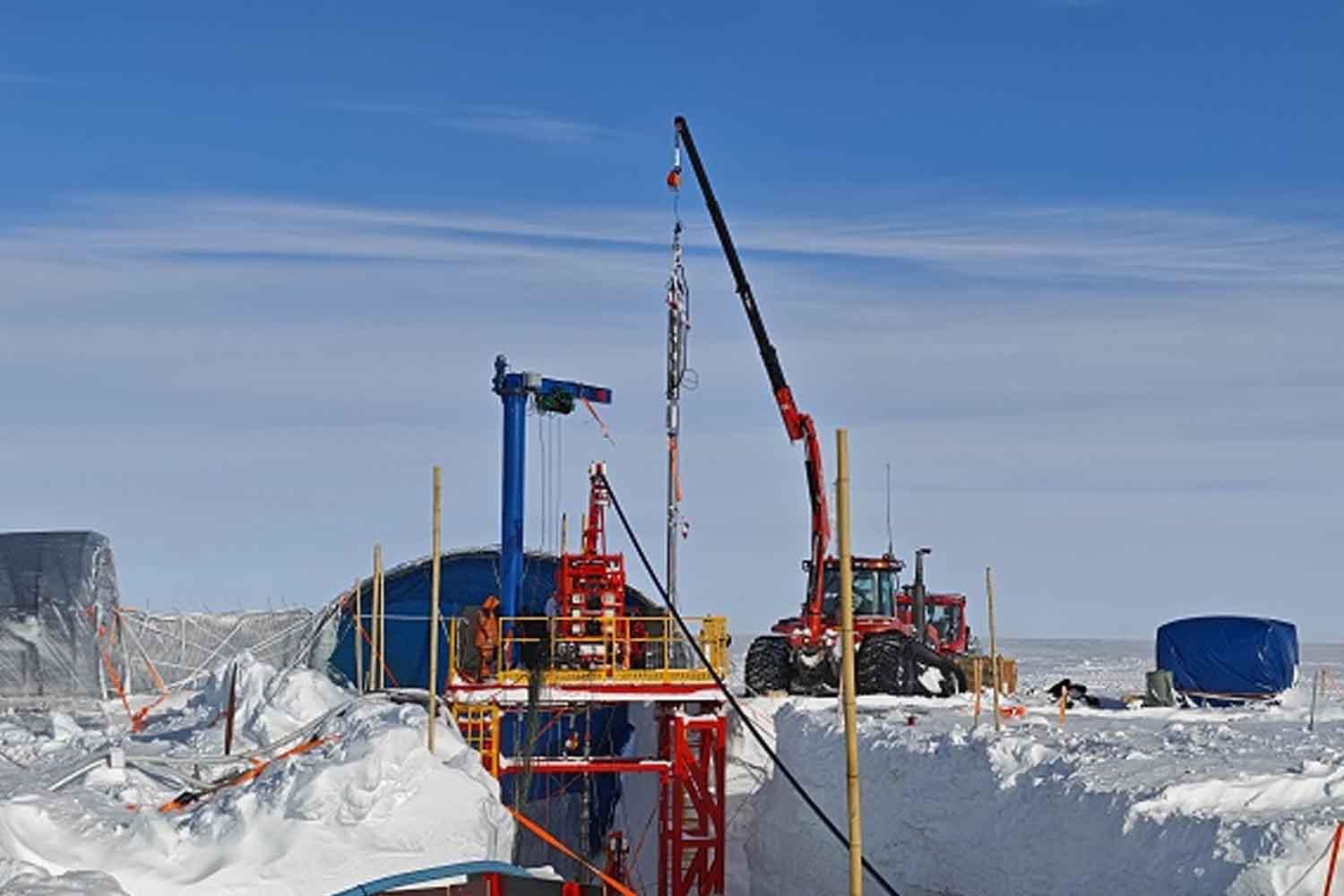
To get to Qilin Lake you must first cross more than three kilometers of ice. Not a slab, not a compact wall from an Antarctic postcard, but an enormous, ancient, compressed mass, crossed with a system that uses hot water at high pressure. China achieved this during its 42nd Antarctic expedition, completing a test drilling down to 3,413 meters deep in the area of subglacial Lake Qilin in East Antarctica.
The result was announced by the Chinese Ministry of Natural Resources and represents a new record for polar drilling with hot water, the so-called hot-water drilling. The previous reference was around 2,540 metres, reached in Greenland as part of the international NEEM project. Here, however, the hole went much deeper, above an environment that has enormous value for science: a lake hidden under the cap, far from light, wind and almost everything we associate with life on the surface.
The test was completed on February 5, 2026 in the Qilin Lake area, about 120 kilometers from China’s Taishan Antarctic Station. It is an important detail, because in Antarctica even the most apparently manageable distance becomes pure logistics: equipment, fuel, pipes, generators, teams, monitoring instruments and filtration systems must work in a place where the margin of error is very narrow.
What is Qilin subglacial lake and why does it interest scientists
Subglacial Lake Qilin is located in Princess Elizabeth Land, East Antarctica. It has been indicated by preparatory studies as one of the most promising sites for future exploration under the ice cap. Estimates describe it as a lake tens of kilometers long, with a surface area of around 370 square kilometers and an average ice cover of around 3,600 metres.
These numbers are used to understand the scale. Above is a cap as thick as a mountain. Below there is liquid water, which has remained isolated for very long periods in extreme conditions: permanent darkness, high pressure, cold, lack of nutrients. Environments like this interest researchers because they can preserve precious signals on the Earth’s climatic history and, at the same time, help understand how far life can go.
Deeply mined ice cores can hold chemical traces of the past, from oxygen and hydrogen isotopes to impurities trapped in the ice. Through these signals, temperature variations, changes in atmospheric circulation and transformations of large glacial masses are reconstructed. Sediments at the bottom of subglacial lakes, when they can be sampled safely, could add even more ancient information about the evolution of the East Antarctic Ice Sheet.
How hot water drilling works
The technique used by the Chinese expedition does not work like a traditional mechanical drill. Hot-water drilling uses a jet of heated water pushed at high pressure, often above 80°C, to progressively melt the ice and create a vertical well. The diameter can reach several tens of centimeters, enough to lower scientific instruments and observation systems.
The advantage is above all operational. Under favorable conditions, warm water allows you to pass through ice much faster than other methods. This matters a lot in polar missions, where work windows are short and the weather can block everything in a matter of hours. The cleanliness of the process also counts: when you try to access an environment that has been isolated for a very long time, the risk of contamination becomes one of the main problems.
For this reason, future research phases will have to proceed with extreme caution. Getting above a subglacial lake is one thing; sampling water and sediment without altering the environment is an even more delicate job. Every microbe brought from the surface, every chemical residue, every foreign material risks distorting the very thing we want to study.
What can it tell us about the climate and extreme life
Chinese drilling is not just about a technical record. Under the Antarctic ice sheet lies a still little-known part of the Earth’s climate system. Ice is not as immobile as it seems: it flows, deforms, interacts with the rocky substrate, with liquid water and with sediments. Understanding what happens at the base of the ice sheet helps to better understand the future stability of Antarctica, a central issue in a warming planet.
Subglacial lakes also offer rare access to deep environmental history. If the sediments of Lake Qilin are studied in the coming years, they will perhaps be able to tell how the East Antarctic ice sheet reacted to climatic phases very different from the current one. The data is slow, difficult and expensive to obtain. Precisely for this reason they have value.
Then there is the biological part. Any microbial communities present in these environments would live without sunlight, in conditions of extreme pressure and isolation. Studying similar organisms would mean broadening our idea of possible life on Earth and offering new comparisons with icy environments on other worlds, from the moons of Jupiter and Saturn to the oceans hidden under ice crusts.
China, with this 3,413 meter drilling, has demonstrated that it can open a deep hole in the Antarctic ice sheet using rapid and complex technology. The most important scientific part, however, begins now. Because under that hole there isn’t just a remote lake. There is a fragile archive, closed in the dark, which must be reached without dirtying it.
You might also be interested in:
