
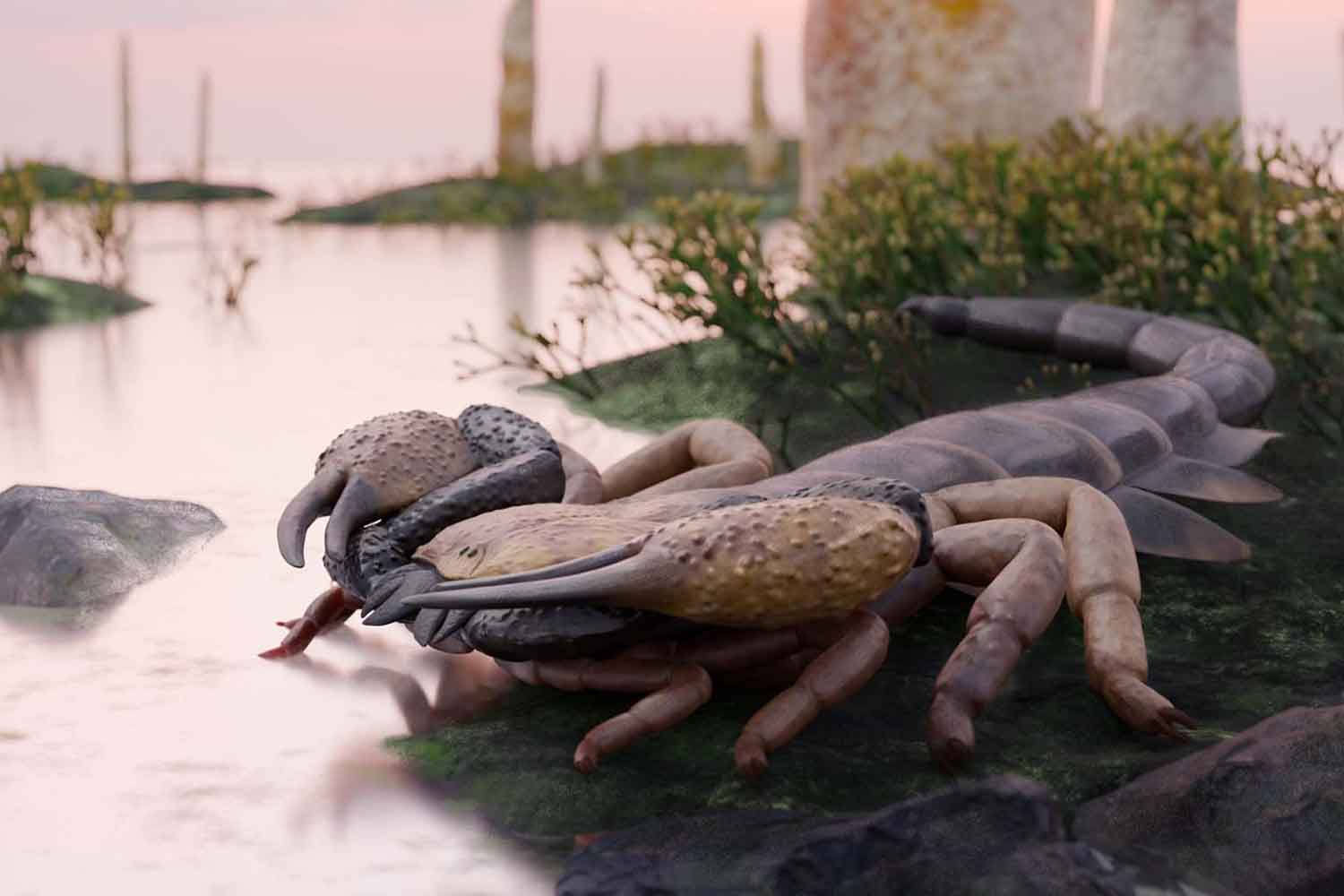
Before the dinosaurs, before the large marine reptiles, before those enormous creatures that we now use as a yardstick for anything with teeth, fins or disproportionate jaws, the Earth already had its rulers. Smaller in our imagination, of course. Stranger, too. Armored arthropods, articulated legs, claws, armor, bodies made to move through mud, shallow water and still almost bare banks. In that ancient world, long before the ancestors of amphibians, reptiles, birds and mammals actually left the water, an animal over a meter long could be enough to change the scale of fear.
His name was Praearcturus gigas and for more than a century it has had a wrong, or at least incomplete, identity. Its fossil remains were found between England and Wales, in the St Maughans Formation, within that complex of red rocks known as the Old Red Sandstone. Lower Devonian rocks, ca 415 million years agowhen the mainland was just beginning to be populated with low plants, fungi and small arthropods. Nothing to do with dense forests, large land vertebrates or dinosaur documentary landscapes with dramatic music. Here we are much earlier. The scenography is poorer, rougher, more experimental.
And precisely in this environment, according to a new review published on Palaeontologylived what is described as the largest scorpion ever known. Its claws could reach approximately 16 centimetreswhile the overall length exceeded one metre. To clarify: the largest living scorpion remains much smaller in size. Praearcturus gigas, on the other hand, had a size that was out of place for its time, almost brazen. A huge presence in a world where terrestrial life was still becoming familiar with the air.
The fossil with the mistaken identity
The scientific history of Praearcturus gigas starts in 1871, when Henry Woodward described those remains as belonging to a gigantic isopod, something closer, so to speak, to a huge relative of the earthen pigs that we find under pots or in humid areas. Even the name preserves that first misunderstanding: Arcturus recalls a group of isopods. Putting it this way, it has a certain bureaucratic charm: even fossils sometimes get trapped in the first wrong document.
In the following years the animal was pulled from one side to the other of the arthropod tree. Someone has brought him closer to eurypterids, the so-called “sea scorpions”; others to arthropleurids, relatives of those giant millipedes that would become famous much later, in the Carboniferous. Only in the 1980s did the idea that Praearcturus gigas could really be a scorpion gain strength. A suggestive hypothesis, also quite cumbersome, because it meant placing an enormous predator in a very early phase of the colonization of the mainland.
The problem was in the remains. They were fragmentary. The classic scorpion tail was missing, the one that in the common imagination resolves every doubt without too many turns. The certainty came from more patient work, much less spectacular than a discovery made with a brush under the sun, and perhaps for this very reason more interesting: reanalyzing material already present in the collections, some pieces kept for over 150 yearsusing instruments that in Woodward’s time would have seemed like the stuff of a séance.
The research team, led by Richard J. Howard, curator of fossil arthropods at the Natural History Museum in London, re-examined the specimens attributed to the species with macro photography, technical drawings on transparencies, morphological analysis and computed tomography. Researchers from the University of Manchester and the Technological University Dublin also participated in the work. The result has brought order to a very crowded taxonomic history: Praearcturus gigas is recognized as a scorpion and some names attributed in the past to similar materials, such as Brontoscorpio anglicus and Bennettarthra annwnensis, are considered more recent synonyms of the same species.
In the reconstruction, what weighs heavily are anatomical details that are inconspicuous for those who look at a fossil like a strange stone, but which are decisive for those who know how to read it. The researchers identified large pedipalps with fixed and mobile fingers, i.e. the appendages transformed into claws; a stridulatory surface, a structure associated with the production of sounds or vibrations and also present in some modern scorpions; a particular morphology of the prosoma, the anterior part of the body; ornaments similar to those of other Paleozoic scorpions; especially an elongated and subtriangular sternum, very similar to that observed in Eramoscorpius brucensisa Silurian scorpion described in Canada in 2015 and unambiguously considered a scorpion.
That comparison was fundamental. Eramoscorpius offered a kind of anatomical key, a solid comparison. Praearcturus had a similar structure. At that point the giant scorpion hypothesis stopped seeming like an elegant stretch and became a much more robust reading.
A predator between land and water
The Early Devonian was a planet in rehearsal. On the mainland, small plants, a few centimeters high, and life forms still far from the complexity of the forests were beginning to spread. Earth’s ecosystems were young, unstable, full of free spaces. A creature as large as Praearcturus gigas could take advantage of this. Less competition, fewer predators capable of keeping up with it, more possibility of occupying a high role in the food chain. Said without too many bows: in that context he was probably one of the guys to avoid.
Its gigantism, however, also tells another thing. Terrestrial arthropods have very concrete physical limits: body weight, breathing, the need to move without the support of water. This is why researchers suggest that Praearcturus gigas had a life semiaquatic or amphibious. It could hunt on land, among small arthropods and prey within its reach, but it probably found the real smorgasbord in the water. Fish and other aquatic animals would have offered enough energy to support such a bounty.
Some fossils found in Wales show lateral flap-like structures, called epimera, which resemble in some respects those found in crustaceans such as crabs and lobsters. A detail that leads us to imagine an animal capable of moving in a border area: banks, alluvial plains, shallow water, mud, perhaps river environments where land and water mixed without a clear separation. The giant scorpion, then, may have been one of those organisms that complicates our neat categories. Terrestrial enough, aquatic enough.
This part is also interesting for another reason. Many famous giant arthropods are associated with the Carboniferous, at least 50 million years later, when the increase in atmospheric oxygen and the development of more complex terrestrial ecosystems would have favored exceptional dimensions. Praearcturus gigas arrives first. Much earlier. He lives in a world without real forests, with a landmass still lacking in major competitors. His case suggests that arthropod gigantism may have had multiple paths: not just favorable environmental conditions, either ecological opportunities leave free.
In other words, Praearcturus gigas may have gotten huge because its world let it. Few creatures capable of challenging him, prey available between water and land, an ecosystem still under construction. An evolutionary gap, more than a simple oddity.
Much remains to be understood. Fossils are fragmentary, and new findings could better clarify its appearance, the way it moved, the real duration of its presence on Earth. Some fragments found in Portishead, Somerset, leave open the possibility that forms referable to Praearcturus survived for another 40 million years, but the link remains cautious.
The most beautiful thing, however, is perhaps in the place from which this story re-emerged. Sometimes paleontology works like this: it takes a finding that seemed to have already said everything, puts it back in a colder, more precise light, and it starts speaking again. Praearcturus gigas had been there for 150 years. He was just waiting for someone to stop calling him the wrong thing.
