
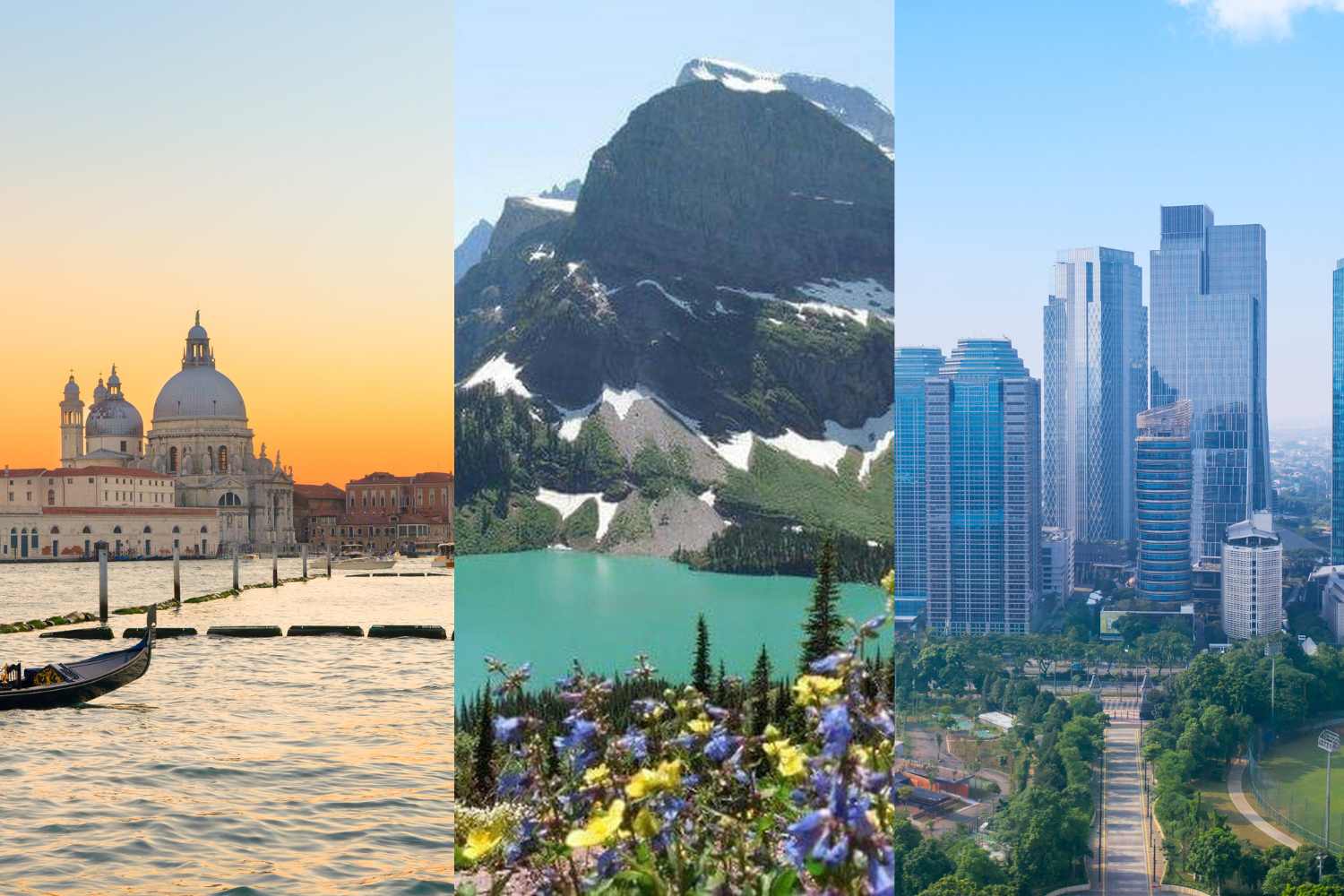
They are places “to be seen at least once in a lifetime”, of course, but the reason why they should be seen is much less romantic than one might think: many of the most incredible places on the planet are disappearing and not by chance, nor by a destiny written by nature. They are changing, retreating, burning, sinking or losing life. All our fault.
From bleached coral reefs to atolls threatened by rising seas, from Venice to retreating glaciers to forests devoured by fires and deforestation, the world we would like to visit, photograph, live in, is the same one that we contribute to consuming every day.
And then, probably, the question is not only which places to see before they disappear, but also and above all what are we willing to do so that they don’t really disappear.
One by one, they risk disappearing or becoming something else, here are (just) a few:
View this post on Instagram
Venice
Various studies show that for Venice the danger is actually slow and therefore more subtle: the sea rises, the land subsides and the lagoon, year after year, becomes increasingly exposed to flooding which could transform one of the most fragile and loved places in the world into an increasingly less livable city.
A study published in Remote Sensing in 2025 it analyzes the future of the Venice lagoon up to 2150, combining satellite data, tide gauges, LiDAR and IPCC climate scenarios. The central point is that Venice is threatened by a double phenomenon: the sea rises while the ground subsides. According to scholars, by 2150, up to 65% of the emerged land could be affected by flooding.
The risk does not only concern the historic center, but also Chioggia, Lido Cavallino, Sant’Erasmo, Marghera and the Marco Polo airport area. The study also raises doubts about the future stability of the MoSE: if sea levels continue to rise, the system may no longer be enough by the end of the century. Therefore, Venice does not risk disappearing suddenly, but becoming progressively more fragile, more floodable and increasingly difficult to inhabit and protect. And visit.
HERE is the complete study.
The Great Barrier Reef
The Great Barrier Reef is experiencing its worst decline on record since records began. Nearly half of the 124 reefs monitored between August 2024 and May 2025 lost coral cover, according to the Australian Institute of Marine Science report. The main cause is heat stress linked to the climate crisis: when the water becomes too hot, the corals expel the symbiotic algae that give them color and nourishment, they turn white and, if the heat lasts too long, they die.
The problem is that bleaching events are increasingly frequent and corals would need years to recover, but the intervals between one extreme event and another are getting shorter and shorter.
View this post on Instagram
This is why we risk no longer being able to admire it as we know it: but it is losing colour, life and biodiversity. If temperatures continue to rise, the Great Barrier Reef could transform from one of the most spectacular ecosystems on the planet to a bleached, impoverished seascape that is increasingly unable to regenerate.
Miami
For those who intend to take a trip to Miami, know that you have little time to waste. In fact, not everyone knows that Miami is among the most vulnerable cities in the world to rising sea levels linked to the climate crisis. In South Florida the sea has already risen about a foot since the beginning of the 20th century and high tide flooding has become much more frequent. The most serious forecasts speak of an increase of up to 1.5-2 meters by the end of the century, a scenario that could make large areas of the county uninhabitable and force many people to move.
Meanwhile, institutions are trying to adapt the environment without really questioning the continued real estate expansion along the coast. But sooner or later adaptation could also mean an uncomfortable choice: accepting that some areas can no longer be inhabited.
Jakarta
Jakarta is one of the cities that we risk no longer being able to admire as we know it today because it is literally sinking. The problem is the rise of the sea, but also the subsidence caused by the excessive extraction of water from underground aquifers, aggravated by wild urbanisation, overbuilding and the climate crisis. In some areas the land continues to sink much faster than the sea rises, making floods increasingly frequent and devastating.
A study on coastal flood risk in Jakarta estimates that, between 2000 and 2050, the potentially floodable area could increase by more than 110 km², with subsidence responsible for 88% of this increase.
We talk about it here: Jakarta is sinking and Indonesia is building a new capital in Borneo: “it will be an ecological disaster”
This is why Jakarta risks disappearing from our travel imagination: its face will change under the combined pressure of water, concrete and the climate crisis.
Glacier National Park
Glacier National Park, in the United States, risks no longer being “the park of glaciers”. The large masses of ice that gave it its name have been receding for decades and the Grinnell Glacier, one of the most iconic, is now reduced to a fraction of what it was: where there was once ice, today there is a lake.
The park has already lost around 60% of its glaciers since the mid-19th century and, according to forecasts, those remaining could disappear by the end of the century.
This is why we risk no longer being able to admire Glacier National Park as we know it: the mountains will not disappear, the lakes will not disappear, the paths will not disappear. But what makes it unique, the very heart of its name, could disappear. A park created to protect glaciers could become the most visible monument to their disappearance.
Timbuktu, UNESCO World Heritage Site
In Timbuktu the damage to cultural heritage is quite more serious than initially estimated: a UNESCO mission a few years ago ascertained the destruction of 16 mausoleums and the loss of over 4 thousand ancient manuscripts after the occupation of the city by jihadist groups in 2012. Among the places affected there were also mausoleums registered in the World Heritage List and sites linked to the Djingareyber mosque, one of the symbols of the city, built in 14th century.
The most recent news is that some of the saved manuscripts have returned to Timbuktu after 13 years in Bamako, where they had been transferred for protection. But the city remains fragile: instability in northern Mali and the threat of armed groups continue to make the full restitution and conservation of this unique heritage complicated.
To date, in short, Timbuktu is not just a city wounded by war: it is the symbol of how culture can become a target when extremism wants to erase identity, memory and knowledge. And how, on the contrary, saving it means defending not only the past of a people, but a piece of the history of humanity.
All these places, then, and others are not magically vanishing. Not due to the natural course of things, but as a result of emissions, concrete, wars, deforestation, predatory tourism, short-sighted political choices and consumption that we continue to consider normal.
So perhaps the best invitation would be not so much to rush to see them while they still exist, but to stop treating them as disposable scenography. Venice is not a postcard to be walked on in one day, the Coral Reef is not a giant aquarium, the glaciers are not a backdrop for selfies. Everything is memory, ecosystems, homes, cultures and lives. And if we really want to continue to admire them, the first thing to do is to change the way we live in them.
