
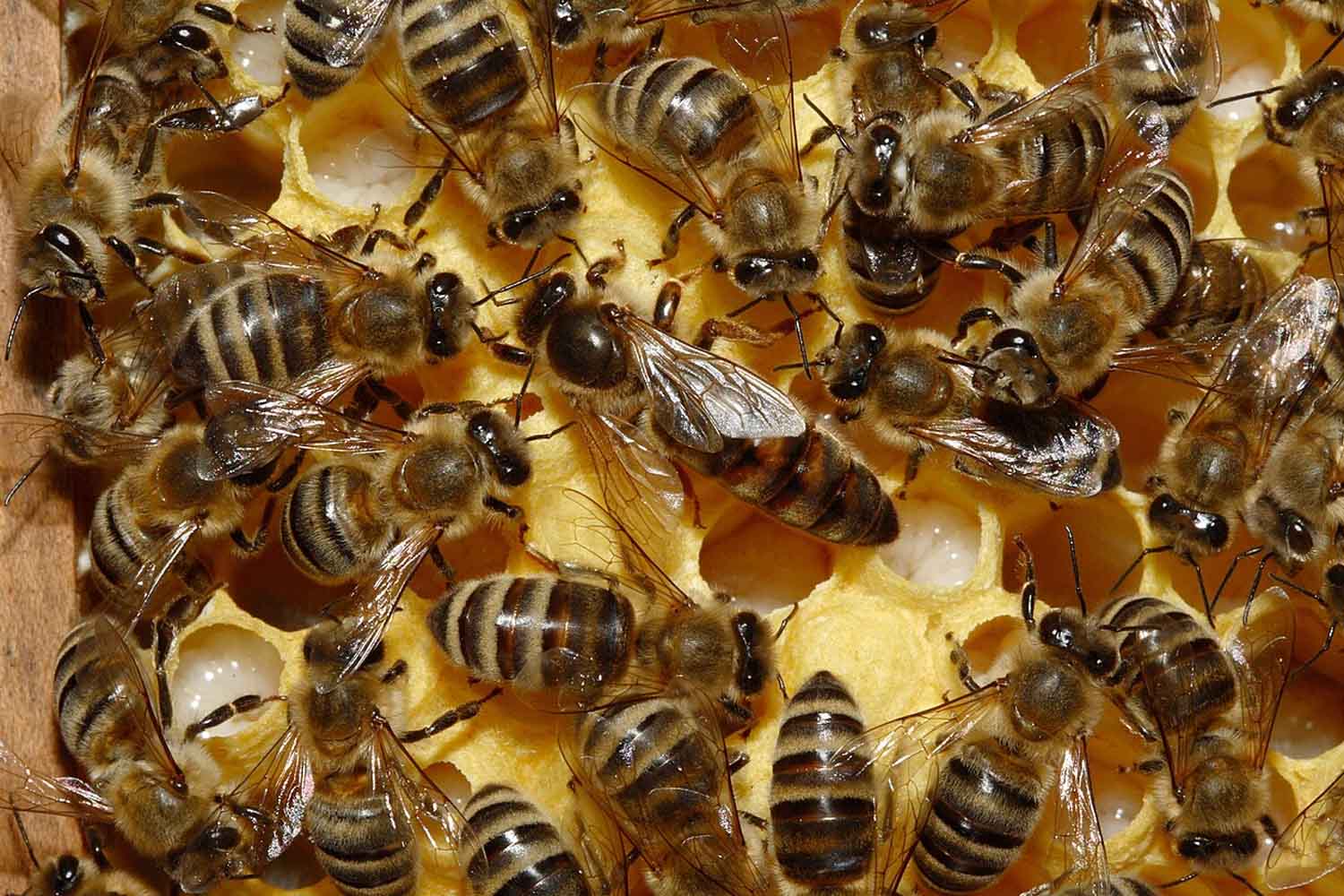
Inside a hive, a queen begins long before appearing to be a queen. Before the crown, before the larger body, before the longer life and enormous function that awaits it, there is a room. Small, elongated, hanging like a wax peanut among the honeycombs. Around, young workers who heat, supervise, modify material, adjust the environment. A kind of very high precision maternity ward, except that here the white coats are worn by creatures measuring just a few millimetres.
For years the story of the queen bee has been told in a fairly linear way: same departure of the workers, same origin, then royal jelly arrives and changes everything. A common larva receives enough special nutrition and becomes the reproductive female of the hive. The new research published on Nature It complicates this image a lot. Royal jelly remains fundamental, of course, but food tells only part of the story. The rest lies in the wax, the temperature, the humidity, the chemical signals and the coordinated work of workers who seem to have a much more specialized task than imagined.
The room matters
Worker bees and future queens start from almost identical eggs. Then their lives take very different directions. Queens grow more, mature earlier, live much longer and become the only fertile female in the colony, the one on which the next generation depends. Up until now, the classic explanation revolved almost entirely around royal jelly, that milky, nutrient-rich substance that the workers provide to the larvae destined for a different future.
The research team, coordinated with the contribution of the Center for Integrative Bee Research at the University of California, Riverside, looked elsewhere: at the room in which that larva grows. Royal cells, also called queen cells, are very different from the classic hexagonal cells used to raise workers. They have a more elongated shape, almost like a peanut shell, they protrude from the honeycomb and are built when the colony needs to produce a new queen.
Through thermal imaging, behavioral observation, material analysis and chemical testing, the researchers saw that these cells have properties of their own. The wax used to build them is less dense, more flexible, better suited to retaining heat and humidity. The fatty acids and chemical signals present in the material also change. In short, the future queen bee grows inside a tailor-made microenvironment, a biological cradle in which shape, material and internal climate participate in development.
To understand how much that cradle really weighed, scientists raised larvae destined to become queens in cells made with real wax or with ordinary wax, that of the worker cells. Given the same diet, larvae grown in worker wax were more likely to die and tended to become smaller queens. The difference, therefore, also passed from the environment around the body of the larva. Royal jelly nourished. The cell decided some of the conditions in which that nourishment could function.
The queen’s workers
The most interesting discovery concerns who builds these cells. The researchers have identified a class of young specialized workers, defined as “queen cell builders”, i.e. builders of real cells. They are usually younger than other workers in the hive and, while working on the future queen, display a higher body temperature and different physiology.
That additional heat appears to play a real role. A queen bee matures in approximately 16 days, while a worker takes approximately 21 days. Five days, in a hive, can weigh a lot. When a colony needs a new queen quickly, because the previous one has died, is weak or is about to leave with a swarm, speed becomes organized survival.
The workers, then, seem to do much more than recycle ready-made wax. They collect material from other areas of the hive, modify it, enrich it and activate biological processes linked to the production of wax. In practice, they also change their own internal functioning to better build the future queen’s environment. The paper talks about physiological and transcriptomic reprogramming: said without a shirt on, their body puts itself at the service of that work.
To test this, the team added small traces of graphite to the wax of an ordinary honeycomb. Later, that darkened wax also appeared in the actual cells. A sign that the bees were recovering material from other parts of the hive and transforming it to use in the chamber intended for the queen. More than a simple makeshift room. There is a construction site here.
A society that builds biology
Boris Baer, entomologist and director of CIBER, compared the process to a kind of royal court, with a group dedicated to the growth of the new sovereign. The image makes you smile, because we always tend to put human titles on animals, as if the hive were a miniature monarchy with ceremonial and good carpets. But the substance remains strong: the colony sets in motion a collective organization to produce the individual on which its continuity will depend.
The same pattern has been observed in both European and Asian honeybees, a detail that suggests an ancient strategy rooted in the evolution of social bees. The work combined different skills, from behavior to physiology, from chemistry to genomics, up to materials science. The research was led by Yu Fang and Yahya Al Naggar, former postdoc researchers at UCR, in a project built precisely on the intersection of disciplines that usually speak little to each other.
The result also shifts the gaze beyond bees. Because a real cell tells something broader: the environments built by animals can guide biological development. Nests, dens, honeycombs, rooms, social structures. What is around an organism can enter into its history much more than it seems. In the case of the queen bee, the hive almost becomes a larger body that prepares a part of itself.
For decades we have had a convenient explanation: special food, special insect. Now the scene is filled with young workers, different wax, controlled heat, humidity, chemical signals, material moved and reshaped. The queen is born from a diet, yes. It also comes from a well-built room and a colony that knows exactly where to put its hands. Or rather, the paws.
You might also be interested in:
