
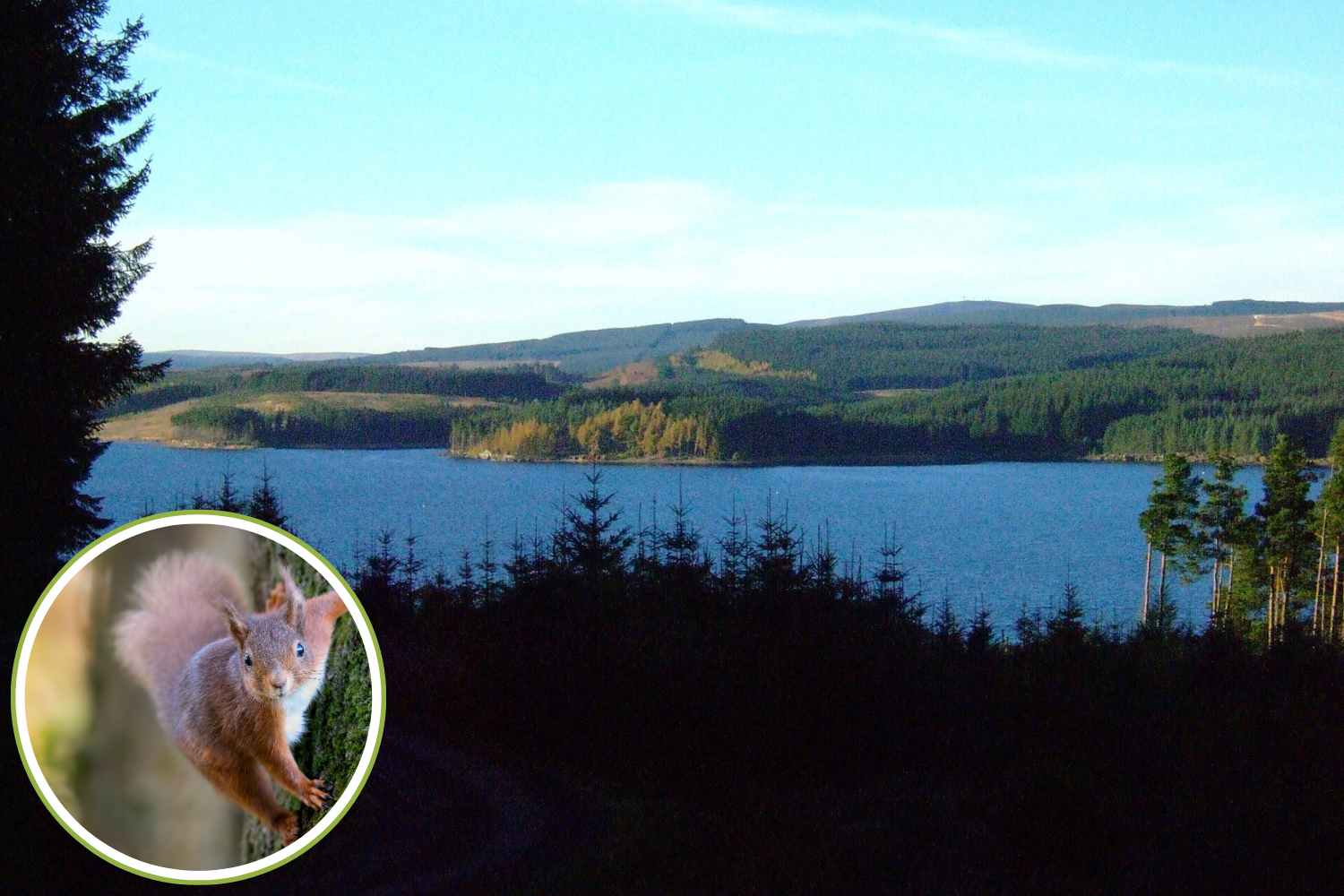
Sixty thousand hectares of Sitka spruce, a North American conifer, planted across one of the most intact moors in England. Not for the love of nature, but to feed the war industries. It was 1926, and the newly formed Forestry Commission had a specific mandate: British forest cover had collapsed to 5%, wood was in short supply, it was necessary to take action. Thousands of unemployed former soldiers were employed in manual planting. Result: 250 square miles of monoculture. Functional, efficient, and ecologically devastating.
@Wikimedia
Yet, a hundred years later, what should have been a timber reserve has become something else: one of the richest habitats in the north of England, with otters, water voles, kestrels and around 50% of the red squirrels still existing in the whole of England. It’s called Kielder, and it’s the largest forest in England.
Ospreys absent for 200 years
The change in direction came in the 1960s, when managers realized that a dense, homogeneous monoculture offered little to any species other than the Sitka itself. From there, the transformation: buffer areas, i.e. bands of vegetation, along watercourses, areas left to spontaneous evolution, and a project called “Wild Kielder” which will allocate six thousand hectares to active conservation.
Paul Pickett, wildlife manager, still remembers when, in 2009, a pair of ospreys landed on the first nesting platform installed in the forest. They were the first in Northumberland for two hundred years. “It’s a great honor to be involved in initiatives like this,” he told the Guardian. Today that population is expanding beyond Kielder’s borders, colonizing other areas of northern England.
Under the trees, the true climatic treasure
However, there is one aspect of Kielder that does not appear in the photographs: the peat bogs. Expanses of thousand-year-old peat that store more carbon than all the trees in the forest combined. Peatlands cover only 3% of the Earth’s surface, but they are the largest natural carbon sink on land.
When the forest was planted, many were drained to prepare the soil. The problem: by lowering the water table, the peat oxidizes and releases the carbon accumulated over centuries into the atmosphere. Bog restoration manager Rowan Hickman is plugging old drainage ditches to raise the water table and allow sphagnum moss to grow again. Over 50,000 meters of drainage have been blocked so far. “They are fabulous places,” he says, “and at the same time a truly underrated environment.”
The trees of tomorrow are planted today
Mark Holroyd, director of Forestry England for the Northern District, looks at what has happened in German forests, plants weakened by drought, attacked by pests: “With climate change, our forests are more vulnerable. When a disease hits a large commercial forest, the impact on the economy and wildlife is enormous.”
The answer is to diversify the species planted, knowing that the climate in a hundred years will be different from today. The UK imports 80% of the wood it consumes, second only to China, and Kielder demonstrates that producing it at home does not mean giving up nature. If anything, it means learning to make fewer mistakes.
