
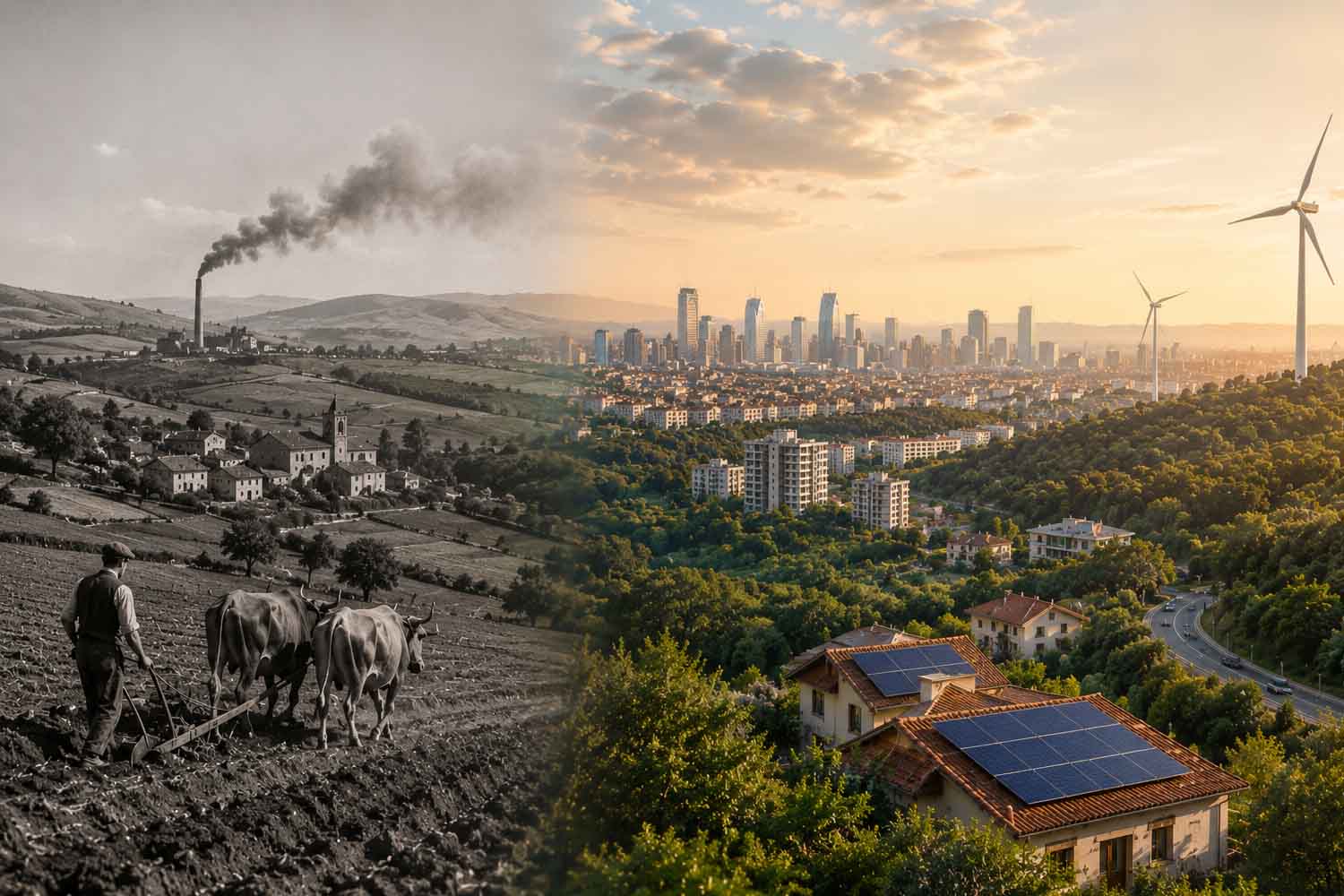
In 1925 Italy was still a country with its feet in the fields. The agricultural surface occupied approximately 70% of the national territory. Today it has dropped to just under 40%. In the same period of time, forests went from just under 20% to 33.6%. This gap is enough to understand how much the Italian landscape has changed, even where it seems to have remained identical to itself.
The new Istat framework on the environment and energy in Italy, published for the centenary of the Institute, recounts a century-long transformation: fewer cultivated fields, more forests, more cities, more buildings, enormously increased energy consumption, advancing renewables and a waste system that has gone from the almost obligatory landfill to a supply chain much more oriented towards recycling.
The campaign retreats
The first change is physical. It can be seen on the ground, even before in the statistics. In one hundred years, the share of agricultural land has almost halved, while forestry has grown continuously. Within this transition there is the abandonment of many cultivated lands, especially in inland and mountainous areas, but also the productive transformation of the country: less agriculture as the dominant structure, more settlements, infrastructures, industrial activities and services.
Istat recalls that today in Italy artificial coverage, i.e. buildings, roads and infrastructures, reaches 6.5% of the territory. In Germany it is close to 8%, while in Spain it remains lower also because around half the territory is occupied by wooded areas. France, among the large European countries considered, retains the largest share of agricultural territory.
The Italian transformation has a second face: urbanization. In 1931 more than a quarter of the present population, 26.4%, lived in the municipal districts, outside the centres. Today over 9 out of 10 residents live in centres. In the same period the population increased by almost 20 million and from 1950 to 2025 the density of buildings in the centers rose from 140 to 575 per km². Outside the centers it went from 2 to 9 buildings per km², also due to the effect of second homes, with particularly strong increases in Lazio, Campania, Basilicata, Sicily and Sardinia.
Warmer cities, warmer seas
The second transformation concerns the climate, and here the numbers have less patience. Between 2006 and 2023, in the 21 Italian regional capitals, summer days, i.e. those with maximum temperatures above 25°C, went from 101 to 114 compared to the 1981-2010 climate average. Tropical nights, those in which the minimum remains above 20°C, increased from 38 to 49.
Even the seas tell the same direction. Between 1940 and 2025 the average annual temperature of the Tyrrhenian and Adriatic Sea grew by more than 1°C, double the speed of the global average. The Mediterranean thus confirms its climate vulnerability: hotter, more fragile, more exposed.
In 2024, compared to the period 1991-2020, ground temperatures were higher by +0.7°C globally, by +1.3°C in Italy and by +1.5°C in Europe. In Italy, 2022 and 2023 were the warmest years since measurements began. In the cities the increase weighs even more: in Rome, in the Collegio Romano station, the average temperature has increased by around 3 degrees from the beginning of the 1980s to today. In Berlin, Madrid and Paris the increase is around 2 degrees.
The heat also enters fresh water. The analysis of a century of flows of the main Italian rivers shows a tendency towards contraction in the Tiber and Arno basins since the 1980s. The Po holds up better thanks to the natural regulation of the pre-Alpine lakes, but even in the Po basin the summer low water levels have become more severe, until the crisis of 2022.
Energy changes face
The energy leap is enormous. In 2025, energy consumption in Italy is over 9 times that of 1930: from 15 to 140 million tonnes of oil equivalent. In the same period the population has become one and a half times that of 1931, while the GDP has grown by approximately 10 times.
In the 1930s, coal and wood dominated. After the Second World War, the oil era began, which exploded during the economic miracle: between 1953 and 1973 consumption multiplied approximately 7 times. Then came the oil crises of the 1970s, the exit from nuclear power in 1987 and the growth of natural gas.
The historical peak of energy consumption was reached in 2005, with 192 Mtoe. Since then, consumption has decreased, due to the reduction in industrial activity, greater energy efficiency, the change in the mix of sources, the demographic transition and also milder winters. Between 2005 and 2024, the share of renewables in gross domestic energy consumption rose from 7% to 21%.
Electricity shows the turning point even better. Between 1924 and 2024, electricity production went from 0.6 to 23.3 Mtoe. In 1973 oil covered two thirds of electricity production. In 2007 natural gas reached 55%. In 2024, renewables will cover almost half of production and the objective is to reach two thirds in 2030. The rest of the requirement is guaranteed by gas and imports, equal to 4.8 Mtoe.
A heavy fragility remains: Italy is among the European countries with the highest energy dependence on foreign countries, around three quarters of the total, compared to an EU average of less than 60%.
The waste bin is no longer the same
Even waste has changed history. In 2024, the production of urban waste in Italy amounted to 508 kg per inhabitant, in line with the European Union average. Between 1996 and 2024, production increased by 11.2%, so the quantitative problem remains. However, the management has changed.
In 1996 the landfill absorbed 83% of municipal waste. In 2024 that share fell to 15%, below the EU average. Incineration went from 5% to 18%. The most significant part concerns recycling and composting, which grew from 6% to 55%.
In the capital municipalities, however, the picture remains more complicated. The production of urban waste reaches 546 kg per inhabitant, therefore exceeding the national average, while separate waste collection is more than 9 percentage points lower. Among the metropolitan capitals, in 2024 only Cagliari and Bologna exceeded 65%, a target set in Italy already for 2012 and achieved at a national level only in 2022.
In a century, Italy has consumed more land, lost fields, gained forests, warmed cities and seas, multiplied the energy used and then began to correct part of the course. The landscape has changed without making any noise, one hectare at a time, one power plant at a time, one dumpster at a time. Looking at it in the data has a certain effect. Especially because the big work now comes later.
You might also be interested in:
