
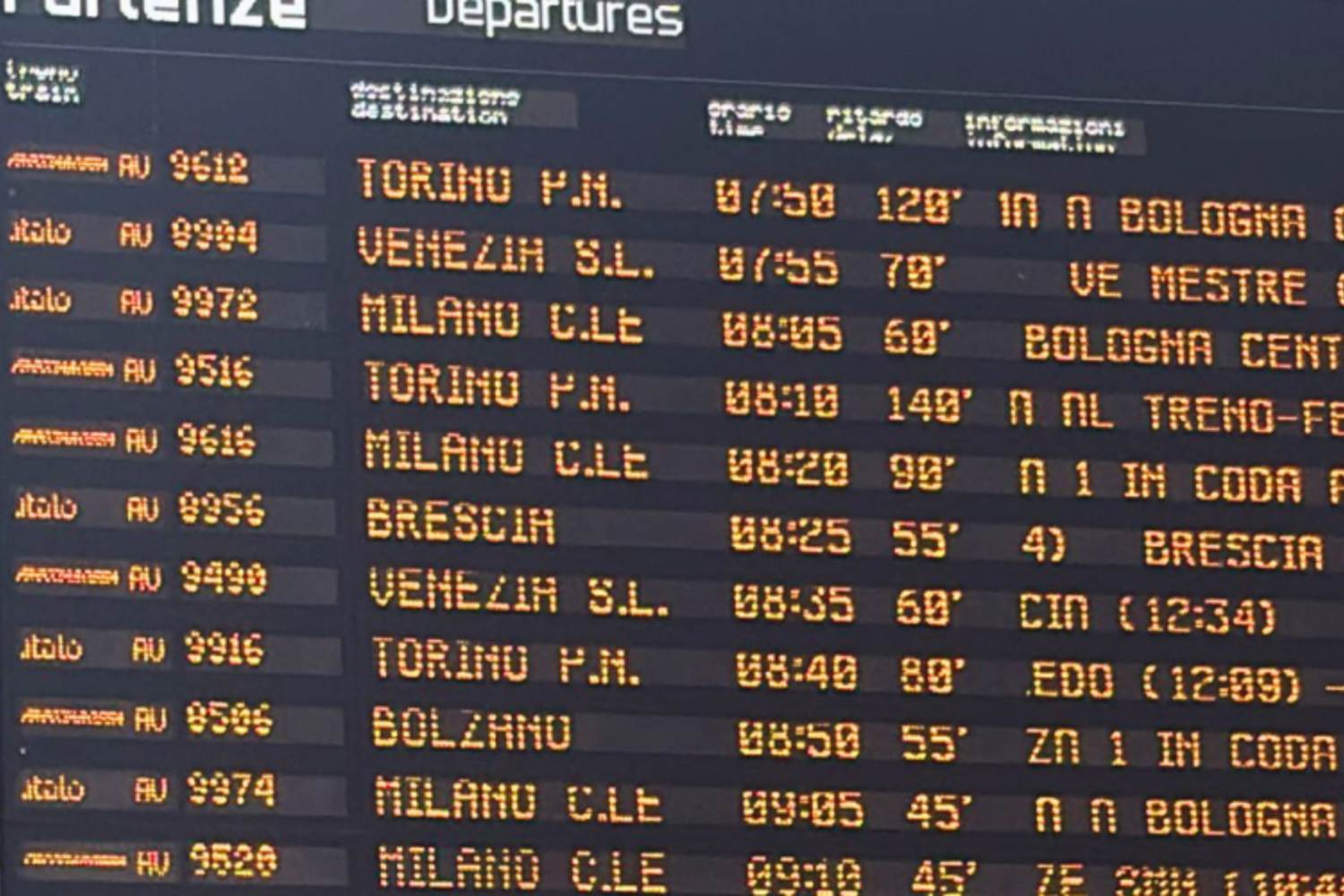
The Italian railway network is experiencing a prolonged structural block, paralyzing the country’s strategic connections precisely at the beginning of the large summer tourist flows. For the second consecutive day, passengers on the main routes find themselves having to deal with a real odyssey. After the heavy electrical fault that isolated the northern axis yesterday, this morning the ax of outages hit the southern Tyrrhenian route, causing chain slowdowns, forced diversions and convoys stuck in stations.
Sabotage in the Caserta area stops the Rome-Naples line
Today’s emergency occurred around 6:50 am, when the Italian Railway Network’s monitoring systems detected a power outage. The cause of the fault can be traced back to the criminal action of unknown persons who, near the Tora and Piccilli station, in the province of Caserta, caused serious damage to the installations by cutting and removing numerous copper cables.
The act of vandalism forced Trenitalia to route the high-speed trains on the conventional line via Formia, an emergency maneuver that increased travel times with immediate delays of up to 90 minutes. Among the most penalized trains are the Frecciarossa which left at 6:00 from Florence Santa Maria Novella and headed to Naples Central, and the 7:45 convoy which left from the Campania capital towards Milan. Although the intervention of the maintenance technicians allowed a partial resumption of the tracks starting from 8.30 am, the domino effect on timetables continues to have repercussions on the entire peninsula. All the updates here.
Yesterday’s odyssey on the Milan-Bologna route
Today’s inconveniences are added to a situation already heavily compromised by the collapse recorded yesterday, Wednesday 17 June. At 10.20 in the morning, a very serious failure of the overhead power line in the stretch between Milan Rogoredo and Piacenza, located precisely in Livraga, in the Lodi area, completely paralyzed the high-speed train towards Bologna. The failure of the high voltage cables also generated a dangerous brush fire along the roadbed, requiring the emergency intervention of the Fire Brigade.
The total blockade lasted over six hours, leading to the permanent cancellation of around ten long-distance trains. Waiting times have exceeded the critical threshold: the Frecciarossa 9311 for Turin was 280 minutes late, while an Italo train from Naples arrived at Milan Central station with a five-hour delay, forcing the passengers on board to endure hours of confinement in the carriages without the aid of air conditioning due to the system blackout.
Consumer protests and political reaction
The Adoc intervened harshly, criticizing the management of communication flows by transport companies, deeming the total absence of clear information within the stations unacceptable. The association to protect citizens has activated a dedicated toll-free number to assist passengers with requests for a full ticket refund.
In the meantime, the emergency quickly moved to the level of institutional debate: Transport Minister Matteo Salvini asked for an in-depth technical report from RFI and Trenitalia to verify the efficiency of the network, while the opposition forces severely criticized the management of the security of national infrastructures.
You might also be interested in:
