
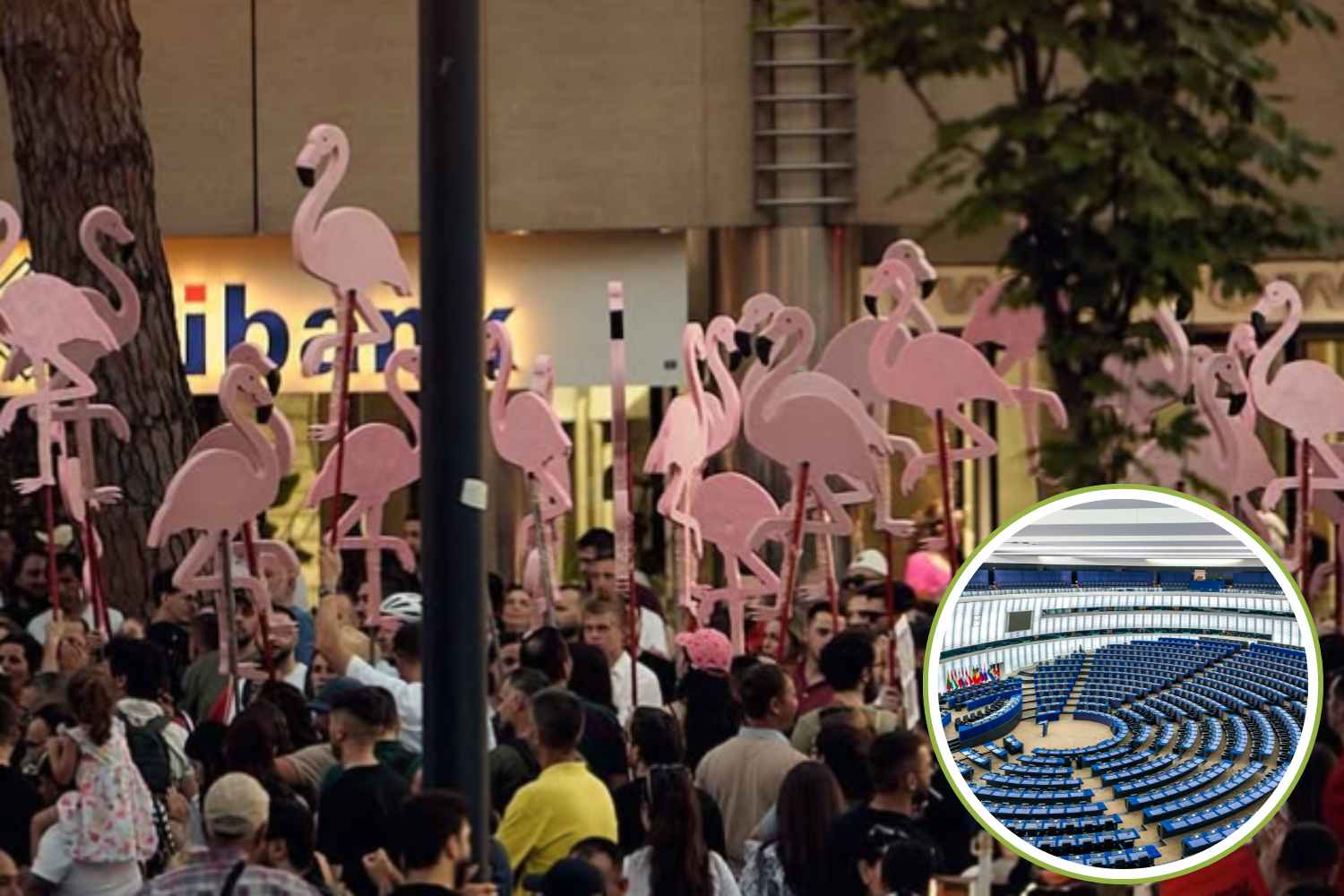
Eighteen days of consecutive protests. Over one hundred thousand people in the streets of Tirana and Albanian cities, plus diaspora demonstrations from New York to Sydney, from London to Rome. The “Flamingo Revolution” has forced the European Parliament to deal with a Balkan coastal lagoon that most Europeans would not be able to point out on a map.
On 17 June, Strasbourg deputies adopted the annual resolution on the 2025 Commission report on Albania, including a specific request: immediate moratorium on new permits and construction sites in the country’s protected areas, valid until the amendments to the law on protected areas approved in 2024 are repealed and until full compliance with European environmental standards is demonstrated. A political act with an equally precise recipient: the government of Prime Minister Edi Rama.
@Zenialia_ (IG) / Canva
A resort, a lagoon, Trump’s son-in-law
To understand what’s happening you have to go back a few months earlier. The Vjosa-Narta Protected Landscape, on the southern Albanian coast, is one of the last intact deltaic systems in the Mediterranean. It is home to over 200 species of birds, more than 70 threatened species, and is located on one of the most important migratory corridors in Europe, used every year by millions of birds in transit between Africa and the European continent. Among the species that find refuge there are the flamingo, the Mediterranean monk seal and the caretta caretta turtle, which Greece, Italy and Croatia have a legal obligation to protect under the EU Habitats and Birds Directives. What happens in Vjosa-Narta, therefore, is not an exclusively Albanian issue.
In May 2026, trucks arrived in the protected area. Building materials, bulldozers, earthmoving. No plans made public, no environmental impact assessments, no public consultations, no valid permits. The goal: a luxury resort financed by Affinity Partners, the fund of Jared Kushner, son-in-law of US President Donald Trump. The Albanian law on strategic investments, amended in 2024, had paved the way for accelerated authorization procedures that effectively bypass normal environmental controls.
The reaction was immediate and massive. Albanian citizens took to the streets in numbers the country had not seen for decades, demanding the suspension of the project, the repeal of the laws that made it possible and Rama’s resignation.
Nga flamingot te pelikani kaçurrel, protest po vijon nën simbolet e biodiversitetit shqiptar, duke e zhvendosur focusin nga mbrojtja e natyrës te denoncimi i korrupsionit dhe project që sipas protestuesve janë paraqitur si investime për turizmin, por kanë sjellë dare… pic.twitter.com/9BC0CtuZht
— Amfora.al (@AlAmfora) June 16, 2026
What Strasbourg decided and what it did not decide
Parliament’s resolution calls for the repeal of the 2024 amendments to the Protected Areas Law, stresses that the path to EU membership requires “proven track record in the implementation of environmental legislation, environmental impact assessments and the right to public participation,” and specifically calls for the freezing of any new building permits in Albanian nature reserves.
“This vote shows that environmental protection is not a secondary issue in the accession process. The European Parliament has made it clear that nature, public participation and the rule of law are not optional elements of EU membership,” said Gabriel Schwaderer, Executive Director of EuroNatur.
It must be said, however, what the resolution does not contain. An initial amendment that explicitly mentioned the Kushner project was rejected: the final text does not refer to any specific project. A distinction that is not just technical: it reflects the balance of power within Parliament and the difficulty of building a majority on an act that would directly involve an ally of the current American administration.
The distance between Parliament and the Commission is clearer. On June 15, Enlargement Commissioner Marta Kos said she had received “guarantees from the Albanian government” that an environmental assessment would be carried out, ignoring the documented fact that the work had already started without any legal procedure. Parliament, at least on this point, has shown more coherence.
Brussels watches, Tirana responds
Rama’s reaction to the resolution came via Instagram with criticism of the “outcry” and reassurance that “the flamingos will be protected”. Meanwhile, work in the area has been suspended, at least temporarily, under pressure from the streets.
View this post on Instagram
“Europe should pay close attention to what is happening in Albania. There is no better guarantee for the path to accession to the European Union than a lively and aware people, capable of mobilizing against predatory capitalism, in defense of justice, common goods and freedom”, said MP Ilaria Salis in the debate on 16 June. The political dimension of the story has grown exponentially in recent weeks. Aleksandër Trajçe, executive director of PPNEA (the Albanian organization for the protection of nature, present on the field during the protests), framed the issue precisely: “The debate on Vjosa-Narta goes far beyond environmental protection alone; it has become part of a broader European debate on the rule of law, democratic participation, transparency and the credibility of the enlargement process itself”.
View this post on Instagram
What remains at stake
Vjosa-Narta is a candidate for the Emerald Network under the Bern Convention and is expected to become part of Natura 2000 with Albania’s accession to the EU. Since 2023, the Standing Committee of the same Convention had already asked Albania to suspend work on the Vlora international airport, also built within the protected landscape starting from 2021.
However, the question remains: what happens now? A resolution of the European Parliament has no binding force. It can guide the Commission, it can influence the political climate of the negotiations, it can give cover to civil movements. But construction sites stop, or resume, on the basis of decisions that are made in Tirana, not in Strasbourg. One hundred thousand people in the square for eighteen days know it. Precisely for this reason, most likely, they will not stop.
