
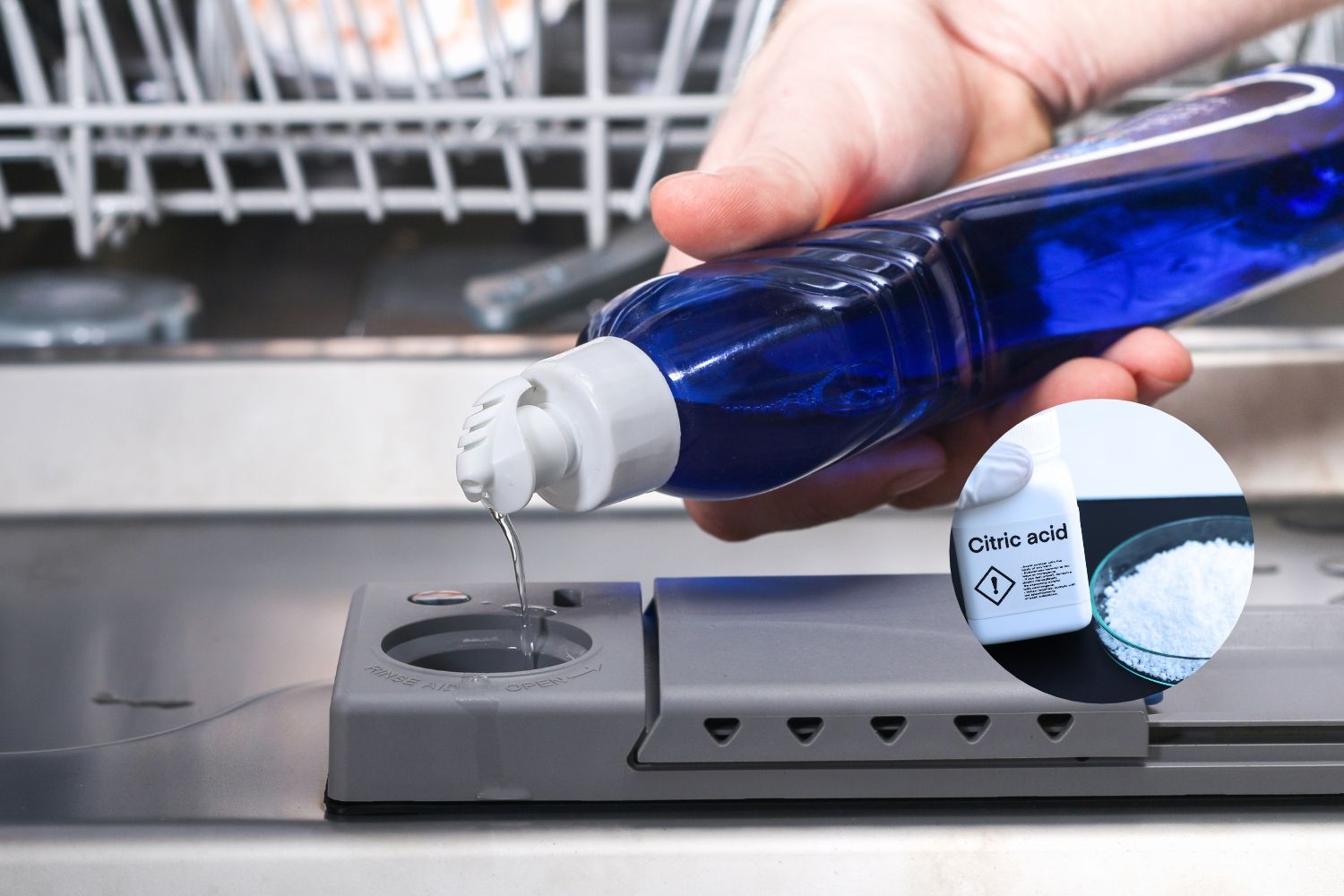
The rinse aid in the supermarket already has citric acid, the point is that it doesn’t only contain that. Altroconsumo has sifted through the labels of the most popular products: up to 90% of the formula is water and alcohol, then come the surfactants (5-15%), citric acid (1-5%) and, lastly, preservatives, perfumes and colourants. The home-made version, in practice, keeps the supporting character and gives up the protagonist.
How to prepare it and how to use it
The most common dose is a 15% solution, i.e. 150 grams of citric acid dissolved in a liter of water, the same as indicated in the technical data sheet of common citric acid on the market. To prepare less, Altroconsumo suggests two generous spoonfuls in a 200 milliliter glass of water. Stir until the crystals disappear completely, then pour the solution into the rinse aid dispenser, the one with the sun symbol on the inside of the door, up to the maximum level. The program remains the same as always. What is left over should be kept in a closed bottle with a clearly visible label, so as not to confuse it with water.
Don’t buy rinse aid anymore! Prepare it at home with this foolproof recipe
Two different jobs
The rinse aid comes into play in the last rinse and has two tasks. The first is due to surfactants, which lower the surface tension of water: instead of collecting in drops, the water slides off in a thin film and dries faster. It is precisely the drops that retain the dissolved salts, which become marks and stains after evaporation. The second task falls to citric acid, a limescale remover that acts on the calcium and magnesium ions in hard water. The solution of water and citric acid only covers this second part, because citric acid is not a surfactant. Altroconsumo, which indicates it as an alternative to 15% (two large spoonfuls in a 200 ml glass of water, poured directly into the compartment), says it bluntly: the properties are not the same as rinse aids and the results are not comparable. It does something against the white marks of limestone; on drying, much less.
The manufacturers’ warning
Bosch, on its website, does not recommend self-produced rinse aids: it says they could damage the appliance and any use would risk invalidating the warranty. Before trying, it is therefore a good idea to read the manual for your machine. Altroconsumo’s opinion on vinegar is clear: it is an acid that in the long run can ruin dishwashers and crockery, and does not leave that film that makes the water slide off.
The most common doubts
The dispenser in the tray must be adjusted as for classic rinse aid. The scale, explains Bosch, generally goes from 1 to 6: if marks remain on the glasses, the level is raised. On gaskets, the risk that the manufacturer indicates concerns vinegar, whose acidity can ruin them in the long run. There is no similar warning for citric acid, on the contrary: it is among the ingredients of the dishwasher descaler sold by Bosch itself. However, a descaler is used every three to six months, while the solution in the tray comes into play with every wash. To switch from supermarket rinse aid to homemade rinse aid, it is best to wait until the tray is empty, so the two products do not mix.
The crux of surfactants
Complicating the picture is a study by the Swiss Institute of Allergy and Asthma Research, published in the Journal of Allergy and Clinical Immunology. Cezmi Akdis’ group exposed human intestinal epithelial cells, grown in the laboratory, to dishwasher detergents and rinse aids. At the typical dilutions of professional machines, the rinse aid damaged the epithelial barrier and among its components the culprit identified were ethoxylated alcohols, a family of surfactants.
However, these are in vitro tests, referring to catering, where the rinse aid is often not rinsed at the end of the cycle: transferring those results to the home kitchen would be a leap that the study does not make. The verdict, in the end, depends more on the tap than on the recipe. The verdict, in the end, depends more on the tap than on the recipe, because if the water at home were to be very soft, the citric acid solution would be of little use, given that there would be little limescale to fight. It is not even useful for those who use all-in-one tablets, which already contain rinse aid.
