
Twenty squats in the morning, twenty in the afternoon and another twenty in the evening. Three short appointments, to fit in between work, household chores and various commitments. Research compared this distribution with a single session of sixty repetitions, finding improvements in strength and muscular endurance in both groups, without statistically significant differences between the two programs.
The study published in Journal of Exercise Science & Fitnessconducted by researchers at Tongji University in Shanghai, involved 45 young men already accustomed to weight training. The squats were performed on the Smith machine, a device that allows you to lift a barbell along a guided trajectory.
The research therefore concerns overload training. The principle of distributing the exercise throughout the day, however, can also be interesting for those who train at home, with a dumbbell, a small weight or simply with a free body. With one caveat: these domestic variants were not directly compared in the study.
Twenty squats at a time: what happened after eight weeks
The researchers divided the participants into three groups of fifteen people. The first performed twenty squats three times a day, the second concentrated all sixty repetitions in a single session, divided into three series. The third group, used as a control, did not follow the experimental program.
Training took place three days a week for eight weeks. The weight lifted progressively increased, going from 40% to 55% of the maximum load that each participant could lift once. In both programs, therefore, the overall amount of exercise was identical.
At the end of the eight weeks, the two trained groups had significantly improved maximum strength, force expressed while maintaining a stationary position and muscular endurance compared to the control.
Those who performed all the squats together showed numerically greater improvements, but the statistical comparison between the two programs revealed no significant differences.
This means that, under the conditions examined, distributing the squats throughout the day worked to improve strength and endurance. However, we cannot consider perfect equivalence demonstrated: with such a small sample, any differences may not have been detected.
Then there is another interesting result. Through a questionnaire, the researchers discovered that those who trained three times a day appreciated the activity more than those who concentrated everything in one session. A potentially useful advantage for those who struggle to find the time, even if the satisfaction does not demonstrate that you will continue to train for longer.
Do squats work even without gym weights?
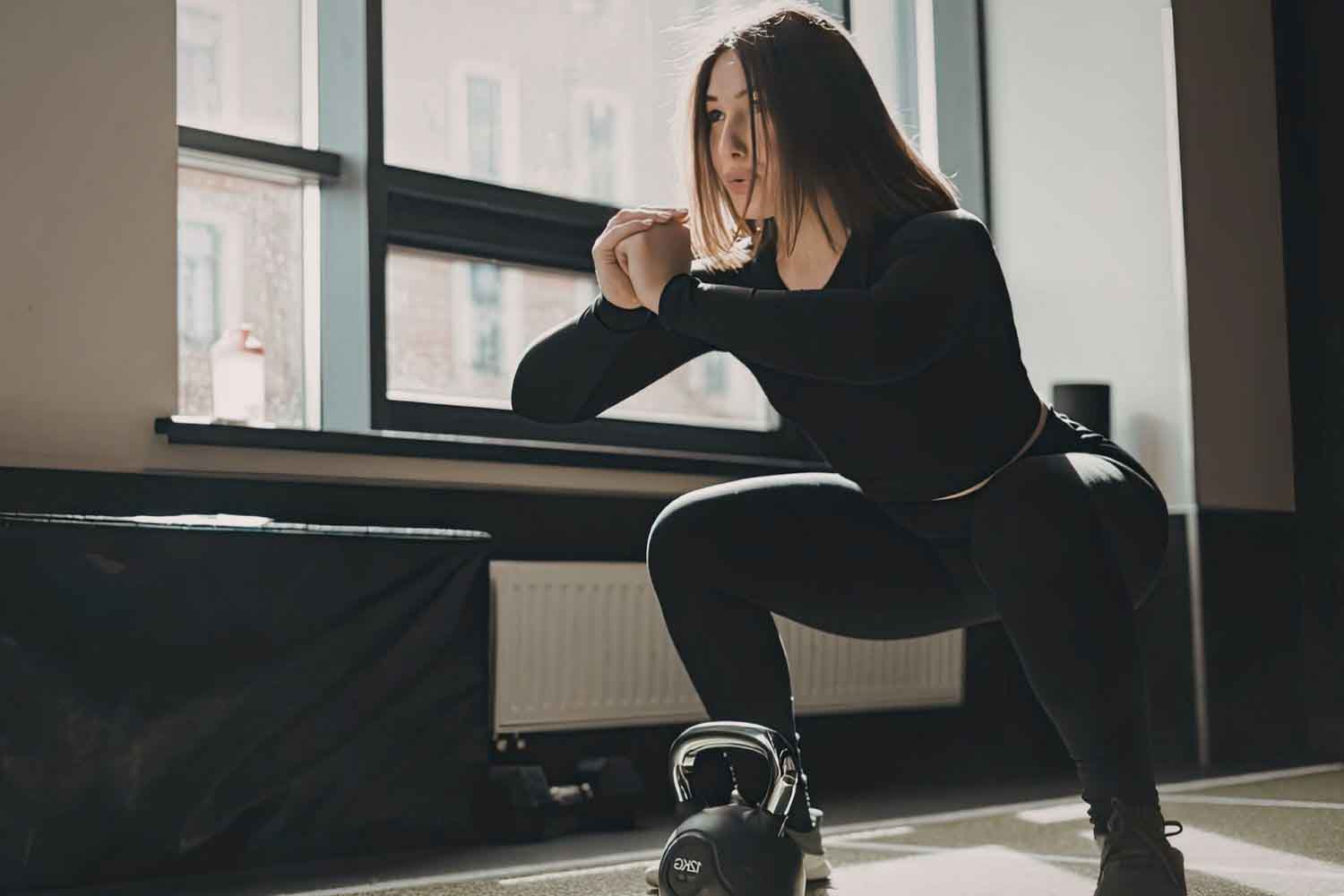
To apply this type of training at home you don’t necessarily need a Smith machine. Squats can be performed with your own body weight or using a dumbbell, a kettlebell or a small load suited to your preparation.
The effectiveness depends above all on the difficulty of the exercise. A sedentary person may find ten bodyweight squats already challenging, while someone who trains regularly may need an additional load or a more difficult variation to adequately stimulate the muscles.
Confirming that even the free body can produce improvements is research published in Scientific Reports in 2023, which compared unweighted squats and barbell squats in thirteen sedentary young women. For six weeks, the participants trained twice a week following progressive programs. Those who used the barbell gradually increased the load, while those who worked free body moved on to increasingly difficult variations, up to exercises performed on one leg.
Both groups improved leg strength and thickness of some muscles, with no statistically significant differences between programs for these measures. The sample was very small and the research did not compare sessions distributed throughout the day, but it showed that even the weight of one’s own body can represent an effective muscular stimulus. Another indication comes from the University of Bath. In 2019, a small study of twenty adults between 65 and 80 tested a home program consisting of short morning and evening sessions with different exercises, including getting up and sitting down from a chair.
After 28 days, those who had followed the program were able to perform 31% more rises from the chair within a minute, while the control group had not shown similar improvements. The benefit affects the entire program, so it cannot be attributed to that exercise alone. They are different research, conducted on different populations. They offer guidance on the usefulness of short workouts and equipment-free exercises, but they do not demonstrate that any variation of the squat produces the same results as the Chinese program.
How to distribute squats throughout the day
The simplest idea is to divide the work into two or three short sessions, leaving several hours to pass between one and the other. The number of repetitions, however, must be adapted to individual preparation. Those starting from scratch can start with a few free body repetitions, trying to perform the movement correctly. When they become too easy, you can gradually increase the number or difficulty of squats.
Those who are already trained can use an additional load, for example a dumbbell held in front of their chest. Even a water bottle or backpack that is tightly closed and its weight is stably distributed can offer light resistance, as long as it is easy to control and does not compromise balance.
To perform a squat, just start standing, with your feet approximately shoulder-width apart, bend your hips and knees as if sitting on a chair and then get back up, keeping the movement controlled. The depth of the descent must be adapted to your mobility. For those who have difficulty, a stable chair can be a good starting point: you sit down and get up, gradually trying to improve movement control.
The number twenty, therefore, has nothing magical about it. It is simply the one used by researchers, along with a precise and progressively increasing load. Reproducing the same repetitions without weights, or with a makeshift object, does not automatically guarantee the same results.
And above all, those who use an additional load must choose a weight that they can control without losing correct execution. In the presence of joint pain, balance problems or physical limitations it is advisable to adapt the exercise with the help of a professional.
Are squats enough to keep fit?
Squats mainly involve the muscles of the thighs and buttocks and train a movement that we use continuously: sitting down, getting up, picking up something from the ground. However, they remain an exercise for one part of the body. World Health Organization guidelines recommend muscle-strengthening activities that involve all major muscle groups for adults at least two days a week, along with regular aerobic activity.
Distributing a few sets of squats throughout the day can therefore be a practical way to train your legs, especially when you have little time available. To obtain results, it also matters how demanding the exercise is compared to your preparation.
The Chinese study suggests that, at least in the young men involved, separating the sets throughout the day can produce significant improvements in strength and endurance, with even greater satisfaction than the traditional session.
Those who have little time can therefore consider this organization as an alternative to experiment with, adapting exercises and loads to their abilities. For those who train at home, it also means being able to take advantage of a few free minutes without necessarily having to prepare a gym bag.
