
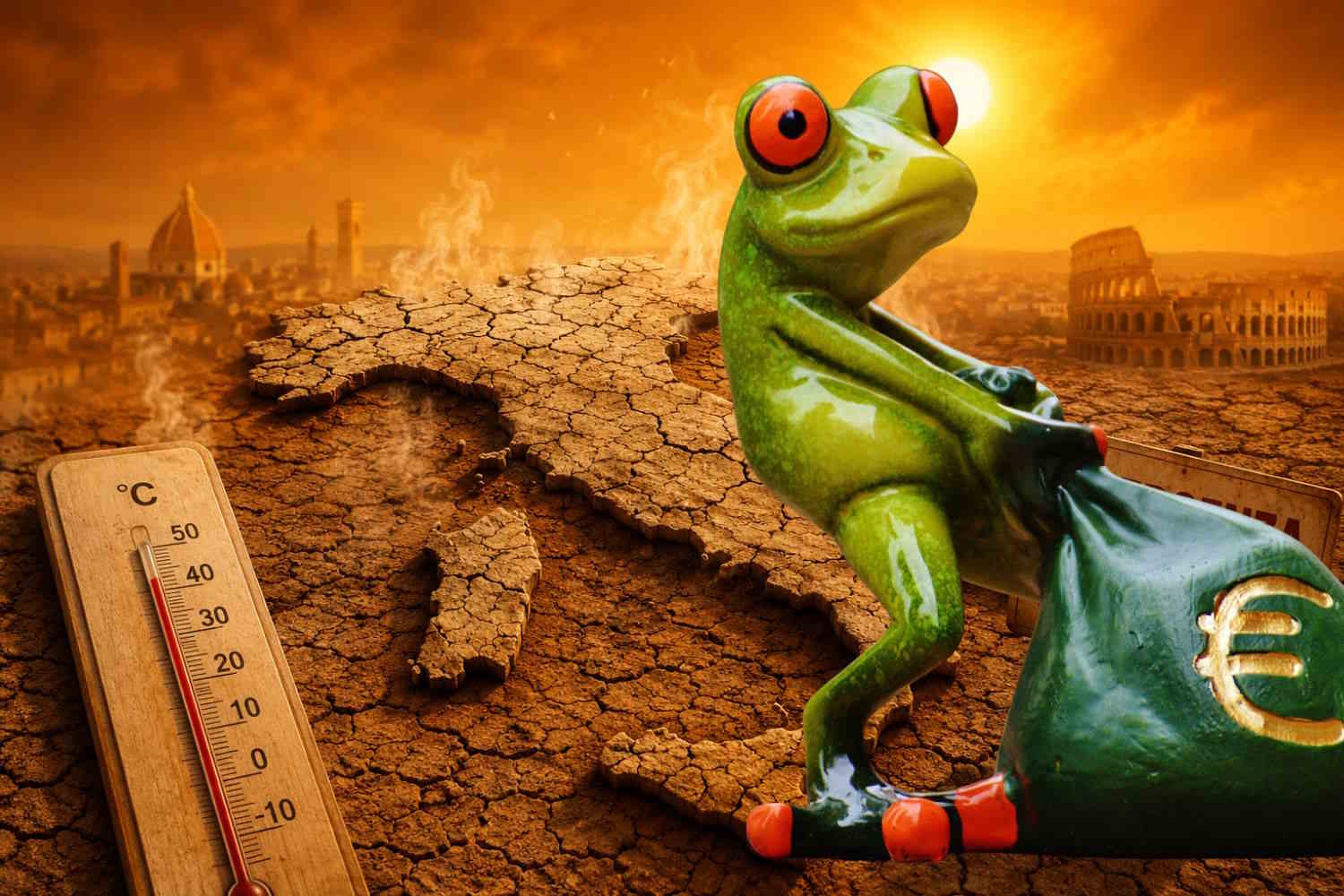
The most concrete part of the heat arrives in the evening, when the walls return heat, the fan moves warm air and those who live in a poorly insulated house understand very well how the energy transition is a domestic matter even before a European one. The Ministry of Health monitors heat waves in 27 cities. And while the country makes do with lowered shutters and bills looked at like medical reports, the Social Climate Plan remains there: announced, discussed, awaited, full of public money and practical promises, stuck at the formal passage that should open the discussion with Brussels.
We are talking about a 9.3 billion euro document, at least in the version announced by the ministry in August 2025, with interventions on construction, bills and mobility: redevelopment of fragile buildings, gas social bonus, public mobility in disadvantaged areas and digital wallets for public transport. Everything clear. Too bad for the usual national liturgy: that vulgar and very tiring detail called implementation is missing.
That money is needed in real homes
The Social Climate Fund was born within the European package linked to ETS2, the new emissions trading system which also concerns buildings, road transport and small businesses: fuels and fossil fuels will have a more explicit climate cost, and part of that mechanism should support those who risk paying the highest price of the transition.
The European Commission had indicated a precise deadline: each country would have to transmit its national plan by 30 June 2025, with the measures expected between 2026 and 2032. Italy, on the European page dedicated to national social plans for the climate, manages to get noticed by subtraction: other countries have a state of progress, we have a box that shows the talent of the “not arrived”.
ETS2 puts a price on emissions, the Fund should prevent that price from ending up on the shoulders of vulnerable families, micro-businesses and people who depend on cars or complicated transport to work, care and study. The technical presentation published by the GSE talks about vulnerable families, vulnerable micro-enterprises and vulnerable transport users, with an allocation for Italy of 7 billion euros and a minimum national co-financing of 25%. Hence the overall figure is over 9 billion.
The European framework indicates practical interventions: building renovation, clean heating and cooling, renewable energy, storage, low-emission mobility, improved access to transport and technical assistance. Ergo: thermal coats where today it freezes in winter and cooks in summer, heat pumps, photovoltaics for those with low incomes, less energy-intensive public housing, decent transport where moving costs too much.
The energy income for installing photovoltaic systems and heat pumps for domestic use also appeared in the material being consulted, with reference to households with ISEE under 15 thousand euros, or under 30 thousand for families with at least four dependent children. Measures capable of changing bills and quality of life. As long as the Plan comes out of limbo. Sore point, I understand, but quite central.
The silence after the consultation
The organizations involved in the initial consultation phase speak of “unacceptable delays”, asking for transparency, certain times and a new public discussion. According to the note released by WWF Italy, civil society has remained without updates on the draft for twelve months. The latest rumors speak of an informal discussion between the Ministry of the Environment and the European Commission which closed at the end of March, awaiting the political signature. The famous “we’re almost there” which in our public apparatus lives longer than some legislatures.
According to the organisations, the Plan should have been operational from the beginning of 2026, while over 9 billion intended for families, businesses and fragile mobility are treated as a practice to be kept in some ministerial folder with the writing “one moment and I’ll be with you straight away”.
To make the story more rough there is also a political detail. In recent months, the Italian Government has supported the need to review the ETS system, presenting it as a hub of competitiveness for businesses and bills. The European debate on the price of CO2 certainly exists. However, the Social Climate Fund was created precisely to accompany those who risk being crushed by energy costs and inefficient homes. The parachute was expected. Keeping it locked in your backpack while discussing free fall requires some administrative imagination.
The associations also fear improper use of resources. That money should be additional, consistent with the objectives of the Fund, according to a principle of additionality which prevents it from being used as a patch for ordinary spending. The fear is that the Fund will be folded into current administration, losing its main function: making the transition fairer for those with fewer economic margins. Because the ecological transition described as a great green horizon works very well in conferences. If the bill always arrives at the same address, the problem is the postman.
The climate is already taking its toll
The delay weighs even more because the climate has long since stopped being a distant projection. The European Environment Agency estimates that between 1980 and 2024, extreme weather and climate events caused 822 billion euros of economic losses in the European Union, with over 208 billion concentrated between 2021 and 2024 alone. In Italy, calculations released in 2026 by Italy for Climate indicate around 145 billion euros of damage between 1980 and 2024.
And 2025 added another piece. A study coordinated by the University of Mannheim has estimated 11.9 billion euros of economic losses for Italy in 2025 linked to heat, drought and floods, with an impact that could rise to 34.2 billion by 2029. There are lost crops, slowed down construction sites, hospitals under pressure, unlivable cities, families squeezed between minimal comfort and threatening bills.
The Social Climate Plan would make sense precisely in this friction: helping a family consume less energy, making a council house less energy-intensive, supporting a micro-enterprise, financing better transport where today the private car remains a daily tax. The ecological transition becomes unfair when it asks vulnerable people to pay in advance for benefits that will come later, perhaps in a house that is damp in winter and hot in summer.
The Plan needs transparency: who will receive aid? Which territories will be reached? Which buildings will be redeveloped? What idea of mobility will enter the underserved areas? Letting it slip into closed rooms means treating as a technical practice a choice that will enter kitchens, condominiums, commuters’ journeys, and the budgets of those who already have a few centimeters of maneuverability.
The heat, meanwhile, doesn’t care about the political signature: it comes in through lowered shutters, inflates bills, empties the streets at the worst hours, puts into difficulty those who work outdoors and those who live in apartments built for a climate that resembles that of today less and less.
You might also be interested in:
