
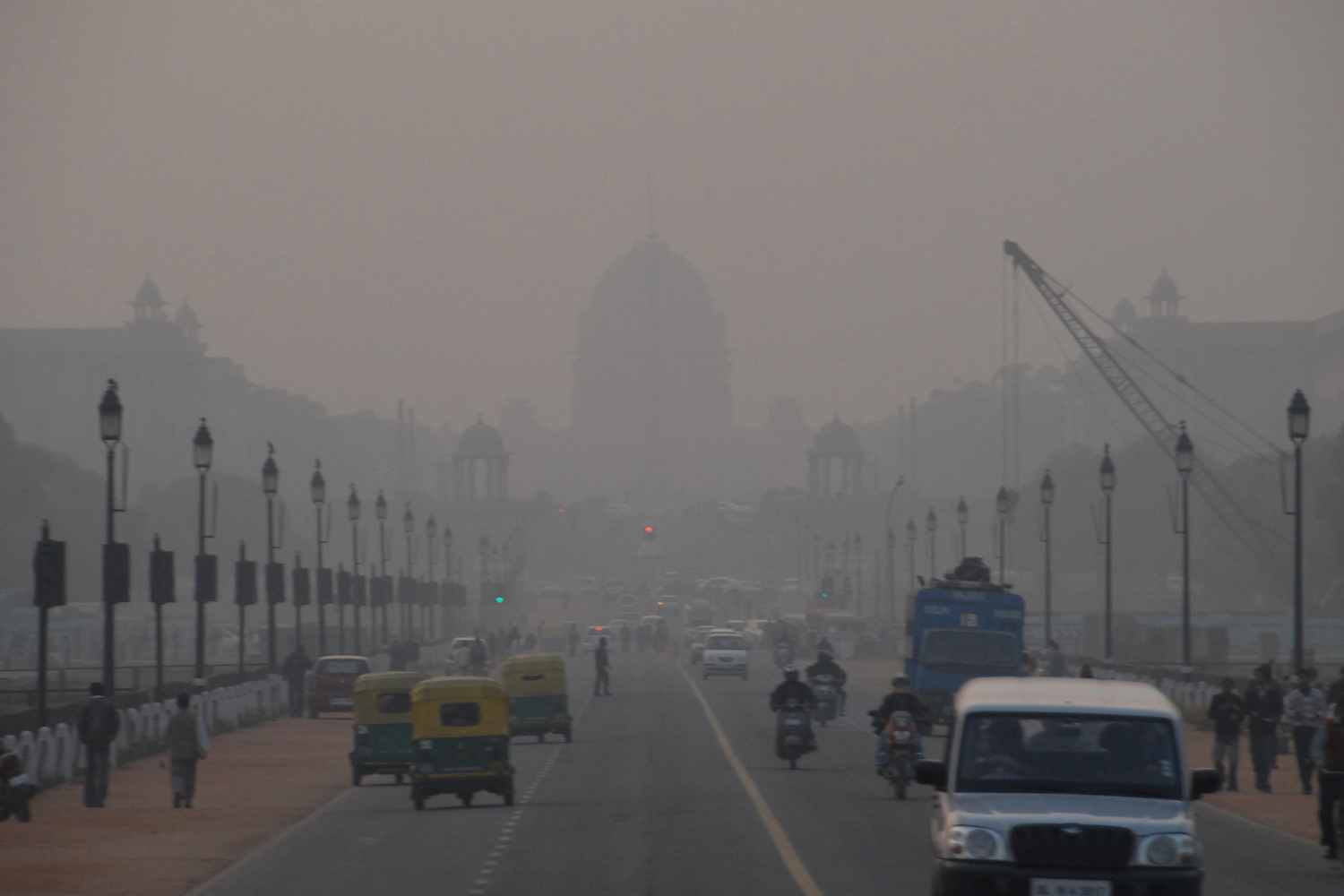
Delhi is trying to change its relationship with one of its most chronic problems: air pollution. The Indian capital, which for years has consistently ranked at the top of the world rankings of the cities most suffocated by smog, has launched a plan that aims to accelerate the spread of electric vehicles through economic incentives, tax breaks and a calendar of bans intended to redesign urban mobility.
The strategy is to reduce the burden of traffic on city emissions by intervening precisely on the largest segment of the fleet. According to Reuters, the local government will invest 150 billion rupees, equivalent to about $1.59 billion, over the next four years to support the transition to electric, finance new charging infrastructure and encourage the purchase of battery-powered cars, scooters, motorcycles and small commercial vehicles. Among the most relevant measures is a contribution of over 1,000 dollars intended for those who scrap a car purchased before April 2020 to replace it with an electric model. Added to this are the exemption from circulation tax and registration costs and incentives also dedicated to two-wheeled vehicles. Hybrids, however, remain excluded from the new policy.
A city that doesn’t breathe
Mobility is only part of Delhi’s environmental problem, but it is a crucial part. In fact, the pollution of the capital depends on several factors: emissions due to the combustion of agricultural residues in neighboring states and the dust produced by intense construction activity are added to the exhaust gases. During winter, atmospheric conditions favor the stagnation of pollutants, transforming the city into an open-air gas chamber. Reuters reminds us that in this season air quality reaches the most critical levels.
According to data reported by Guardianvehicle emissions represent on average 23% of the city’s air pollutants. It is a sufficient share to explain why the government has decided to concentrate its intervention here, setting the objective of electrifying at least 30% of the vehicle fleet by 2030.
Incentives and prohibitions
The plan, however, is not limited to bonuses. The most significant innovation concerns the progressive abandonment of traditional engines in the segments that characterize Delhi’s traffic. From 2027 only small trucks and electric rickshaws will be registered, while from 2028 the same principle will apply to scooters and motorcycles. In the meantime, over 30 thousand public charging points will be installed, one of the main requests made by sector operators in recent years.
For Amit Bhatt, director general of the International Council on Clean Transportation, the gradual elimination of two- and three-wheeled vehicles with traditional engines could represent “a turning point in Delhi’s fight against air pollution”. Accelerating the spread of zero-emission vehicles, he noted, means significantly reducing emissions from traffic and improving public health.
The transition also affects people
The government’s announcement, however, also leaves many questions open. For millions of workers who drive rickshaws and scooters every day, the transition to electric doesn’t just depend on economic incentives. What matters is the autonomy of the vehicles, the charging times, the maintenance costs and the possibility of continuing to work without losing precious hours.
“I’m not against change and making the air cleaner, but I hope we won’t be the ones to pay the price,” Rajesh Gopi, a rickshaw driver, tells the Guardian, expressing fear that the stops needed to recharge the vehicle could result in a loss of daily income.
Even some environmental organizations urge us not to consider electrification as a sufficient solution. Bhavreen Kandhari underlines that “having more cars on the road is not a solution” and calls for accompanying the transition with a decisive strengthening of public transport and last mile connections, so as to truly reduce traffic, congestion and emissions.
This is probably the most interesting aspect of choosing Delhi. The city attempts to intervene on one of the main sources of urban pollution through a policy that combines incentives, investments and rules. It remains to be seen whether the pace imposed by the government will be compatible with the needs of millions of citizens who do their job with mobility every day.
