
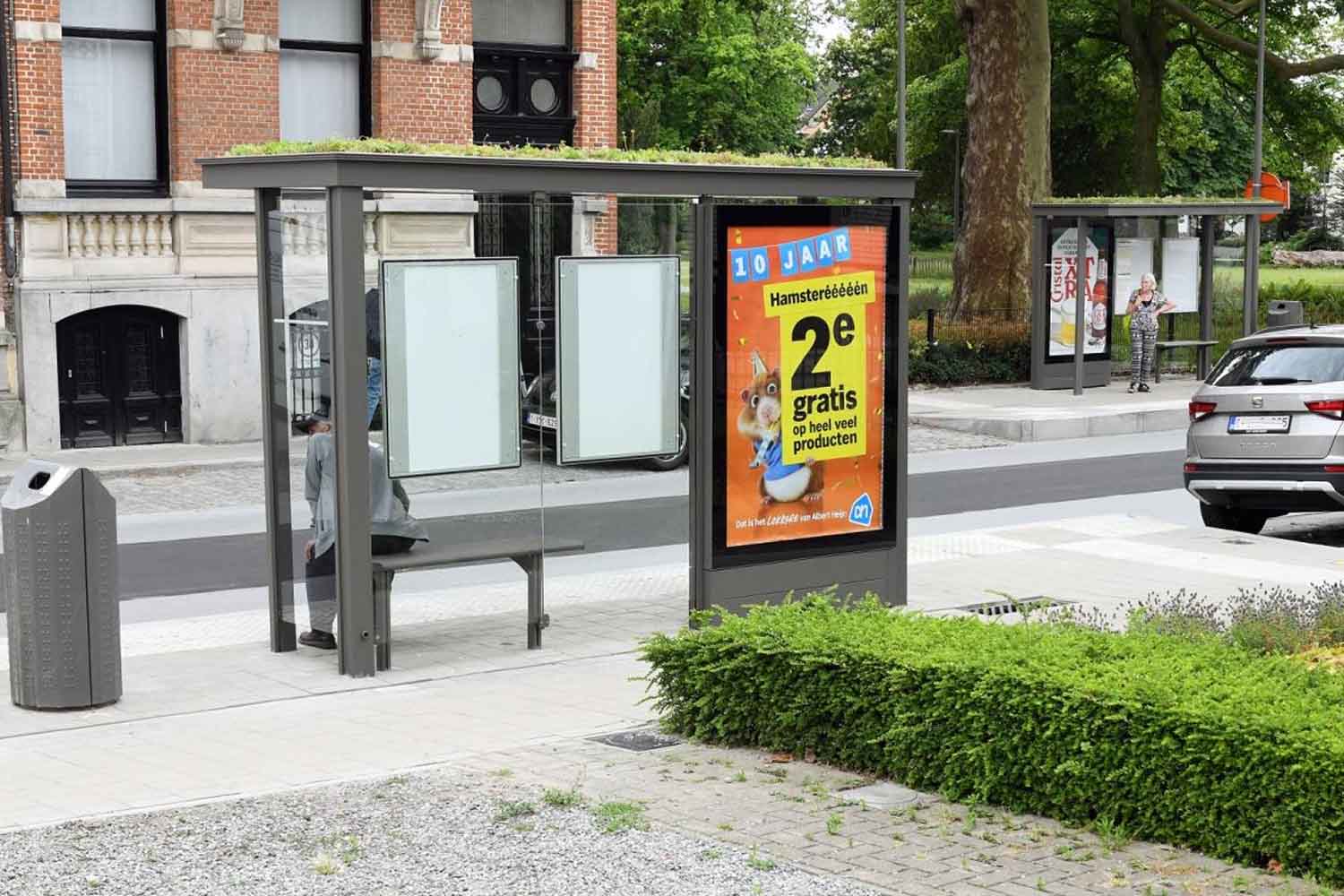
A bus stop usually enters the day from the most boring part: the wait, the delay, the rain coming from the side, the bag clutched to your chest, the phone checked every thirty seconds. In Belgium, however, some sustainable shelters are changing the role of these seemingly minor urban objects. They remain places of passage, of course, with people getting on, getting off, puffing, looking at the time. But they are also starting to retain water, support greenery, reduce waste, and lighten the city’s daily work a little.
The most evocative story talks about stops capable of collecting rainwater from the roof and reusing it to wash public spaces or water nearby plants. The documented part leads in the same direction, with less postcard tones and more of real maintenance: in Belgium, street furniture operators declare the use of rainwater to clean their structures, with a reduction in water consumption of 50% per wash, together with the introduction of recyclable shelters, solar lighting and green roofs.
View this post on Instagram
The rain stays there
The mechanism has an almost annoying simplicity, the kind that makes you wonder how many things are still designed, leaving what could be needed slip away. The rain falls on an already present surface, the roof of the shelter. From there it can be retained, slowed down, absorbed by vegetation or conveyed for service uses. Clean, irrigate, cool a minimum, prevent every drop from immediately ending up in the drains during a downpour.
In Kontich, a Flemish municipality south of Antwerp, the new passenger shelters planned are equipped with green roofs made of sedum, a resistant and low-maintenance succulent plant. These small suspended gardens help retain rainwater, reduce fine dust, counteract heat islands and offer support to pollinating insects such as bees and butterflies. It seems like little, because we are used to imagining sustainability only when it has monumental dimensions. In the city, however, he often works in a few square meters.
The same logic also appears in public transport services in Brussels, where almost three out of four vehicle washes use rainwater or recycled water. Here the bus stop stops being just a shelter and is part of a broader reasoning: buildings, depots, vehicles, street furniture, cleanliness, energy. All small, dirty pieces from everyday use, much more interesting than the promises polished at conferences.
A very practical thing
Sustainable shelters work because they lower the tone. No revolution to be inaugurated with golden scissors, no technological miracle to be described with inflated words. There is a roof. Water falls. That water is retained or reused. Plants capable of withstanding heat, wind, dust, bad days and limited maintenance can grow around it. The city receives a little relief right where it usually accumulates concrete, asphalt and nervous waiting.
The beautiful thing is in its normality. A stop remains a stop, with the shelter, the bench, the advertising, the display, someone who arrives running just as the bus closes the doors. But above that ordinary scene there may be a vegetal layer that retains rain. Next to it, a cleaning system that uses less drinking water. Inside, a more careful form of design. Useful innovation often looks like this: it does its job without asking for applause.
In a Europe that alternates drought, water bombs and increasingly hotter cities, even street furniture becomes a surface to be rethought. It’s not enough to plant a few decorative flowerbeds and call it an ecological transition. We need objects that can withstand real use, maintenance, dirty rain, vandalism, the July sun, municipal budgets. A shelter with a green roof or water recovery makes sense precisely because it lives in the midst of all this, outside the clean images of the renderings.
You might also be interested in:
