
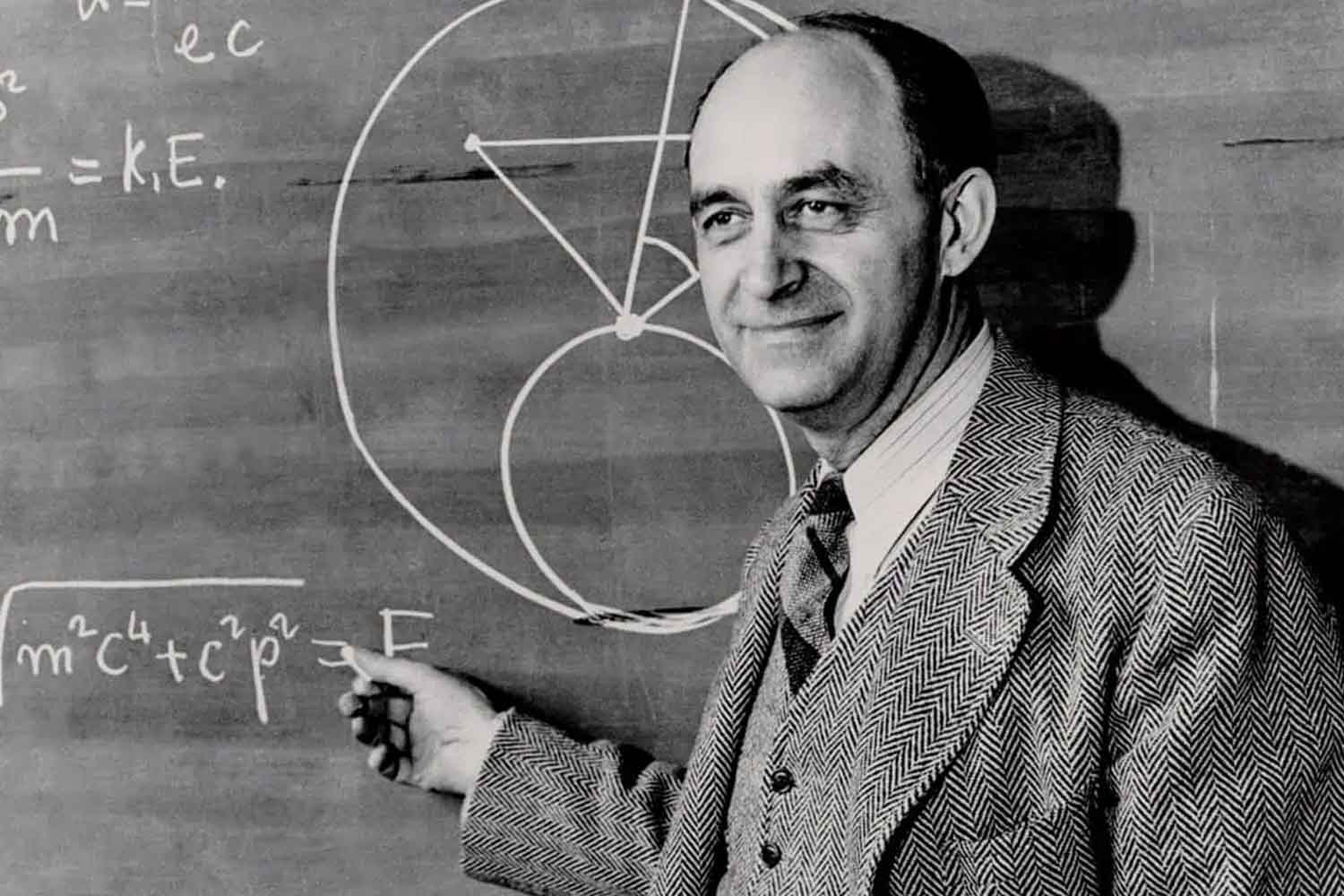
In the New Mexico desert, on July 16, 1945, Enrico Fermi had a few pieces of paper in his hand. A few kilometers away from him the Trinity Testthe first nuclear detonation in history. Fermi, Italian physicist and Nobel Prize for Physics in 1938made an almost banal gesture: he dropped those pieces of paper as the shock wave arrived towards him and observed how far they were moved by the air.
From that movement he obtained an estimate of the power of the explosion: approximately 10 kilotons of TNT. One kiloton is equivalent to the energy released by one thousand tons of TNT. Subsequent reconstructions have placed the real value of the event higher, often around 20-25 kilotons, with a radiochemical estimate indicated in the literature around 25 ± 2 kilotons. His rating was low, sure. It remained in the same order of magnitude, obtained without sophisticated instruments, in front of something that no one had ever seen before.
From this ability was born what we call today Fermi problems. These are questions that seem impossible: how many piano tuners work in Chicago, how many golf balls fit in a school bus, how many cups of water holds an Olympic swimming pool, how many smartphones are turned on in the world. At first glance, everything is missing. Then you take a piece of paper, divide the question into smaller parts, make educated guesses and arrive at a number that is solid enough to orient yourself.
A good estimate is worth more than a perfect number
A Fermi problem thrives on approximations. The exact answer is of interest up to a certain point. What matters is the way in which the reasoning is constructed, step by step. You start from what you know, add what you can estimate, round it up, then look at the result with a little distrust.
The particle physicist Stefan Funkwho taught a course on back-of-the-envelope calculations at Stanford, insists on just this: an estimate off by a factor of two or three is still acceptable. An estimate that is off-scale by twenty orders of magnitude signals that the logical chain has broken.
Take the case of piano tuners. You can start from the population of Chicago, imagine how many families have a piano, add schools, theaters and rehearsal rooms, estimate how often an instrument is tuned and how many visits a tuner can make in a year. At the end a number appears. Imperfect, perhaps. Useful, however, because it shows if we are in the right order of magnitude.
The famous example has also become conversation material at tech companies. Wired used it to explain open-ended questions like Chicago piano tuner: they don’t look for an answer learned by heart, they look for a mind capable of moving in uncertainty.
The same goes for an Olympic-sized swimming pool. Simple measurements are taken: 50 meters long, 25 meters wide, about 2 meters average depth. The volume reaches 2,500 cubic meters. Each cubic meter contains 1,000 litres, so we are at 2.5 million litres. Converting to cups, the result is close to 10 million cups of water. The actual depth can change, the cups have different sizes, the number fluctuates. The reasoning, however, holds up.
The mathematics you need when data is missing
THE Fermi problems they restore dignity to the approximation. In a world full of figures pronounced with enormous confidence, they train us to ask ourselves whether a number is proportionate to reality. A quantity may seem gigantic and yet be small compared to the phenomenon it is talking about. A percentage may appear modest but instead reveal a huge shift.
For this reason they also enter teaching. The National Council of Teachers of Mathematicsone of the main US associations dedicated to mathematics teaching, presents them as useful tools for developing quantitative thinking, problem solving and connections between different disciplines. They work because they force you to think before looking for a formula.
In class, asking how many steps it takes to cross Italy from north to south can become an exercise on distances, units of measurement, average step length and checking the result. Asking how many pizzas a city eats in a year brings in population, habits, frequency of consumption, commercial activities, margins of error. The question seems light. The brain, on the other hand, works seriously.
Fermi remains the perfect figure to tell all this. Born in Rome in 1901, protagonist of the Italian physics of via Panisperna, then moved to the United States, in 1942 he led the group that obtained the first self-sustaining nuclear chain reaction created by man, under the stands of the Stagg Field of the University of Chicago, inside the structure that went down in history as Chicago Pile-1.
His skill in estimating speaks to a very portable form of intelligence. You don’t need a laboratory. You need to learn to live with incomplete information, distinguish a reasonable guess from a fantasy and check whether the result resembles the real world.
How to use the Fermi method
The first step is to write. The head skips steps, confuses numbers, convinces itself that it remembers data it never knew. A sheet forces you to stay honest. The question is written down, then a chain of simple hypotheses is constructed: “let’s consider two people per family”, “let’s imagine one tuning per year”, “let’s use an average depth of two metres”.
The second step is rounding. In Fermi problems, round numbers help. Three million are handled better than 2,746,388. Five hundred interventions a year are displayed better than 487. Ten million cups remain more useful than a result full of decimals.
The third step is to check the scale. If a huge city produces, by our count, two piano tuners or two hundred thousand, we have to go back. If a swimming pool contains a water bottle or an ocean, the error lies in the transition between units of measurement. This final check is as valuable as calculation, because it trains you to recognize absurd numbers before they become convincing.
The charm of Fermi’s problems lies right there: they teach us to make mistakes in a reasoned, transparent and correctable way. Two people can arrive at different results and discuss hypotheses, not argue about the final number. It’s an exercise in mental hygiene. Not very spectacular, very useful.
Fermi did it in front of an atomic explosion, with pieces of paper dropped into the desert air. We can do it in front of a figure read in a hurry, a technological promise, a public expense, a strange question at dinner. A pen, a piece of paper, some round numbers. Often it is enough to bring order to the chaos.
