
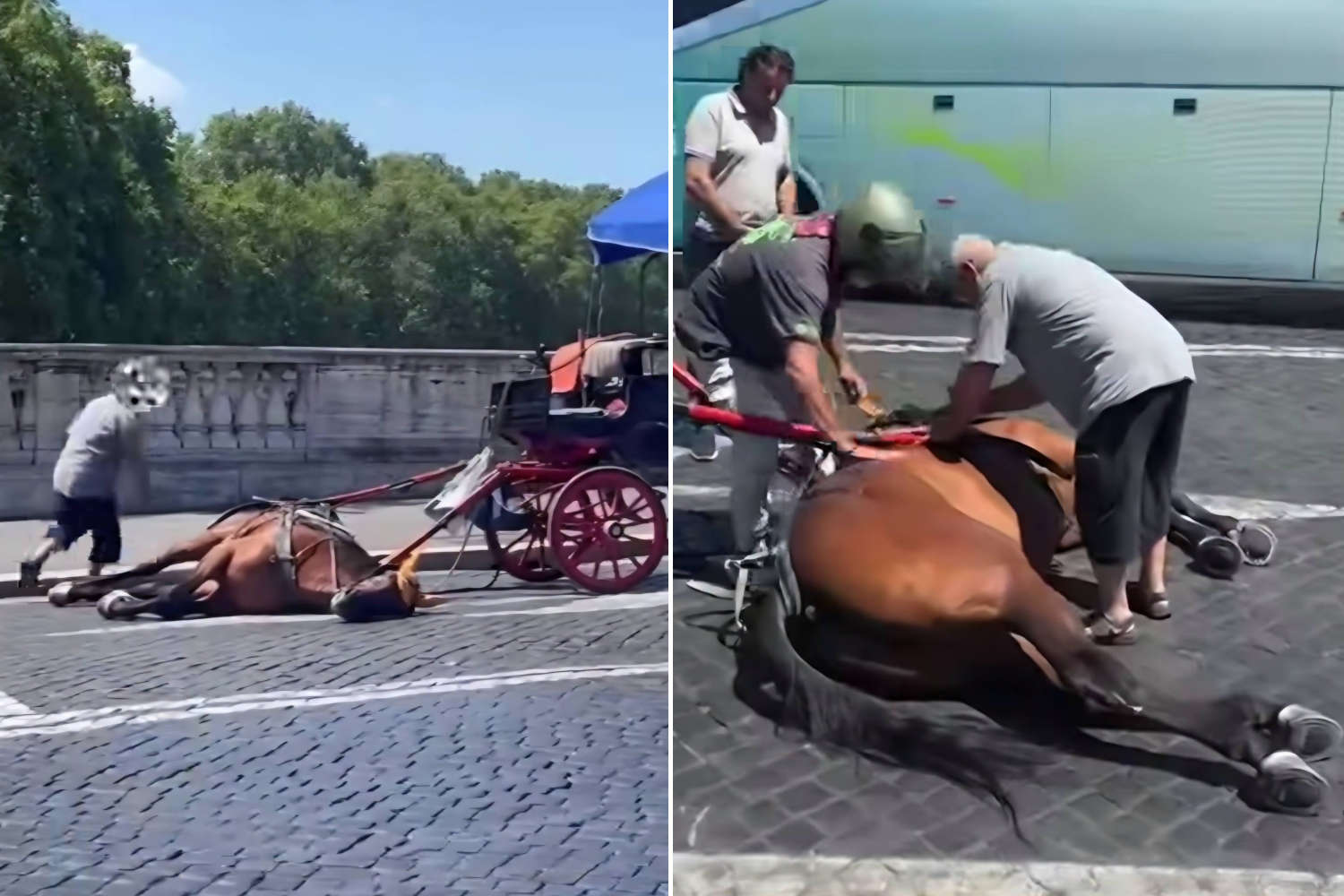
A powerful and painful image has once again shaken the center of Rome, transforming the hot asphalt into a terrain of political and civil conflict. On Saturday 4 July, around 11.30am, a horse used to pull the historic barrels fell to the ground on Ponte Cavour, collapsing in the middle of city traffic under the astonished eyes of passers-by and foreign tourists.
The animal, crushed by a lethal mix of fatigue and Saharan temperatures, remained motionless on the pavé, while the driver clumsily tried to pick him up and some motorcyclists stopped to provide first aid and caress the exhausted beast. Although the driver downplayed the incident by talking about a badly hooked iron, the video of the collapse immediately made the rounds on social networks, raising a wave of general indignation.
Political convergence against animal exploitation
The episode triggered an immediate and transversal reaction in the Capitol, overcoming traditional ideological barriers in the name of protecting animal rights. Rachele Mussolini, Rome group leader of Forza Italia, reposted the images, speaking of a ten-year battle that must not have a political colour, defining it as intolerable to consider a sentient being as an object to be exploited.
On the same wavelength is Patrizia Prestipino, exponent of the Democratic Party and guarantor for the protection and well-being of the animals of Rome Capital, who has forcefully reiterated that the Capital, with its chaotic traffic and its torrid summers, is no longer an environment biologically compatible with the presence of horses.
The Capitol’s plan for the last cabmen
The administrative solution to put an end to this practice, now considered anachronistic by much of public opinion, is already ready on the Municipality’s table. The council’s objective is to eliminate the presence of animal-drawn vehicles through the conversion of licenses. The plan provides for the transition of the approximately sixteen coachmen remaining in Rome to the public road service. Operators will be guaranteed taxi licenses completely free of charge and cars will be supplied at no cost directly by some car manufacturers that have already made themselves available, thus protecting the employment future of families without burdening their finances.
Zero tolerance and tight controls by the Local Police
Despite attempts at mediation, the resistance of part of the category remains strong, anchored to old logics of tourist attraction and tradition. For this reason, Prestipino announced that he had officially requested the heads of the Local Police of Rome Capital to drastically strengthen road checks. In the next few days, tight controls will take place which will monitor every single carriage to verify not only the rigorous compliance with the highway code and the tax regularity of the receipts, but above all the health conditions and the workload imposed on the animals on the city’s hot pavement.
The activists’ cry of alarm: “This is not tradition”
Also giving voice to the profound indignation of civil society is the National League for the Defense of Dogs (Ostia branch), which through a harsh social media statement summarized the anachronism of this suffering in the heart of 2026. The activists underlined how it is simply unacceptable and unworthy for the Italian capital to continue to tolerate such scenes, reiterating that forcing animals to tow tourists in suffocating heat has nothing to do with folklore. The association’s message is clear and leaves no room for compromise: it is not about preserving a historical tradition, but about stopping once and for all (and everywhere) a dynamic that translates exclusively into exploitation and agony.
You might also be interested in:
