
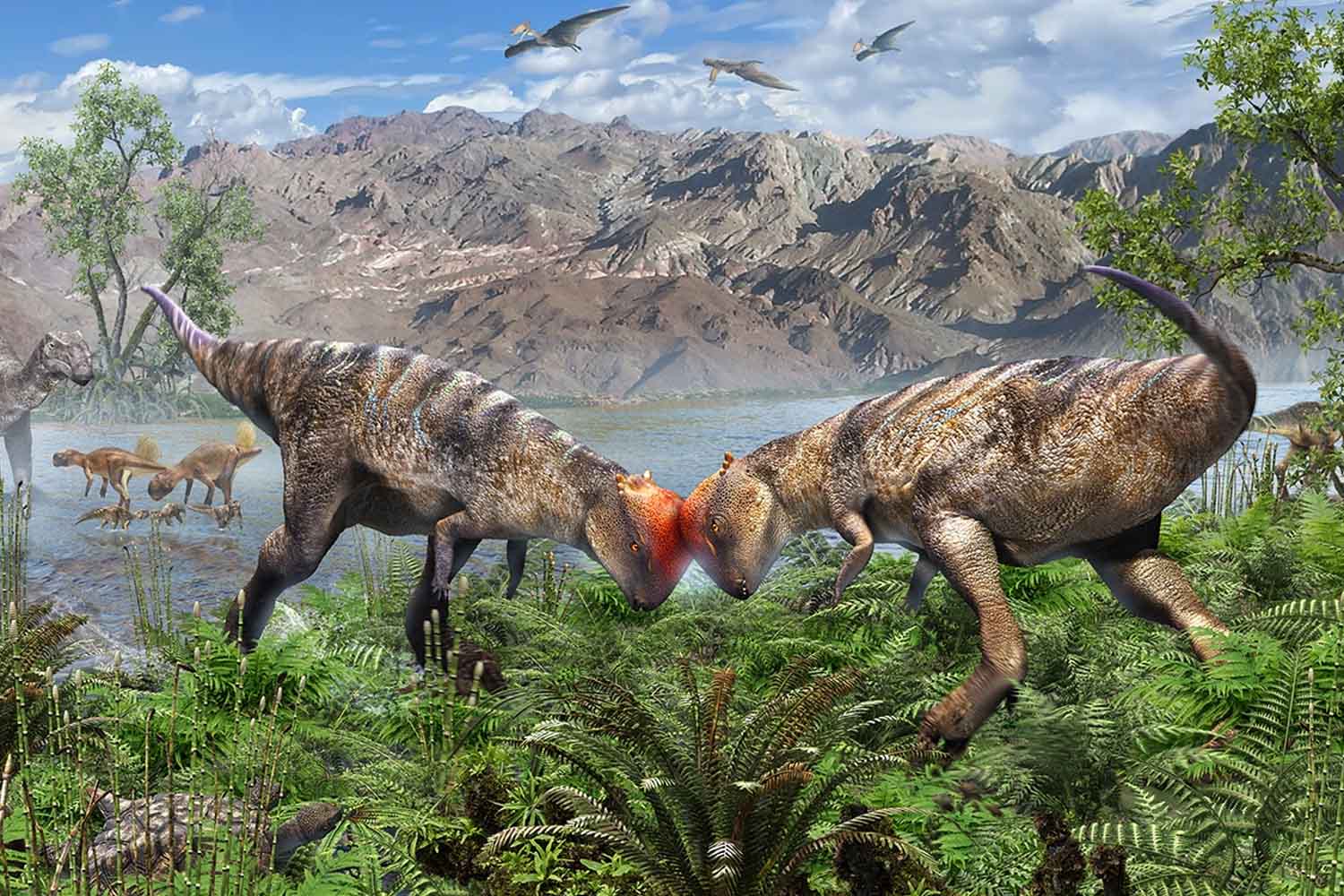
From a rock face in the Gobi Desert protruded a smooth, rounded surface, similar to a polished stone. Under that small portion of bone was hiding one of the most important fossils ever found for reconstructing the history of dome-headed dinosaurs.
The new species is called Zavacephale rinpoche and lived in approximately present-day Mongolia 108 million years agoduring the Lower Cretaceous. Its skeleton represents the oldest and most complete pachycephalosaur known so far and anticipates the certain fossil evidence of the appearance of the characteristic cranial dome by at least 14 million years.
The finding was described in the scientific journal Nature by an international group of researchers led by Mongolian paleontologist Tsogtbaatar Chinzorig, from the Mongolian Academy of Sciences and North Carolina State University.
A dinosaur the size of a dog
The specimen was still young when it died. He measured less than a meter from head to tail and therefore had dimensions comparable to those of a small dog. It walked on two legs, had short forelimbs and probably ate vegetables.
The comparison with a Miniature Tyrannosaurus rexsuggested by the general shape of the body, however risks confusing very different animals. T. rex belonged to the group of carnivorous theropods and appeared tens of millions of years later. Zavacephale was instead a small herbivorous dinosaur belonging to the pachycephalosaurs.
These animals are best known for their very thick skull roof, formed by the expansion of the frontal and parietal bones. In the larger species that lived towards the end of the Cretaceous, the dome could reach considerable thicknesses. The skull of little Zavacephale was naturally smaller, even if the rounded structure was already clearly recognizable.
The fossil comes from Khuren Dukh Formationin the eastern Gobi basin. Today the area appears arid and severe, while in the Cretaceous it was a valley crossed by waterways, with lakes, vegetation and rocky walls. Fine sediments covered the animal’s body and preserved a very rare quantity of bones for this group.
The most complete skeleton ever found
Much of the knowledge about pachycephalosaurs comes from skull fragments. Their domes were sturdy and more likely to fossilize, while the lighter bones of the body could scatter, deteriorate, or be washed away. With Zavacephale rinpoche something very different happened. The find preserves the skull, numerous vertebrae, the scapula, the humerus, parts of the front legs, the pelvis, the femur, the tibia, a long articulated section of the tail and other elements of the skeleton.
They were also recovered bones of the handsnever before documented with this precision in a pachycephalosaur. The fossil therefore offers paleontologists the possibility of studying the entire animal, going far beyond the dome which makes it immediately recognisable.
Some also appeared next to the bones gastrolithssmall stones swallowed. Several herbivorous dinosaurs and some modern animals use them to help break down food within the digestive system. It is the first time that such stones have been found directly associated with the skeleton of a pachycephalosaur.
The finding thus allows us to connect anatomy, nutrition, age and cranial development in the same individual. A particularly precious circumstance for a family of dinosaurs often known through isolated and difficult to compare fossils.
The dome grew before the rest of the body
The researchers examined paper-thin sections of the tibia and skull roof. The internal structure of the bones and the signs left by growth indicate that the specimen was still immature and had not reached its final size.
Its dome, however, was already well developed. According to the study published on Naturethe formation of the cranial structure began mainly from the frontal bone, while the openings located in the back part of the skull, called supratemporal windows, still remained open.
The pattern resembles that reconstructed in young specimens of pachycephalosaurs that lived during the Upper Cretaceous. The discovery therefore suggests that this growth mode appeared very early in the group’s evolutionary history.
The analysis also shows a separation between the growth of the body and the development of structures likely involved in social and reproductive life. Simply put, young Zavacephale already possessed a noticeable dome despite still having a lot of growing to do.
This difference may help solve a problem that has long accompanied the study of pachycephalosaurs. Two skulls with different shapes could belong to different species or represent different ages of the same species. Having a skull associated with the limbs allows you to compare the maturation of the dome with the growth rings present in the leg bones.
Did they really headbutt each other?
Paleoartistic reconstructions often show pachycephalosaurs facing each other by hitting each other head-on, similar to rams. The compact dome, some lesions observed on the fossils and the comparison with modern animals make the existence of clashes between individuals plausible.
However, the precise function of this structure remains debated. The head could be used in fights, in lateral confrontations or as a visual signal to show age, strength, species membership or sexual maturity.
The authors talk about structures linked to possibilities sociosexual dynamicsavoiding transforming a plausible hypothesis into an already proven scene. No direct evidence emerges from the fossil of two Zavacephales engaged in hitting each other. However, it remains clear that the dome appeared early and must have played an important role well before reaching adult size.
The still relatively simple shape of the skull also helps to reconstruct how the more complex ornaments observed in later pachycephalosaurs evolved. Upper Cretaceous species may have had nodules, spikes, and bumps distributed along the back and sides of the head. Zavacephale shows an older phase of this path.
Because he is called Zavacephale rinpoche
The name of the genus unites zavaa term that recalls the root or origin, e cephalederived from Greek and linked to the word “head”. The epithet rinpocheused in the Tibetan and Mongolian tradition, means “precious”.
The reference comes from the way the fossil appeared to researchers. The dome emerged from the wall like a cabochona polished and faceted precious stone. Behind that emerging surface, almost all the rest of the animal had been buried for millions of years.
Chinzorig commented on the discovery at North Carolina State University:
Zavacephale predates all pachycephalosaur fossils known to date by about 15 million years.
A temporal distance that changes the chronology of the group and shows how much its characteristic anatomy was already developed in the Lower Cretaceous.
The little Gobi dinosaur still had the body of a growing animal. On his head he already wore the trait that would make his entire family famous. It remained inside the rock for 108 million years, with its dome facing outward, like a stone left there to be found.
