
On construction sites, the excavated earth often has a pre-written destiny: it is removed, loaded onto trucks, taken elsewhere and treated as a burden. It happens when preparing foundations, basements, underground car parks, new infrastructures. Mountains of material that come out of the ground and become a logistical problem even before an environmental one. Yet that very earth, mixed with a substance obtained from algae and also used in the food industry, could be transformed into a material for 3D printed houses.
A research team led by the University of Colorado Boulder studied a mixture composed of clay, sand and sodium alginate, a biopolymer extracted from algae. The result is a dough that is easier to push through a 3D printer’s nozzle, more stable during deposition, and stronger than additive-free soil. The research, published on Nature Communicationsstarts from a very concrete question: how to make the earth a digital construction material without distorting it, without filling it with cement, without transforming it into yet another industrial product disguised as a green solution.
The lesson comes from termites, wasps and marine worms
The trail followed by researchers comes from long before 3D printers. Termites, wasps and some marine worms build complex structures with poor and nearby materials: soil, mineral particles, biological secretions. Termites raise large mounds of earth, wasps shape light and resistant nests, honeycomb worms assemble small coastal architecture similar to cliffs. None of these animals use concrete. The binder comes from biological molecules, often present in saliva or natural secretions, capable of holding clay and mineral granules together.
Hence the work coordinated by Wil Srubar, professor of the Department of Civil, Environmental and Architectural Engineering at the University of Colorado. The idea was to understand with scientific instruments what earth construction has been doing for millennia, often through experience, attempts and local traditions. Raw earth belongs to the history of human living, from adobe to rammed earth walls. The novelty lies in bringing it into a 3D printing process with sand, where each mixture must respect very precise conditions: come out regularly from the nozzle, maintain its shape, support the weight of the subsequent layers, dry with as few cracks as possible.
The team tested five biopolymers. Three come from legumes: guar gum, locust bean gum and cassia gum, substances also known as food thickeners and stabilizers. To these were added xanthan gum, obtained from the fermentation of sugars, and sodium alginate, extracted from algae and also used to give a creamy consistency to some foods, including ice cream. A curious relationship, of course, but the technical point is another: each biopolymer changes the behavior of the clay and sand mixture in a different way.
Some binders hold particles together too tightly. Locust bean flour, for example, creates a more compact mesh, useful for resistance, but inconvenient when the dough must pass fluidly through a printer. Sodium alginate behaves differently. It acts on the electrical charges of the clay particles, makes them repel each other and keeps the mixture more stable, without making it too hard to extrude. A microscopic correction which, in practice, decides whether the material flows or blocks.
Sand matters more than expected
In many building mixtures sand is treated as a mass, volume, filler. In this study he changes role. Its surface, with its electrical charges, influences how the biopolymers bond to the particles and how the entire slurry reacts during printing. The sand therefore becomes a design lever, a variable to be dosed and read carefully, not an ingredient put there just to create body.
The best formulation came with a minimal amount of sodium alginate: just 0.12% added to natural soil taken from a granite quarry near Golden, Colorado, a town in the foothills of the Rocky Mountains. With that very low dose, the mixture withstood up to 25% more pressure than untreated clay and printed 33% faster. Shrinkage during drying was also reduced by approximately three quarters. For an earthen wall this detail weighs a lot, because less shrinkage means fewer cracks, less deformations and a more reliable structure as it dries.
To test the workability of the material, the researchers printed a wall about 8 millimeters thick, inclined outwards at very sharp angles. The structure remained standing even with a slope of 60 degrees, more pronounced than that of the Tower of Pisa. The work mainly concerns printability, therefore the ability of the material to be used in a controlled additive process. More extensive tests on durability, resistance to atmospheric agents, behavior over time and adaptation to different terrains can start from here.
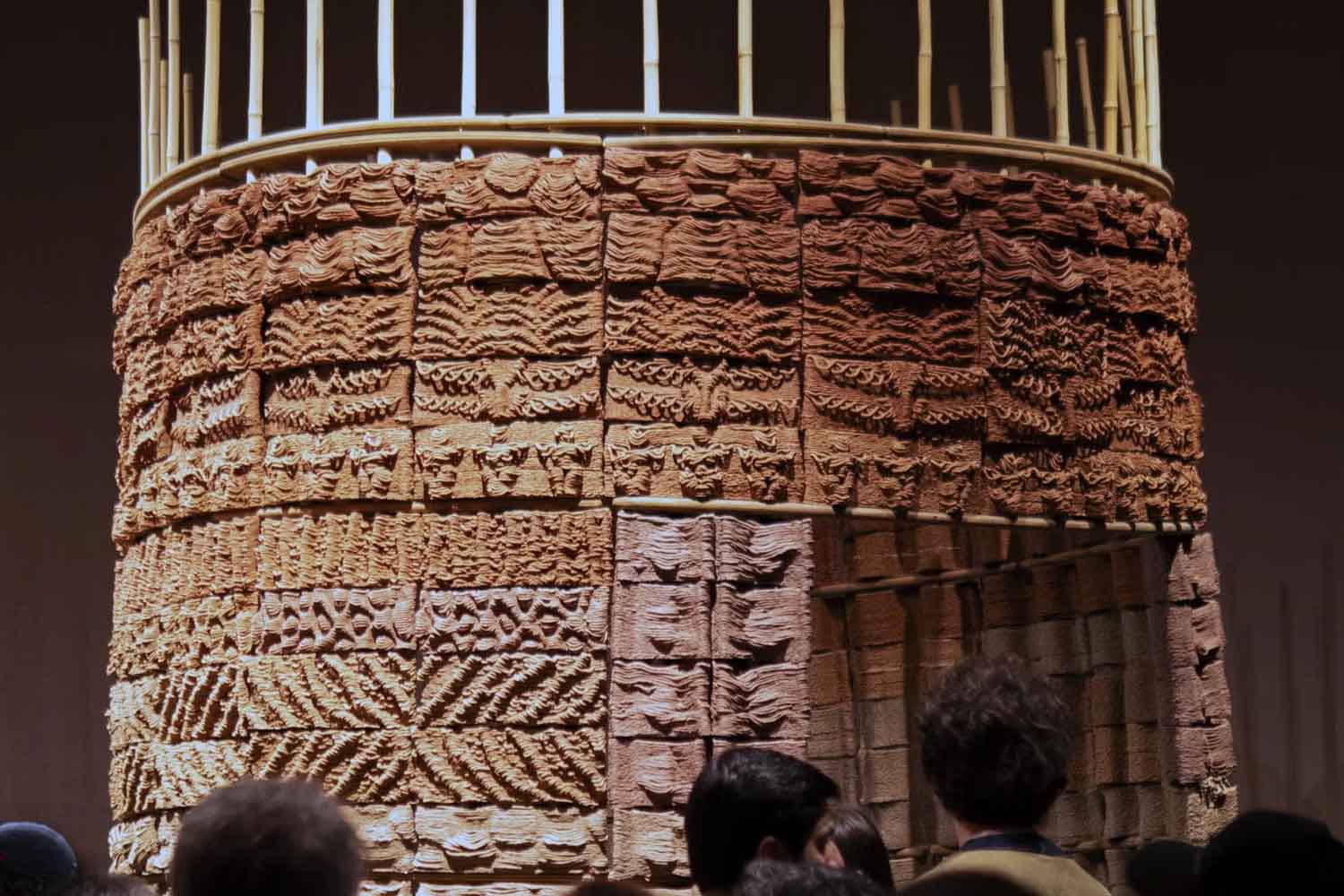
The research also dialogues with architectural experiences already visible outside the laboratory. At the 2026 Venice Architecture Biennale, the Earthen Rituals installation showed structures made of 3D printed earthy materials, developed by Lola Ben-Alon and the Natural Materials Lab. An exhibition context, of course, with all the distance that separates an installation from an inhabited building. But the transition is interesting: 3D printed earth is entering the lexicon of design, it does not remain confined to the prototype closed in the laboratory.
When the waste remains on the construction site
The environmental strength of this research lies in the source material. Clay and sand are among the most widespread resources on the planet. Excavated earth, on the other hand, is a constant presence on construction sites and often becomes waste to be managed. According to the European Commission, construction and demolition waste represents more than a third of all waste generated in the European Union. This enormous flow also includes earth and rocks from excavation, heavy, bulky materials that are expensive to move.
The Joint Research Center of the European Commission estimated that excavated soil and dredging sludge accounted for 23% of the Union’s total waste in 2020. A huge share. Every cubic meter reused on site means fewer trucks, fewer deliveries, less virgin material to extract and transport. This is why the mixture studied in Colorado is of interest beyond the laboratory: it offers a possible way to make part of the land remain where it already is, transforming it from a problem into a resource.
Samuel Armistead, researcher in the same department, underlined precisely this aspect: the possibility of reusing waste earth directly on site and reducing the environmental footprint of constructions. In a sector still very tied to energy-intensive materials, from concrete to steel, even a partial solution can open up space. 3D printing with soil and algae does not on its own replace conventional construction, but it can enter into some applications, especially where the local material has suitable characteristics and where the project allows the use of soil components.
Furthermore, earthen walls have qualities that contemporary construction is once again looking at with interest. They can help regulate indoor humidity, absorb some pollutants in the air and function as thermal mass, helping rooms stay cooler during the summer and more stable in the cold months. These are properties that have long been known in raw earth architecture, reinterpreted here with a more controllable and replicable process.
Prudence remains necessary. A mixture that works in the laboratory and in printed prototypes still has to demonstrate a lot before becoming a widespread building material: resistance over time, behavior with different climates, technical standards, safety, maintenance, real costs, compatibility with construction site practices. But the signal is clear. Instead of treating the earth as a leftover to be taken away, research tries to give it a second function, using a minimal dose of natural biopolymer to make it more precise, more docile, more suitable for digital construction.
You might also be interested in:
