
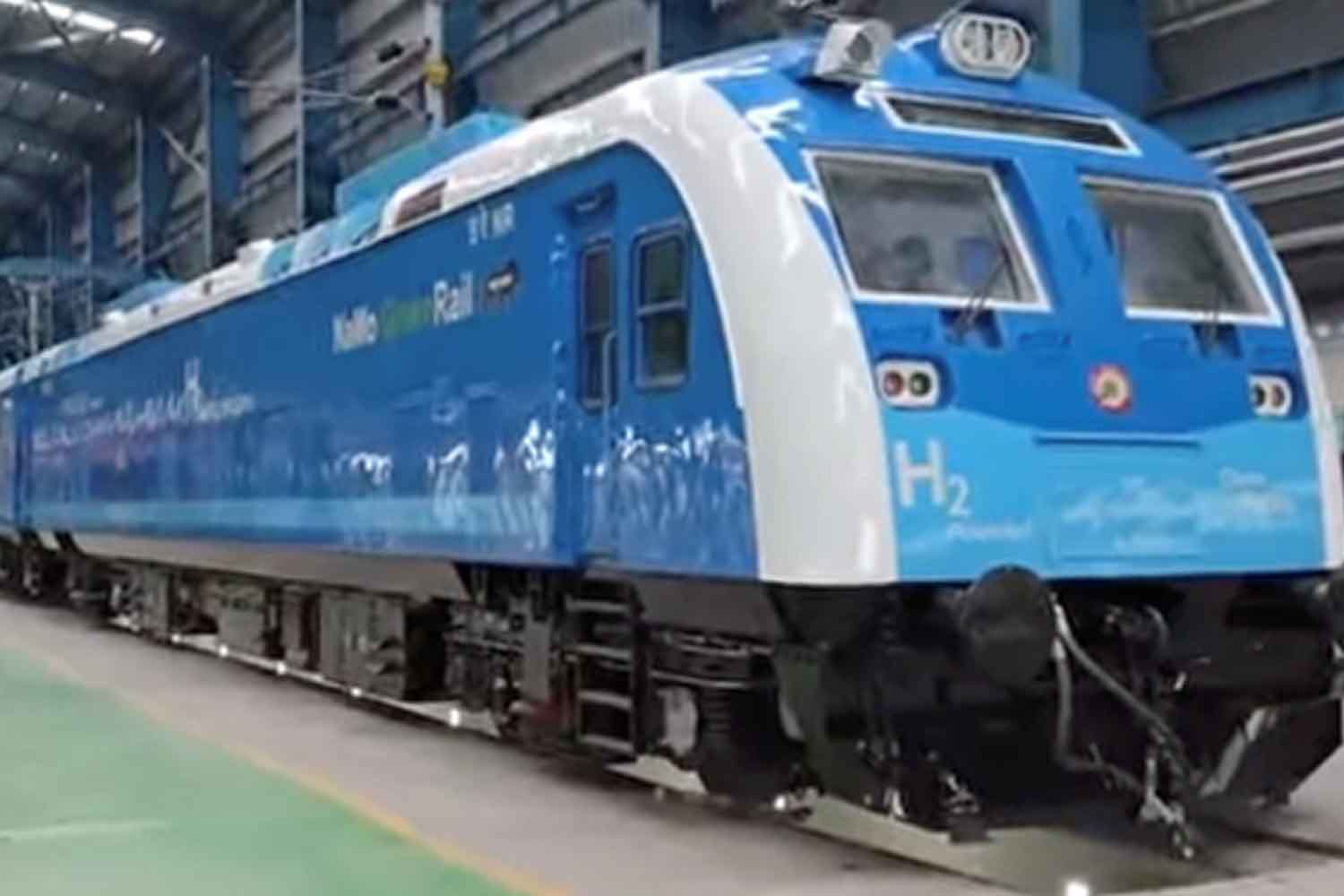
India’s first hydrogen train left Jind station in the northern state of Haryana. Ten carriages, a capacity of around 2,600 passengers and a route that passes through urban centres, villages and agricultural fields up to Sonipat, at the gates of the Delhi metropolitan area. Prime Minister Narendra Modi launched the service on July 17, 2026: with this pilot project, India joins the small group of countries that have brought hydrogen rail propulsion out of the laboratories and onto the tracks. The Government cites Germany, Japan, China and the United States. According to the technical data sheet released by the Indian Press Information Bureau, the convoy was designed, built and integrated entirely in the country.
The Jind-Sonipat route measures approximately 89 kilometers and passes through Gohana and twelve scheduled intermediate stops. The authorized speed is 75 kilometers per hour, while the project allows it to reach 110. A regional race, therefore, with times and performances far from high speed. Here the experiment concerns the engine and everything that is needed to make it work every day: refueling, maintenance, storage and safety. The glittering train to display at the ceremony was the easy part.
How the Indian hydrogen train works
There are two driving carriages and eight passenger carriages on board. PEM-type fuel cells combine hydrogen stored in tanks with oxygen from the air and produce electricity. This powers the engines and recharges lithium-iron-phosphate batteries, useful during acceleration and in moments of greatest power demand.
Heat and water vapor emerge from the reaction. During the journey the convoy does not emit carbon dioxide or the exhaust gases produced by diesel engines. In official communications this characteristic often becomes “zero emissions”; the correct definition concerns direct emissions during operation. Before ending up in the tank, hydrogen must still be produced, compressed, transported or stored.
What authorities describe as India’s largest railway hydrogen storage and refueling facility has been built in Jind. It can store almost 3,000 kilograms of compressed gas and is equipped with compressors, ventilation systems, leak detectors, flame sensors and devices capable of automatically interrupting the supply.
The infrastructure has received authorization from India’s oil and explosives regulator and has undergone an independent safety assessment. During the first phase, specialized technicians will travel on the train and the refueling facility will be monitored around the clock. With a very light gas, easily flammable and stored at high pressure, a few extra precautions don’t hurt.
The water in the drain only tells part of the story
The Indian Railways had announced in December 2025 the construction of a plant in Jind to produce hydrogen through the electrolysis of water. The Government talks about green hydrogen, linking the project to the National Green Hydrogen Mission. However, electrolysis alone does not assign any color to the gas: the climate benefit depends on the electricity used to power the process. With wind or solar energy, emissions can be greatly reduced; with a grid still supported by coal and gas, the bill goes up before the train even leaves the station.
The International Energy Agency recalls in Global Hydrogen Review 2026 that global production of low-emission hydrogen has grown, but remains little more than a niche. It approached one million tonnes in 2025 and is expected to exceed 1% of global production for the first time in 2026. High costs, uncertain demand and insufficient infrastructure continue to slow its spread. In short, water vapor is immediately visible. The climate balance requires a few more lines.
The official data sheets argue about power
Then there is a curious detail. Documentation released in May and July 2026 credits the train with a 1,200 kilowatt fuel cell system. A response from the Ministry of Railways to Parliament, published a few months earlier, instead describes two driving carriages of 1,200 kilowatts each, for a total of 2,400 kilowatts. The prime minister’s office also speaks of 3,200 horsepower, equivalent to about 2.4 megawatts.
The most plausible explanation is that some cards indicate the power of the individual drive unit and others the overall power. In public texts, however, this distinction disappears. The first Indian hydrogen train thus managed to start with two official powers. A small railway miracle, at least on paper.
A laboratory on an already almost entirely electric network
The Indian experiment comes in a particular context. As of March 2026, 99.6% of the national broad gauge network was electrified; in Haryana the tracks are already fully electrified. The hydrogen train was therefore not created to replace en masse the diesel locomotives still present on thousands of kilometers without catenary, as happens in other countries. The network to be wired in India is now down to the final sections.
The project serves above all to gather experience: to understand how much it costs to produce and distribute the fuel, how long the components last, what interventions it requires and with what reliability it is able to transport thousands of people every day. The Railways themselves define it as a pilot initiative and explain that, at this stage, comparing its costs with those of already mature systems would give little significant results. A rare prudence in communication on hydrogen, where the future often arrives before estimates.
The convoy between Jind and Sonipat demonstrates that a large passenger train can produce electricity on board using fuel cells and travel without an exhaust pipe. Now comes the less photogenic evidence: real consumption, continuity of service, costs and origin of hydrogen. The water is already on the tracks. To understand how green it is, we will need data from the next races.
