
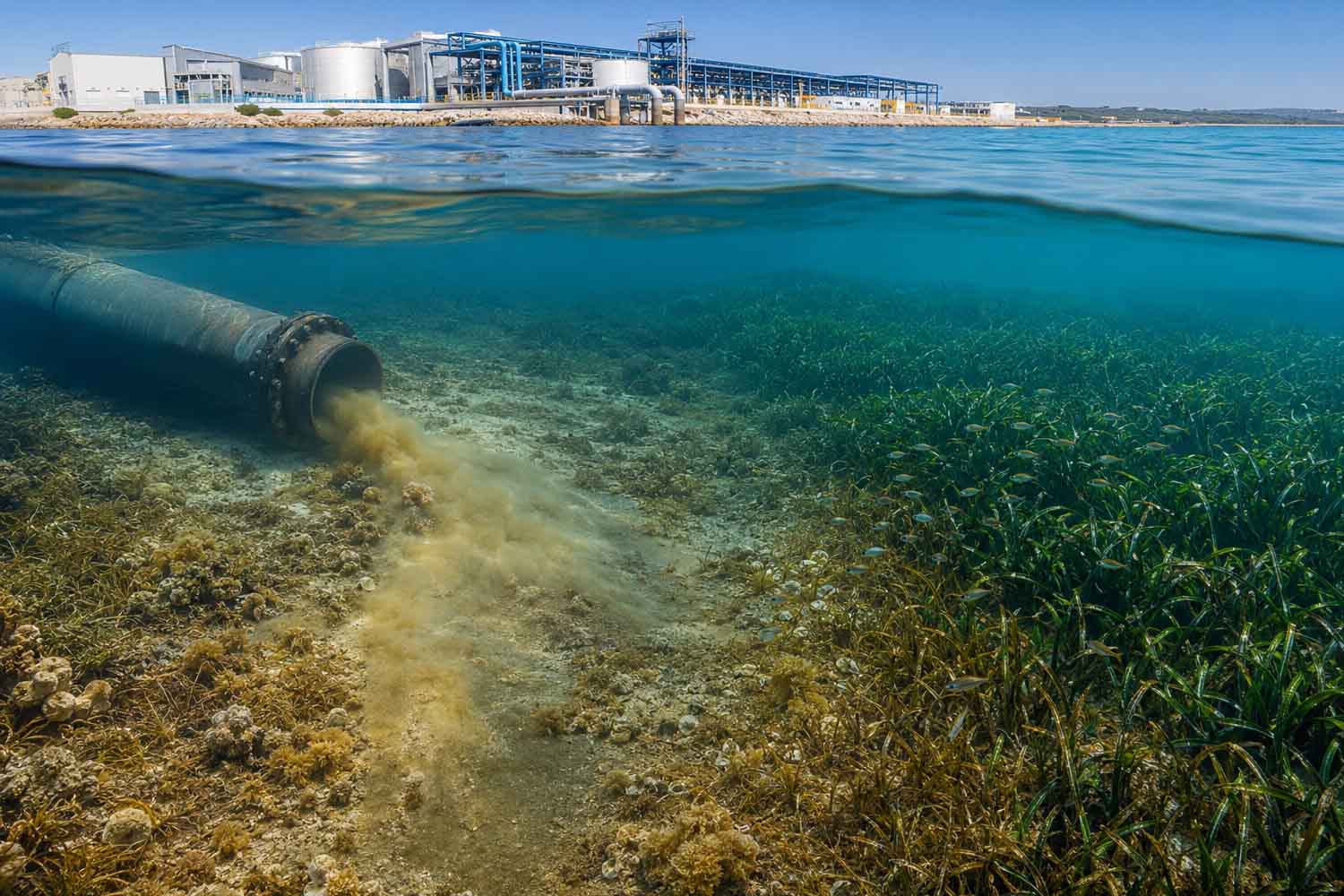
A desalination plant has two large pipes. The first draws water from the sea. The second returns what remains after separating the usable part: much saltier water, chemical residues, heat and everything that the membranes have retained. Fresh water ends up in aqueducts. The rest goes back to sea.
It’s the part of desalination that comes up short when this technology is presented as a response to drought. The sea seems like an immense reserve from which to draw in the worst moments, especially on the islands and along the coasts already dealing with empty reservoirs and aquifers under pressure. However, transforming that water has an environmental cost that remains almost entirely below the surface.
The other product of watermakers
Most modern systems use reverse osmosis. Sea water is pushed at high pressure through membranes capable of retaining salts and impurities. On the one hand, water comes out to be made drinkable. On the other hand, brine remains, a denser and saltier liquid than the water taken. For every cubic meter of fresh water a similar amount of salt concentrate can be generated. In larger structures we are talking about millions of cubic meters discharged every day.
A global study published in 2019 estimated daily production of around 95 million cubic meters of desalinated water and 142 million cubic meters of brine. 50% more than previous ratings. Saudi Arabia, the United Arab Emirates, Kuwait and Qatar alone produced 55% of these wastes.
Being heavier, the brine sinks and spreads on the seabed. In open ocean, with strong currents and deep water, it can disperse quickly. Inside a bay, in a lagoon or on a low coastal platform it tends to accumulate right where corals, molluscs, sponges, algae and marine plants live. The European Commission reports that the risk grows in closed or semi-closed basins such as the Mediterranean, where discharges can change the salinity around pipelines and alter ecosystems.
Salt comes from the sea, concentration changes everything
Salt is natural. Boiling water is also natural, yet no one would pour it into an aquarium expecting the fish to appreciate the consistency of the matter.
Every marine organism lives within a specific salinity range. When that balance shifts, more sensitive species slow growth, struggle to reproduce, or disappear. Only those capable of withstanding extreme conditions remain and the seabed progressively loses variety.
Among the most exposed ecosystems are the Posidonia oceanica meadows. They produce oxygen, provide shelter for hundreds of species, retain sediment and reduce coastal erosion. They grow very slowly and tolerate even small variations in salinity poorly. A study published in 2023 observed specific stress responses provoked by brine in Posidonia. The effects also depend on the other substances present in the exhaust.
A 2024 scientific review compiled the impacts found on bacteria, marine plants, corals and animals living in sediments: alterations in biological activities, deformations and changes in the composition of benthic communities. In the Persian Gulf the pressure is already enormous. Some of the largest plants on the planet discharge into a warm, shallow, nearly enclosed sea where natural salinity is high. Each new release further reduces the margin available to marine species.
Chemical products also end up in the drain
Inside the water sucked by the plants there are bacteria, plankton, eggs and larvae. The ducts are also colonized by algae, sponges and molluscs. To keep pipes, filters and membranes free, biocides, chlorine, antiscalants, coagulants, pH correctors and detergents are used.
The brine may therefore contain treatment residues and metal traces released by the corrosion of the structures. The damage can begin already during sampling: larger organisms are crushed against the grates, while plankton, larvae and eggs are dragged into the filtration systems.
They are tiny life forms that are essential to the food chain. Reducing them means taking away resources from the fish and animals that feed on them, especially when sea intakes are placed near spawning areas.
Mayotte shows how much the chosen location matters
Mayotte, a French department in the Indian Ocean, is surrounded by a large coral lagoon. The reef protects mangroves, seagrass and coral, while slowing water exchange.
The small Petite-Terre plant produces around 3 thousand cubic meters per day and discharges outside the lagoon, where the currents are stronger. However, the control dives documented an almost desertified area of approximately 10-20 square meters around the pipeline.
For the new Ironi Bé structure, a discharge inside the lagoon, in shallow and not very mobile water, was discussed. The site is located near a mangrove, on a muddy bottom. Sediment-rich water fouls membranes more quickly, increases washing and requires more chemicals.
One of the alternatives studied involves a plant five or six kilometers from the coast, beyond the coral reef, where ocean currents could better disperse the waste. The necessary pipelines would cost around ten million euros. The seabed has already presented its estimate, but it continues to be the easiest one to ignore.
Italy is also focusing again on watermakers
Water crises have brought desalination back into Italian programs. In Sicily, plants have been reactivated or designed in Porto Empedocle, Trapani and Gela. Other facilities are planned on the smaller islands, still dependent on tankers.
In the Aeolian Islands, Marevivo asked for independent studies, public data and continuous monitoring. For the Lipari desalination plant, regional regulations require the water used for washing the membranes to be monitored and the activity to be stopped when the salinity exceeds the authorized limits. The project will also have to avoid excavations capable of damaging the Posidonia.
Desalination may be indispensable on islands and in territories without alternatives. However, it requires energy, expensive infrastructure and controls built on the characteristics of each stretch of coast. Using renewable sources reduces emissions. The brine remains. We need the first tube more and more. It is best to start talking about the second, before finding an empty backdrop and calling it a solution.
