
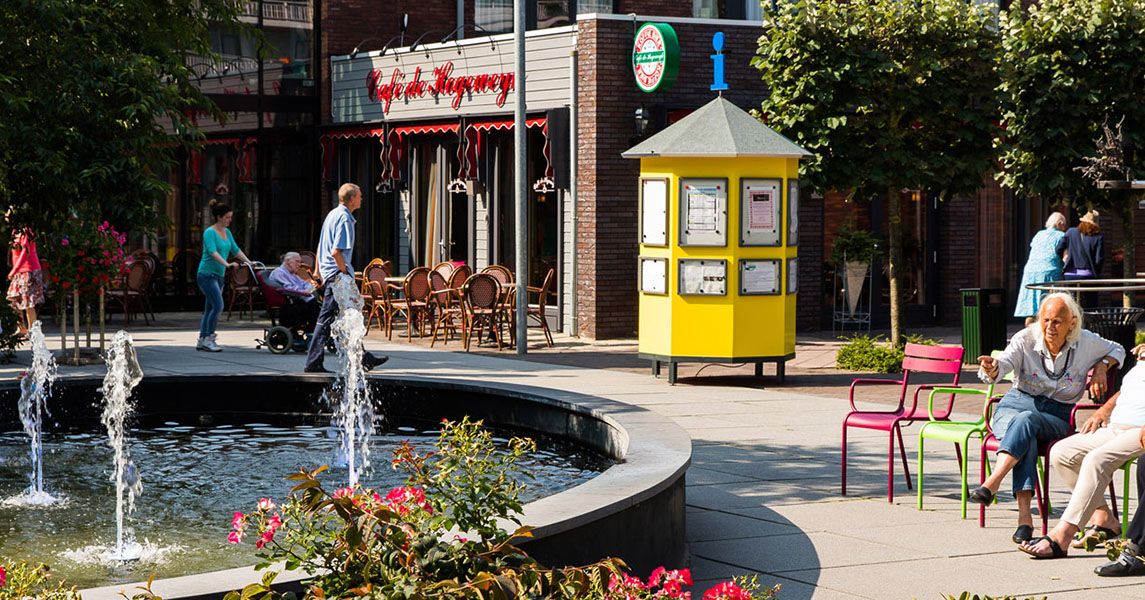
In the Netherlands, in Weesp, a town on the outskirts of Amsterdam, there is a place that has revolutionized the way of assisting people with dementia. It is called Hogeweyk (often abbreviated to Hogewey) and it is much more than a nursing home: it is a real village designed to allow guests to continue to live as normal a daily life as possible, despite the illness.
The project was born in the early nineties from the idea of two healthcare workers, but the village in its current configuration was inaugurated in 2009. Since then it has become a model studied and imitated throughout the world for assisting people with dementia.
View this post on Instagram
A neighborhood designed for those living with dementia
Unlike traditional care facilities, Hogeweyk was designed as a normal residential neighborhood. Inside there are homes, pedestrian streets, squares, gardens and common spaces where guests can move freely in a safe environment.
People live in small groups inside apartments furnished according to different lifestyles typical of Dutch culture, chosen on the basis of the habits and personal history of the guests. Everyone can bring with them furniture, photographs and personal objects, elements that help keep memories alive and aid orientation.
The entire village is protected by a discreet perimeter that allows guests to walk around without the risk of wandering away, thus avoiding the feeling of living in a closed or hospital structure.
Everyday life as therapy
The idea behind Hogeweyk is simple: rather than adapting people to the rules of the structure, the structure adapts to the people.
Guests continue to carry out many of the activities they have always done: they prepare meals together, go shopping in the village supermarket, participate in household chores, go for a walk, stop at the bar or take part in creative and recreational workshops.
Concerts, theatrical performances, gardening, painting, cooking and baking activities are organised, as well as outings and moments of socialising. Everything happens with the support of specialized staff who intervene only when necessary, leaving guests with as much autonomy as possible.
The restaurant, theatre, café and other services are also open to external visitors, encouraging meetings between residents and the local community and reducing the risk of social isolation.
View this post on Instagram
A model that has set standards
Hogeweyk’s approach is based on so-called person-centred care, which focuses on identity, habits and quality of life rather than just the management of the disease.
Several studies have highlighted how environments designed in this way can help reduce stress, agitation and the use of psychotropic drugs, improving the well-being perceived by both guests and family members, even without representing a cure for dementia.
In recent years, Hogeweyk’s model has inspired the creation of similar structures in numerous countries, including Norway, France, Germany, Switzerland, Canada and Australia, becoming one of the main international references for the design of communities dedicated to people with Alzheimer’s and other forms of dementia.
More than a place of care, Hogeweyk demonstrates how it is possible to rethink care by putting dignity, autonomy and human relationships at the centre, offering people with dementia the possibility of continuing to live a daily life that is as familiar as possible.
