
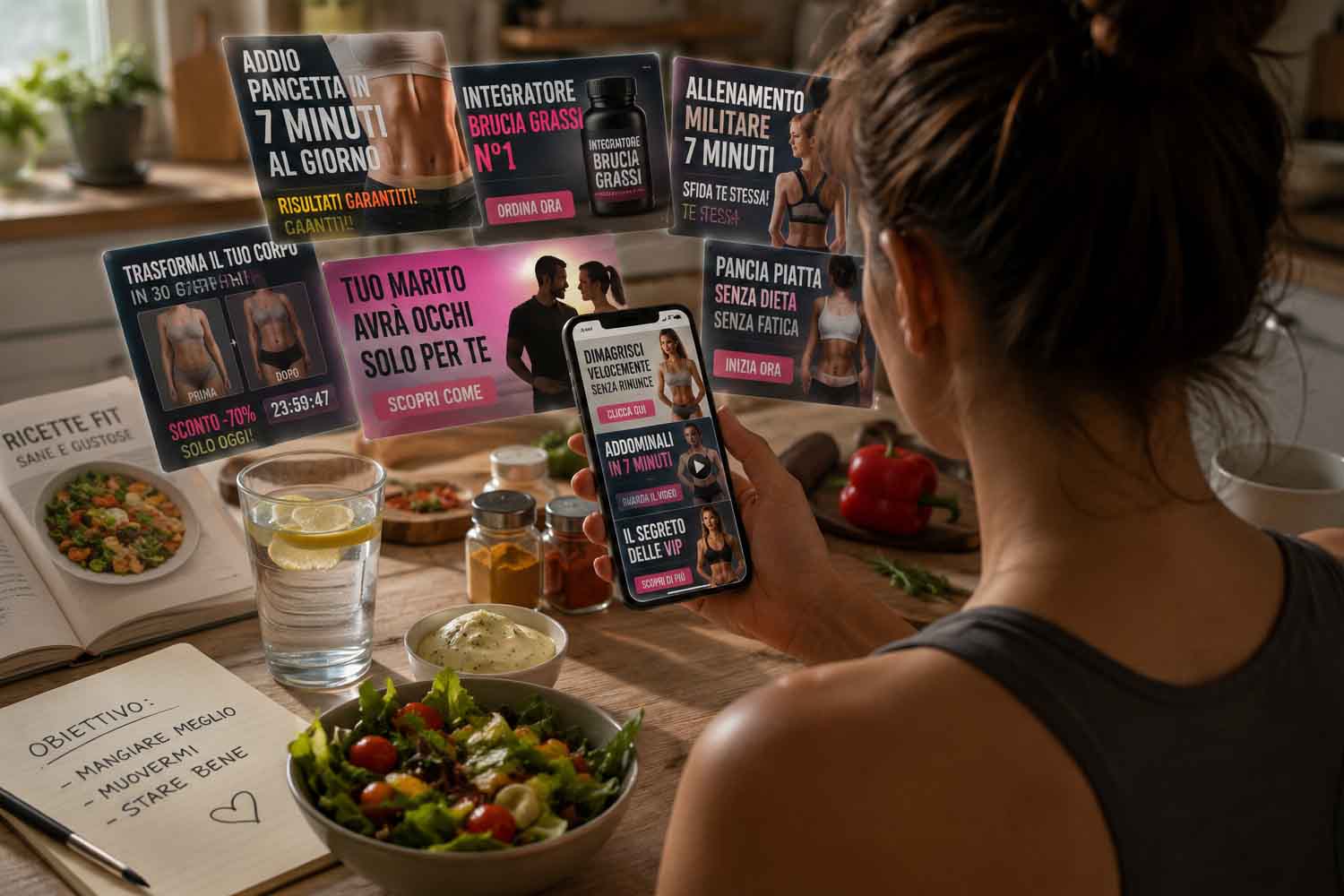
I was looking for some fit recipes to calmly lose the kilos I put on during the holidays. Five, more or less. No emergency: what I calmly called “alcoholic bacon” from excess of aperitifs, to be faced with a little perseverance, water and lemon instead of gin and tonic, muesli instead of biscuits, spices instead of sauces. I wanted to eat better without turning dinner into three salad leaves.
The algorithm received a different request. Supplements have appeared, miraculous transformations, women with abs obtained in a few minutes and “military” workouts lasting seven minutes a day. Many ads seemed to be generated with artificial intelligence: smooth bodies, synthetic voices, lips that came half a second after the words. One promised to make me attractive enough so “your husband will only have eyes for you.” I was looking for dinner. I was handed a marriage to save.
Understanding the trick doesn’t make you waterproof
For work I also write about fitness, nutrition, well-being and misleading communication. I recognize an AI-produced ad from a mile away and know the difference between a reasonable path and a promise built to sell. Yet, after days of sit-ups, pills and women straightened in seven minutes, I began to look at my body with a discomfort that I didn’t have before.
What was once a mess to be disposed of without drama was taking on the dimensions of a general problem. Five kilos suddenly seemed like fifty. I continued to eat as I had decided, to train and not to buy anything. Meanwhile the mirror had become more severe.
No single ad, alone, made me feel enormously overweight. It was repetition that slowly moved the meter: one morning I looked at my belly more harshly, another I thought that losing five kilos was an almost ridiculous goal. The body shown in the ads became the reference, even when that body probably did not exist in the proposed form.
I knew what was happening and it reached me anyway. The question has become inevitable: what can a similar burst do to a very young girl, to a woman going through a fragile moment or to someone who already has a difficult relationship with food, weight and self-image?
The “guilty” wife has changed her graphics
An advertisement from the seventies came to mind:
A fat wife is guilty.
He still loves you, but there are a lot of slim women around.
Human behavior was treated as an atmospheric phenomenon. She gets fat, he looks elsewhere. She loses weight, the marriage starts again. Desire, fidelity and the couple’s estate ended on the female body. Today an ad could hardly use the same words without attracting a riot. The message has learned to present itself better.
It talks about well-being, discipline, metabolism, self-confidence and the “best version”. Then he adds that seven minutes a day are enough for your husband to have eyes only for you. The insult became motivational. It has a countdown, a personalized schedule and almost always a discount that expires at midnight.
The advertising of the seventies waited inside a newspaper and said the same thing to everyone. The contemporary one enters a flow modeled on the activities of the individual person. It comes after a saved recipe, watched video, or fitness content. Mass guilt has become a private communication.
One category is enough for the feed
I cannot reconstruct which gesture sparked each individual announcement. Meta explains that some activities carried out on its products can contribute to the choice of advertisements shown. In some cases, actions carried out on advertisers’ sites may also be included.
The system doesn’t know that I want to lose five kilos calmly. He doesn’t know my relationship with my body or why I’m looking for a yogurt dip that doesn’t taste like drywall. He just needs to classify me: woman interested in light recipes and fitness, possible concern about weight, potential customer.
This limitation also emerged in a study published in 2022 by Liza Gak, Seyi Olojo and Niloufar Salehi. The researchers interviewed 21 adults with experiences of body stigma, problematic diets or disordered eating. Some were looking for content onintuitive eatingan approach aimed at rebuilding a less rigid relationship with food, and they continued to receive weight-loss ads.
The sample was small and made up of already vulnerable people, so the results don’t describe everyone who browses social media. However, the interviews show how much persistence can weigh: according to the participants, those ads rekindled anxieties related to food and exercise and reinforced low self-esteem. From the testimonies a very crude distinction emerged between those who wanted to lose weight and those who were trying to escape the diet culture. Always body, always food, always customer.
The reason that makes the look worse
Even the fitspirationpackaged as encouragement, can leave a less cheerful effect. In 2015, psychologists Marika Tiggemann and Mia Zaccardo involved 130 university students, randomly assigning them to view Instagram images dedicated to fitness or travel photographs.
After exposure, participants in the first group showed more body dissatisfaction, worse mood and lower appearance-related self-esteem. The comparison with the observed bodies helped to explain the result. The study measured an immediate reaction in young women and does not allow the effect to be extended to each person or over a long period. However, it says one thing precisely: content designed to motivate can make us leave the screen with a worse perception of our body.
That’s what happened to me. Those ads were supposed to push me to train. I was already constant. They tried to convince me that I was doing too little and starting from a much worse situation than I actually was. A woman who is satisfied with her journey has less urgency to buy. A woman who believes she is always late can buy the next supplement, the new program and another month’s subscription. The solution needs the problem to remain alive.
I can want to lose weight without becoming a defect
I still want to lose those five kilos. The decision remains mine and I will continue to follow it calmly, eating better, training and leaving their share of responsibility to the holidays. Wanting to change something about your body shouldn’t turn the whole person into a commercial target. A limited objective can remain limited. It shouldn’t become a blame, an improvised diagnosis or evidence that the partner is about to turn his eyes elsewhere.
Advertising from the 1970s pronounced the sentence out loud. Today’s one avoids the word “fat”, then shows enough times the body we should have because we are the ones to complete the sentence. I’m hiding those listings one at a time. In the meantime, I continue to look for recipes with paprika, curry, turmeric and vegetables that taste like something. Paprika, at least, hasn’t asked me to win my husband back yet.
