
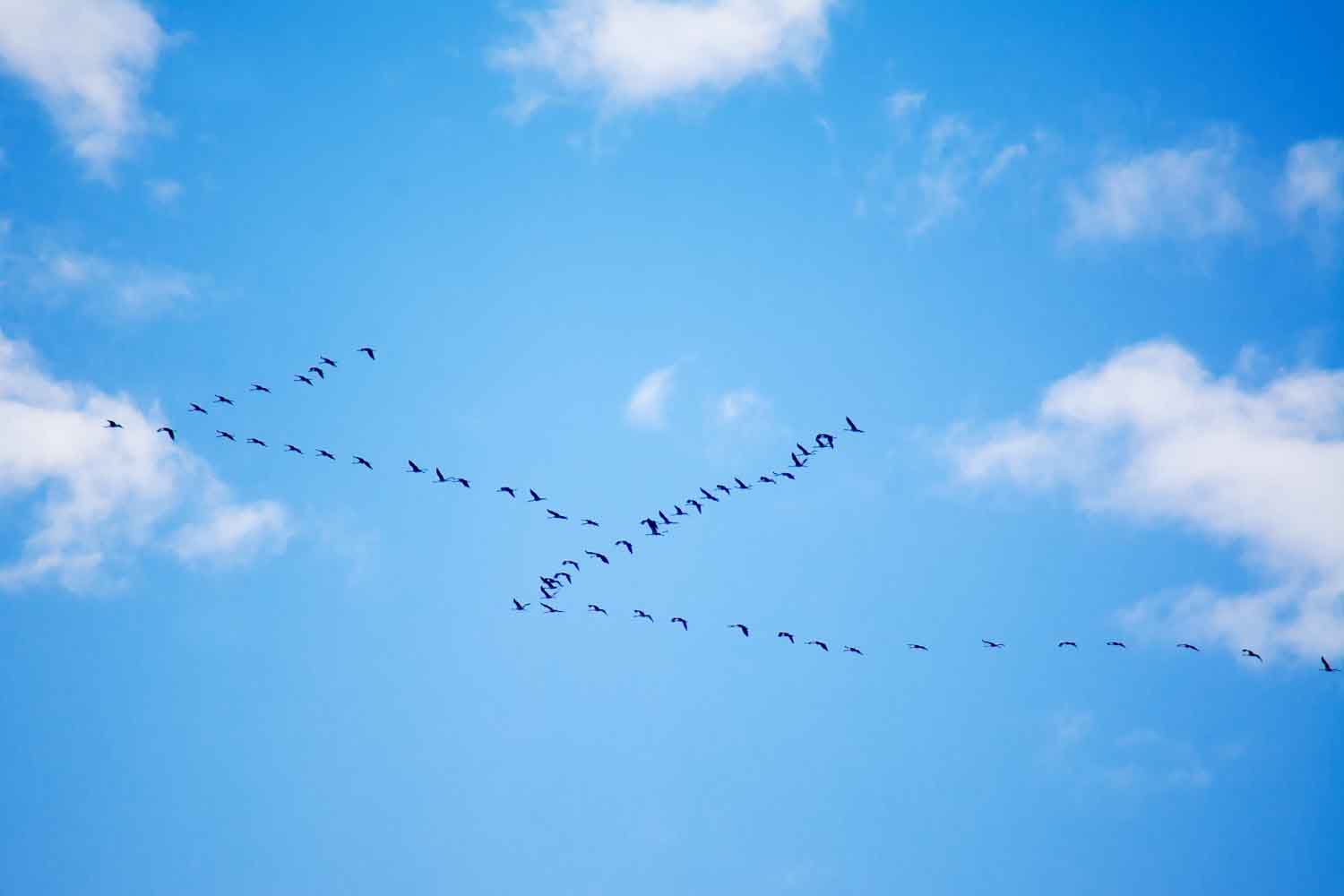
The ibis in the second row makes less progress with its wings. When it settles behind and slightly to the side of its companion, at the most favorable point of the V formation, it can reduce the amplitude of the flap to about 70% of that necessary during solo flight. In the model developed at Brown University, this correction drops the overall mechanical power required to fly by 11%. The V seen from below looks like a clean geometry. In the air it is precision work between wings, vortices and distances measured almost to the centimetre.
The mechanism was reconstructed by Olivia Pomerenk and Kenneth Breuer, researchers at the Center for Fluid Mechanics at Brown University. Their study published in PNAS starts from a now rather solid certainty: many large migratory birds exploit V-shaped flight to make the journey easier. It remained more difficult to understand where, precisely, that advantage came from.
The wake of the first bird shortens the beat of the second
When a bird flaps its wings, vortices of air emerge from the tips. Immediately behind the body they produce a descending current, while at the sides they generate an ascending current. The following animal places itself right in this second area, far enough away to avoid the worst part of the trail and close enough to exploit its upward thrust. A comfortable position, as long as you have the discipline to keep it in the air for miles.
Previous studies had already observed that Northern Bald Ibises synchronize their heartbeat with that of the companion in front. When they occupy the two diagonals of the V, they move their wings in order to better intercept the ascending current; when they end up directly behind, they change phase to limit the effects of the downdraft. They are rapid and continuous adjustments, difficult to see from the ground and even more difficult to reproduce in a model.
Pomerenk and Breuer reduced the scene to its essential elements: two ibises, one in front and one in the wake, with the second free to change position in space, phase and amplitude of the flap and flexion of the wings during the ascent. The model analyzes movement frame by frame, calculating the forces acting on the following animal as the trailing animal’s wake sways with its wings.
The result also clarifies which work is relieved. Each bird must produce lift to support its weight and thrust to move forward. The current generated by the leader above all reduces the effort needed to produce this second force. The follower can therefore lower the flapping amplitude, move the wings less vertically and expend less mechanical power. It makes the same journey, with a smaller movement.
The 11% is a model estimate, not a calorie count
That 11% savings relates to the mechanical power estimated by the model, not the calories consumed and measured directly on a migrating flock. The work also involves two Northern Bald Ibises in an optimized and stable configuration. A real flock changes shape, reacts to the wind, exchanges positions and includes animals that can have different sizes, tiredness and motivations.
The model, however, returns an optimal position that coincides with that already observed in live ibises. The power reduction is also compatible with previous experimental estimates. The merit of the study therefore lies in the mechanical explanation: it connects the air current produced by the first bird to the concrete change made by the second, that is, a less extensive flap and a slightly reduced flexion during the ascent of the wings.
The model could also be used for drone swarms
This reconstruction could also be of interest to those who design artificial flight systems. Breuer mentions the swarms of drones used in agriculture or in firefighting: organizing the position and movement of individual aircraft in order to exploit contrails could reduce energy consumption and prolong their autonomy. The application, for now, remains a research prospect. The ibises have had a lot more time to perfect the technique.
The next step will be to insert the pair into larger groups and add the social and behavioral dynamics that regulate a real flock. The V formation, moreover, does not remain imprinted in the sky like a ruler. It stretches, breaks, recomposes. And within that continually imperfect figure, each bird seeks its little piece of favorable air.
