
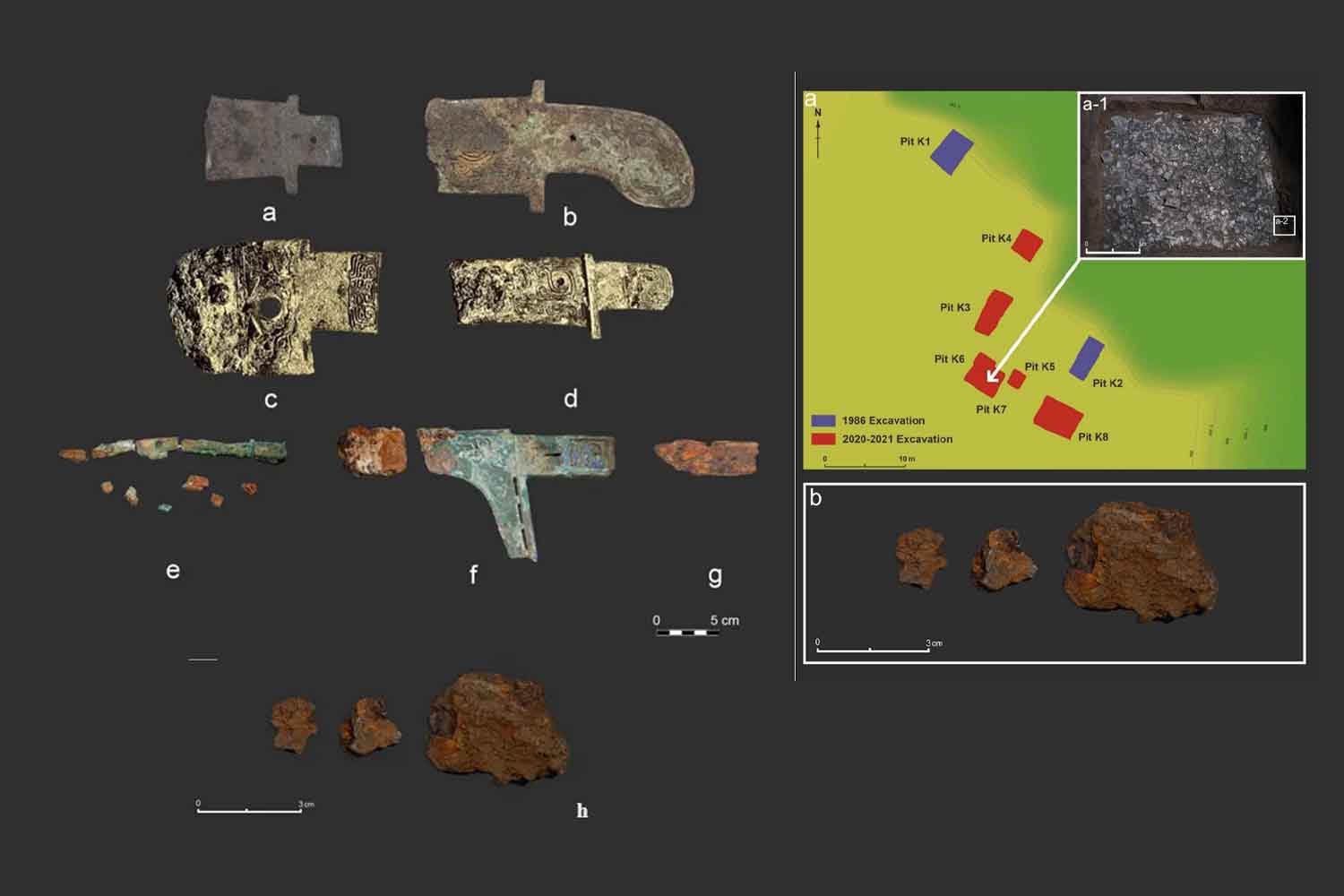
In the laboratory of the Sanxingdui Museum, in Chinathere was a piece of metal that asked for patience even before the answers. It stood there, corroded, fragile, half a prisoner of the deposit that had kept it for centuries, with the humble air of finds that come from a hard excavation and seem to promise above all problems of restoration.
Then the workshop changed the scale of the story. The analyzes transformed that fragment registered as K7QW-TIE-1 into something much heavier than its appearance: today it is described as the largest object of meteoritic iron emerged so far in China and as the oldest Bronze Age specimen found in the southwest of the country. The study, released on Archaeological Research in Asiaplaces it in the late Shang horizon, in a phase preceding the spread of actual iron and steel.
Nickel has opened a road that leads away from the ovens and very close to the sky
Sanxingdui is located in Guanghan, in Sichuan, just outside Chengdu, and for years it has forced Chinese archeology to deal with a cultural landscape that is less orderly and much richer than the old models suggested. From those pits came ritual trees, bronze figures, masks with protruding eyes which have already forced scholars to revisit several certainties about Bronze Age China. K7QW-TIE-1 came from pit 7, in an area with very strong ceremonial weight. Its condition was so delicate that archaeologists took it away along with the surrounding land and transferred it to the museum; during the first cleaning, three minute fragments broke off, which immediately became precious because they allowed analysis without stressing the main body of the find.
The measurements remove any vagueness: 20.05 centimeters in length, a width that oscillates between 5.27 and 7.90 centimeters, a profile that recalls an ax or an elongated tool. The first checks with portable X-ray fluorescence have already put on the table the detail that changes everything: over 90 percent of the piece is iron, accompanied by 7.41 percent of nickel. In such an ancient context, that fact immediately leads us away from the usual paths. The nickel in proportions of this kind he speaks the language of iron fallen from the sky more willingly than that of the metal obtained with terrestrial fusion processes available at that time.
Under the electron microscope the matter takes on even more substance. The metallographic analysis and SEM-EDS showed a microstructure with equiaxed ferrite grains and a distribution of nickel around 20 percent, uniform in the fragment observed. The authors insist precisely on this uniformity: an iron so rich in nickel and so homogeneous escapes the smelting technologies known for the late Shang period. The precise classification of the meteorite remains open, but the meteorite trajectory is considerably consolidated.
An object without inlays, harder than bronze
Here the picture gets really interesting. In China, meteoritic iron known to date almost always appears in the north, especially between Henan, Hebei and the Beijing area, and often enters bimetallic objects where iron combines with bronze. Sanxingdui takes a different route. This specimen is monometallicdevoid of obvious inlays, and is part of a tradition that looks elsewhere. According to the researchers, the piece may have been worked directly from the original meteorite block, with a limited transformation and great attention to the strength of the material. In the Chinese census of meteoritic iron finds, just thirteen objects appear; the oldest remains a knife found in the cemetery of Narensu, in Xinjiang, dated around 3000 BC
From here the question of use arises, and it weighs a lot. The meteoritic iron It offers a higher hardness than bronze, so the hypothesis of a tool designed to engrave, carve or finish hard surfaces is effortless. At that point a concrete possibility comes into play: a tool used in the manufacturing of the famous bronze masks of the region, which show traces of interventions subsequent to the casting. At the same time, the context of discovery pushes with identical force towards ritual reading. A sacrificial pit like that of Sanxingdui can give symbolic weight to even the most functional objects, let alone a rare, eye-catching material that literally arrived from above. Utility and ceremony, in such a case, can fit comfortably in the same hand.
The fact that shifts perspective is right here. Sanxingdui fills a gap in the paper of ancient Chinese metallurgy. The southwest, in this story, remained more blurry. Now it comes into full light with an object arriving from a lateral trajectory, far from the furnaces and close to the sky. The discovery broadens the technical repertoire attributed to that culture and calls for a more careful consideration of the variety of metallurgical practices outside the Central Plains, where the most canonical models of ancient China were concentrated for a long time.
From Spain to Sichuan
The Chinese case remains exceptional, but it lives within a tiny and selective family of findings. In Spain, for example, the Villena Treasure, kept in the archaeological museum of the city of Alicante, collects 59 objects from the Bronze Age and includes two pieces of meteoritic iron: a hollow hemisphere covered in gold and an open bracelet. The comparison is useful because it highlights a common trait. When iron arrives from the sky, in ancient societies it almost always enters the circuits of prestige, ritual and exception. In Sanxingdui this component weighs even more, because the find comes out of a ceremonial pit and is inserted into one of the most intense symbolic landscapes of Asian archaeology.
Then there remains the living material of future work, the least spectacular and most decisive. The object has gone through millennia of corrosion and today requires extremely cautious conservation. The researchers speak of high-resolution analyses, useful for narrowing down the origin of the meteorite and looking for possible correspondences with known falls in the region, always within the strict limits imposed by the fragility of the piece. Meanwhile, the strong fact has already imposed itself: in Sanxingdui iron enters history before the furnace. It descends from above and lands at the bottom of a sacrificial pit.
