
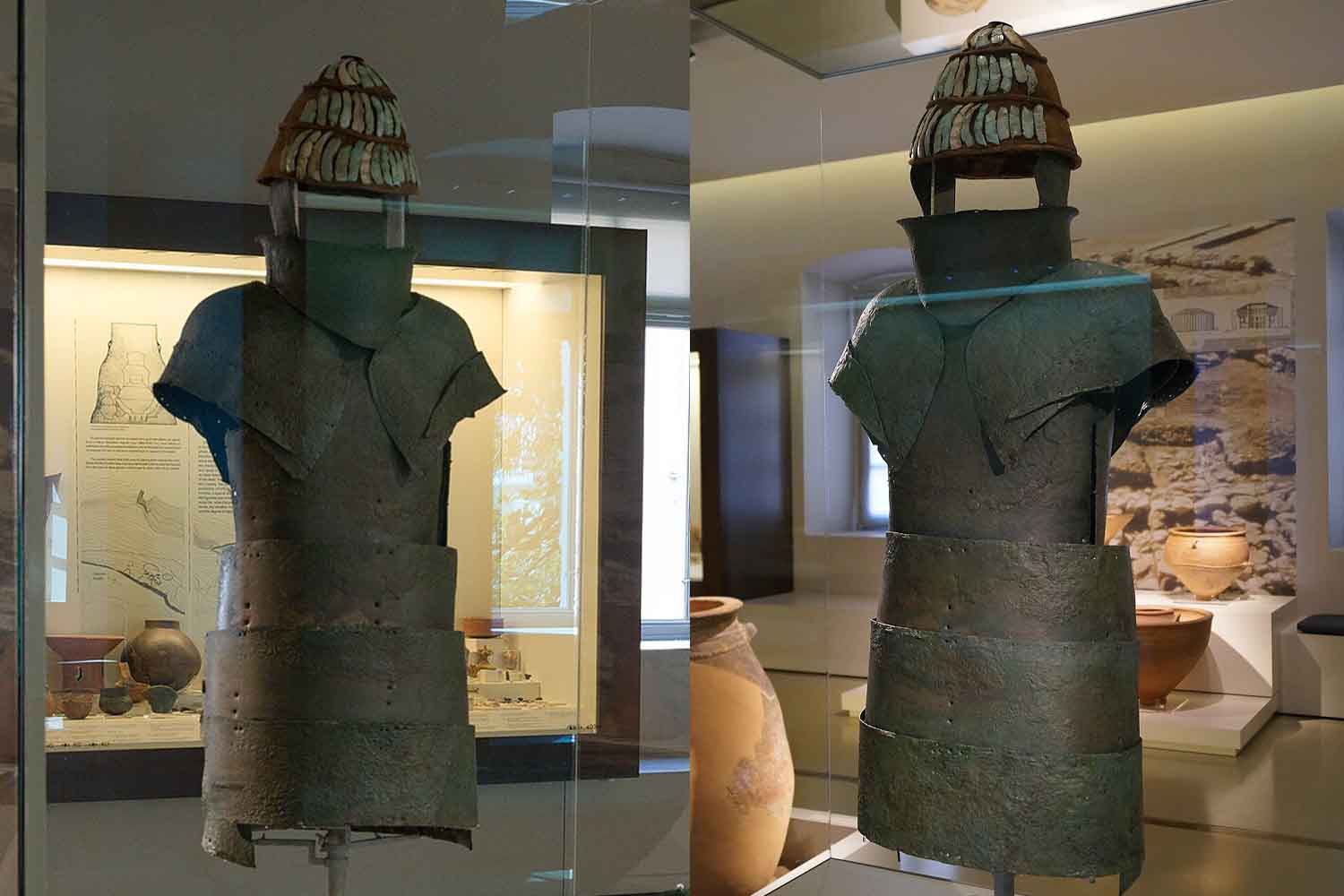
For nearly eleven hours they marched, ran, dueled, threw spears and maneuvered a chariot wearing 23.32 kilograms of metal. When they stopped, the thirteen Greek marines had sore feet, sore shoulders and still had enough strength to strike. Dendra’s Mycenaean armor, some 3,500 years old, had passed the test: it could accompany a warrior through a long day of battle without turning him into a bronze statue.
The result comes from a study published in PLOS ONEwhich has returned to circulation in recent days. The work brings together experimental archaeology, human physiology, analysis ofIliad and numerical simulations. Homer remains a poet. The armor, however, works.
The experiment does not demonstrate that the Trojan War occurred as described in the poem, nor that the armor found in Dendra saw a battlefield. It answers a more concrete question: Was that type of equipment too heavy and rigid to fight for long? The results indicate no.
A bronze boiler capable of moving
The original armor was discovered in 1960 in a grave near the village of Dendrain Argolis, a few kilometers from ancient Mycenae. It dates back to the 15th century BC and is one of the oldest complete pieces of armor from the European Bronze Age.
The panoply was composed of large plates that protected the neck, chest, shoulders, arms and part of the legs. When stationary it appears imposing, almost disproportionate. A boiler with shoulder pads, in short. Precisely that aspect had fueled the hypothesis of a ceremonial object, intended to show the owner’s rank rather than to follow him among spears, stones and chariots.
The researchers used a replica made in Birmingham in 1984 under the archaeologist’s direction Diana Wardle. The plates reproduced the dimensions, curvatures and perforations of the original and were joined with leather strips and laces. For the metal, an alloy composed of 95% copper and 5% zinc was chosen, the one available closest to ancient bronze.
With the helmet, the replica was heavy 23.32 kilograms. The original armor is estimated at around 18, although today some elements are missing and 3,500 years of oxidation make the comparison less linear than a weigh-in in the gym.
The Iliad transformed into a military protocol
Thirteen men belonging to the Marines of the Hellenic Armed Forces wore it, with an average age of 29 years. The volunteers were also chosen by height and build, so as to be as close as possible to the elite warriors described in the poem and the Bronze Age human remains studied by archaeologists.
Before the test they followed two days of training with armor and reproductions of sword, spear, bow and stones. The weapons had blunt tips and edges: reconstructing the Mycenaean war is fine, sending the participants to the emergency room a little less so.
The day started at seven in the morning and ended at 5.54pm. To determine what the volunteers should do, the group looked at theIliad together with the available archaeological and historical literature. Excerpts have been made from the poem 152 clashes and 264 combat movements: throws, close range shots, advances, retreats, duels between warriors on foot and encounters with chariots.
78% of the battles described were a duel between combatants on foot. Eight out of ten ended within three moves and over half with a single fatal blow. What emerges is a battle made up of brief explosions of violence, withdrawals, recovery and new attacks. In modern terms, a form of high-intensity intermittent exercise. Achilles did HIIT, only with much worse consequences.
The climate was also reconstructed on the basis of the paleoclimatic data available for the Troy region: temperatures between 24 and 29 °C and humidity between 70 and 85%. Fairly heavy conditions even without putting yourself inside a metal bell.
To support the effort, the participants followed a meal plan for approximately 4,443 kilocaloriesconstructed using the poem, archaeological evidence and dietary studies of the time. For breakfast there was dry bread, goat cheese, olives and red wine; during breaks bread, honey, onions and more cheese; the meat arrived in the evening. Homeric heroism required a lot of carbohydrates.
The body holds up, with some protests
All thirteen volunteers completed the protocol. They were very tired, with pain in the upper body due to the weight of the armor and discomfort in their feet, also because they had walked, ran and fought barefoot. The armor made itself felt. Not enough to stop them.
The heart rate reached a maximum of 166 beats per minute, with moments of effort equal to approximately 80% of the individual’s maximum rate. Core body temperature remained between 36.4 and 37.7°C. The researchers found no significant worsening in grip strength, reaction times, hydration or key metabolic indicators observed.
Even the shots retained a fair amount of substance. The average force recorded during the attacks was approx 3.5 kilonewtonsa level which, according to the studies used by the authors for comparison, could have caused serious fractures in a real collision. The armor had not transformed the fighters into elegant Mycenaean ornaments.
The team then built a freely accessible numerical model to test how the armor would perform under different temperatures, wind, sun exposure and intensity of effort. In six out of seven scenarios the virtual warrior managed to complete the eleven hours. Only in the most extreme combination — high heat, almost no wind and still very intense combat — would it have stopped after about seven and a half hours. A short day, by Troy standards.
What Homer can really tell
THE’Iliad it is a layered text, constructed through a long oral tradition and fixed centuries after the Mycenaean era. Contains weapons, customs and tactics from different periods. The authors themselves recognize that using it as a military manual involves a significant margin of uncertainty.
The date between 1300 and 1200 BC was adopted to reconstruct the climate and the length of the days. It does not represent a new dating of the Trojan War. Furthermore, the test involved a small sample of modern, trained and selected soldiers. Replicas may differ from the originals in weight, materials, balance and workmanship, while security has mandated controlled movements and blunted weapons.
These limits undermine the more bombastic story according to which the evidence confirmed theIliad. However, an important archaeological result remains: armor constructed like that of Dendra allowed a trained man to move, fight and withstand the effort for many hours. Homeric descriptions of bronze-clad warriors thus have plausible material precedent.
THE’Iliad it remains a poem and the Trojan War remains beyond the scope of this experiment. The boiler with shoulder pads, however, has stopped looking like a parade object. Eleven hours later he was still in battle.
