
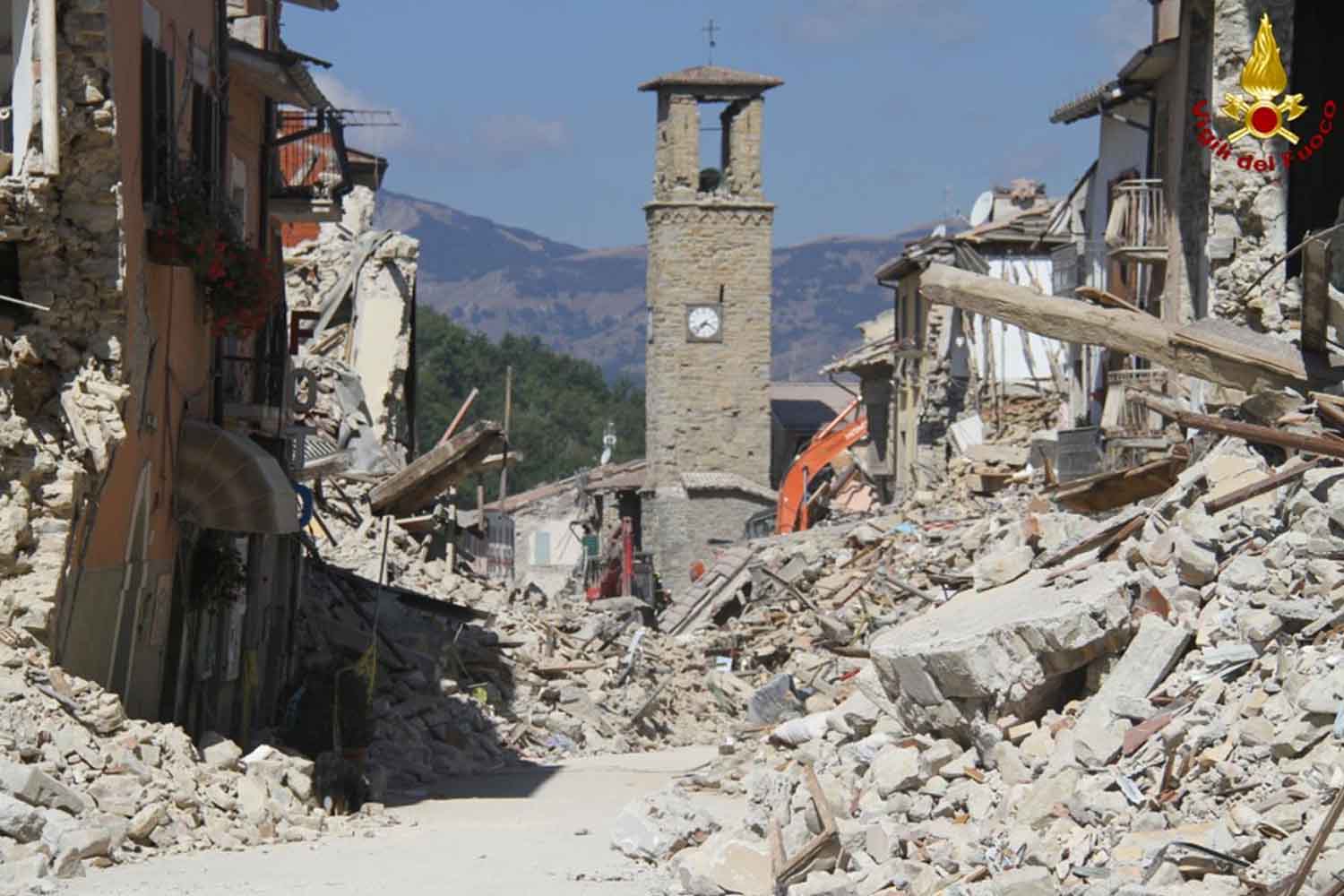
Before the numbers there are names. In Amatrice, at 3.20am on August 24th, they are read once again in the Minozzi Park. As per tradition, sixteen minutes later, at 3:36, the bell of the Civic Tower rings at the exact time when the earthquake changed the lives of thousands of people. For those who lost someone that night, and for those who have lived with the absence and the struggle to start again since then, ten years are a piece of life.
@Fire Brigade
It is within this time that the balance of the reconstruction must also be read. According to ActionAid’s analysis, as of 30 April 2026, two out of three public reconstruction interventions in the crater had not yet reached the physical opening of the construction site.
What does ActionAid’s analysis show?
The figure is 66.3% of the interventions and concerns exclusively public reconstruction: schools, town halls, hospitals, roads and other places that hold together the daily life of a community. Private reconstruction follows a different path and in recent years has produced thousands of construction sites, many of which have already been completed.
As of 30 April 2026, 3,667 public interventions were planned in the crater for over 4.85 billion euros, 125 works and approximately 252 million more than in 2025.
The 2026 Report of the Commissioner’s Structure indicates that 97.5% of the interventions have been started, considering the appointment of the RUP, the sole manager of the project, or the achievement of a subsequent procedural phase. The same document also records a material acceleration: works in progress and completed works represent approximately 40% of public programming, compared to 34.4% in the previous year.
The percentages describe different steps of the same path. In the commissioner’s report, an intervention appears to have been started as early as the appointment of the RUP; ActionAid focuses the analysis on the material opening of the construction site. For this reason, a work can be started on an administrative level and still be in the pre-work phases. In ActionAid processing, 33.6% are in the execution or final stage.
ActionAid also explains that it has reconstructed the picture through requests for access to documents, encountering fragmented data, gaps and information that is not always updated at the same time. Following work by work a reconstruction that has lasted for ten years still requires a long work of collecting, verifying and cross-referencing data.
In the 44 municipalities most affected, 1,544 interventions are planned for approximately 2.1 billion euros. ActionAid places 1,031 of them in the phases prior to the start of work, while 18.4% had reached completion or testing.
The time of the procedures is felt above all where there should be a service. ActionAid analyzed 767 interventions in schools, gyms, universities, municipalities and health and social care facilities. Of these, 235, equal to 30.6%, had achieved at least the start of works. 77 had arrived at the test: approximately one in ten.
In Amatrice the commissioner structure has carried out 172 public reconstruction interventions for over 250 million euros. According to ActionAid, for 136 of these works the construction site had not yet physically started by 30 April 2026.
Amatrice data: rebuilt houses, construction sites and public works
Within the municipal perimeter, the technical office document lists 20 interventions in which the Municipality of Amatrice is the implementing body, distributed between assignment, planning and progress of the works. This is part of the 172 interventions planned in the area overall, which also include works entrusted to other bodies.
For 26 interventions on road infrastructure in the hamlets, for example, the implementing body is the Special Office for the reconstruction of the Lazio Region. The municipal technical office estimates the overall progress of public and private reconstruction at 40% and indicates 540 aggregates constituted, 247 houses rebuilt and usable and 679.50 million euros granted out of 1.10 billion requested.
The report on reconstruction in Lazio, updated to 28 May 2026, counts 1,501 requests for contributions and 828 private interventions activated in Amatrice: 348 construction sites completed. The Municipality indicates 480 active or ongoing. It is the photograph of a segment of the reconstruction that has already entered, in many cases, the material phase of the works.
Out of 4,333 damaged buildings registered after the earthquake, 3,151 were affected by requests for contributions that were not rejected, approximately 72%. The percentage measures the buildings that have entered the reconstruction process; completion and usability belong to the subsequent phases.
Some strategic works have also made progress. The commissioner structure highlights the new hospital, the hotel institute, the town hall, the Carabinieri barracks and the Don Minozzi complex among the main interventions. According to the Municipality, the works on the Alberghiero have definitively begun after a variation to the project.
In May 2026, a further loan of 1,475,013.85 euros was approved for the hospital, which brings the overall value of the intervention to 28,994,260.51 euros. The variant includes a department for dialysis patients and the facilities of the room intended for magnetic resonance imaging. In the municipal material the completion of the work is indicated by 2026.
Rescue&Care was also launched in the area, the platform for teleassistance and future telemedicine developed with the involvement of the Municipality, health and social workers and the Red Cross. A three-year agreement with the ASL of Rieti provides for its evolution towards telemedicine services; according to the Municipality, over 30 devices have already been delivered.
Then there remains life in the SAE, the housing solutions created to deal with the emergency. The municipal material lists a total of 537; 456 are still inhabited by approximately one thousand people. For them, the time of reconstruction continues to pass inside houses that still bear the word “emergency” in their names.
The mayor: “Reconstruction must also be economic, social and cultural”
Mayor Giorgio Cortellesi defines the tenth anniversary as an important moment of reflection and assessment of “what has been done and what still needs to be done”. The tenth anniversary, in his words, can also become “an opportunity to make a qualitative leap in reconstruction”.
Cortellesi recalls the definition of “first crater” for Amatrice, Accumoli and Arquata del Tronto and the economic tools intended for the most affected areas. The reconstruction, he explains, must also be “economic, social and cultural” and aim at the repopulation of the Apennine areas.
Since the earthquake, the way of reading the territory has also changed
Ten years of studies have left tools that are now useful far beyond Amatrice. The National Research Council recalls that the work carried out after the earthquake together with Civil Protection, INGV and ISPRA made it possible to refine knowledge of the faults of the central Apennines and the local response of the land.
In 2016, only 22% of the crater’s municipalities had an approved Emergency Limit Condition, the tool that checks whether an urban system can maintain access and strategic functions after an earthquake. Today, according to the CNR, the share has reached 86%.
Amatrice was also one of the first Italian cases of operational use of satellite radar images immediately after an earthquake. The calculations revealed ground deformations of up to approximately 20 centimeters in the Accumoli area. Techniques that were then used to read the consequences of that seismic sequence are now also used in the monitoring of Campi Flegrei, Vesuvius, Etna and other territories subject to deformations and instability.
Memory and hope for Amatrice
The program released by the Municipality of Amatrice includes a meeting at 2:00 at the Laga Auditorium for the night between 23 and 24 August. At 2.30 the torchlight procession will start, at 3.20 the names of the victims will be read in Minozzi Park and at 3.36 the bell of the Civic Tower will ring.
The Municipality specifically asked that the vigil remain a private moment, without press, photographs or video footage. In the afternoon, at 4.30pm, a wreath will be laid at the Monument to the victims; at 5pm Cardinal Matteo Maria Zuppi will preside over the Mass at the Sports Field and at 8.30pm the Requiem Remembrance will be held.
On August 24th, for a few hours, percentages and progress reports will remain out of sight. Inside there will be names, silence and a community that has been trying to rebuild homes, services and the possibility of staying for ten years.
The hope is that the construction sites still awaited will be able to open soon and those that have already started will reach completion. Because, ten years later, rebuilding Amatrice also means making a very simple choice possible: being able to stay there.
