
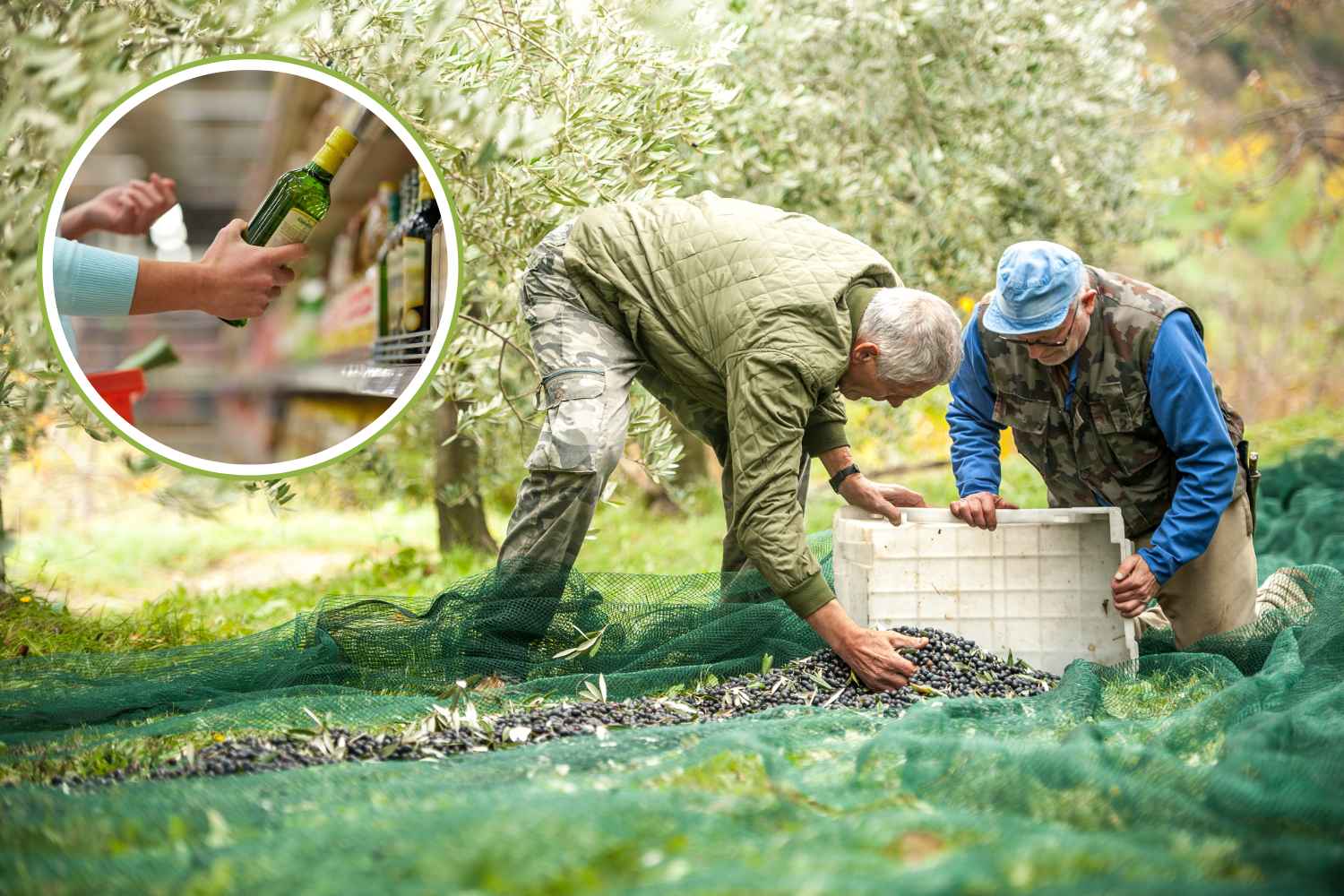
When we buy a bottle of extra virgin olive oil at the supermarket, we often look at the price and try to save, perhaps choosing the one that costs less. But do we ever wonder how much work goes into that product and how much is really recognized for those who grow the olive trees, harvest the olives and take them to the mill? It is a question that we should ask ourselves more often, especially in recent weeks, while Italian olive growers protest against the collapse in prices and denounce production costs that are increasingly difficult to sustain.
The crisis does not only concern a specific agricultural sector, but also the relationship we have with food and the value we attribute to it. We like to talk about Italian excellence, traditions to defend and “Made in Italy” to be promoted in the world. Yet, when it comes to recognizing an adequate price for those who make these excellences possible, the matter becomes much more complicated.
The price of oil has collapsed, but producing it costs more and more
The protest of Apulian olive growers in recent days has brought to the center a contradiction that is difficult to ignore. On 12 October, in Bari, around 2,000 producers gathered to ask for urgent interventions to support the sector. What is especially worrying is the collapse in the prices of extra virgin olive oil: they have gone from around 9.20 euros per kilo in November 2025 to values around 4-4.20 euros, with even lower reports.
In the meantime, the costs of running a farm have not disappeared, on the contrary. Fuel, fertilizers, energy, machinery maintenance and labor continue to weigh more and more on budgets. And the harvest itself requires organization, equipment and work, even before the olives arrive at the mill and become oil.
The result is that for some producers, collecting can mean facing other expenses without the certainty of recovering them through sales. It is also for this reason that, in some areas of Puglia, the possibility of leaving the olives on the trees has been taken into consideration.
When such a situation repeats itself, the risk is not only that of a difficult season. Companies may give up investments, reduce activities or close, with consequences for those who work in the supply chain and for the territories where olive growing represents an important part of the economy and landscape.
Foreign competition and the Made in Italy paradox
The trend of the international market also affects prices. For the 2026/2027 olive oil campaign, the first estimates from the Spanish Ministry of Agriculture foresee a production of around 1.6 million tonnes of olive oil, 23% more than the previous campaign. This is a forecast, which may be updated, but which helps to understand why the increase in supply can put pressure on prices.
Spain is a major European producer and the dynamics of its production inevitably have repercussions on other countries as well. Added to this are international trade and the availability of oil from different areas of the world. For Italian companies, especially those that have to bear high costs, competing in a market where price becomes the main criterion of choice can be very difficult.
But this is where we should stop and reflect. If we want to defend Italian agriculture, can we limit ourselves to celebrating the quality of our products or must we also ask ourselves what economic conditions allow those who produce them to continue to do so?
There is nothing wrong with buying a foreign oil: origin alone does not determine the quality of a product. And international competition is not necessarily unfair. The problem arises when the price paid to producers is not sufficient to cover costs and guarantee the continuity of agricultural activity. In these conditions, the risk is that the ones who resist will be mainly the larger operators or those who can count on lower costs, while the more fragile companies are progressively expelled from the market.
It is a paradox for a country that even has a Ministry of Business and Made in Italy and which considers its agri-food excellence a heritage to be valorised. Promoting Italian origin is important, but protection cannot stop at communication, it must also translate into conditions that allow producers to remain on the market.
How much do we really know about the oil we buy?
Then there is another aspect that directly concerns us consumers: the origin of the oil we put in the cart. Just look at the labels to realize that not all the extra virgin olive oil sold in Italy is produced with Italian olives.
European legislation provides specific indications for the origin of virgin and extra virgin oils. When it comes to blends coming from multiple countries, the label may, for example, contain the words “blend of olive oils originating in the European Union” or “EU”. This is legal information, which allows us to distinguish a product obtained from Italian olives from one coming from an international supply chain.
Reading the origin therefore becomes fundamental for making an informed choice, especially if our objective is to support national olive growing.
It also remains important that the rules on origin are respected and that controls are effective in combating any fraud and misleading declarations. Traceability should not just be a bureaucratic requirement, but a guarantee for those who buy and those who produce correctly.
It is not enough to say that we want to defend farmers
Of course, asking consumers to spend more cannot be the only answer. Not all families have the same purchasing power and it is not right to place the responsibility of resolving a structural crisis on those who do the shopping. Institutions and the commercial supply chain also have a decisive role: transparency, adequate controls, the fight against unfair commercial practices and tools that help guarantee sustainable remuneration for those who produce are needed.
At the same time, we should ask ourselves how much we are used to considering it normal that food obtained through months of agricultural work can cost very little. Behind a bottle there are olive groves to take care of, land to maintain, olives to harvest and transform, people to pay and companies that must continue to invest. All of this comes at a cost, even when it isn’t immediately visible on the shelf.
If we want Italian extra virgin olive oil to continue to exist, we cannot limit ourselves to appreciating it when it arrives on our table or to claiming its prestige when we talk about Made in Italy. We must also worry about the conditions in which it is produced and the future of those who care for it.
Because the risk, in the end, is that we realize too late that behind an increasingly lower price there is not necessarily a more efficient system, but a supply chain that can no longer sustain itself. And at that point it will no longer be enough to say that we want to defend Italian excellence, we will have to ask ourselves what we have done, concretely, to allow them to survive.
However, it is also a good idea to start with our daily choices: when we have the chance, we support small producers, we choose a quality oil of transparent origin, perhaps buying a little less but using it and making the most of it. It’s not about being able to spend more and more, but about giving the right value to what we bring to the table. Because defending Made in Italy does not only mean being proud of it, but also contributing, each according to their own possibilities, to support the people and the work that make it possible.
