
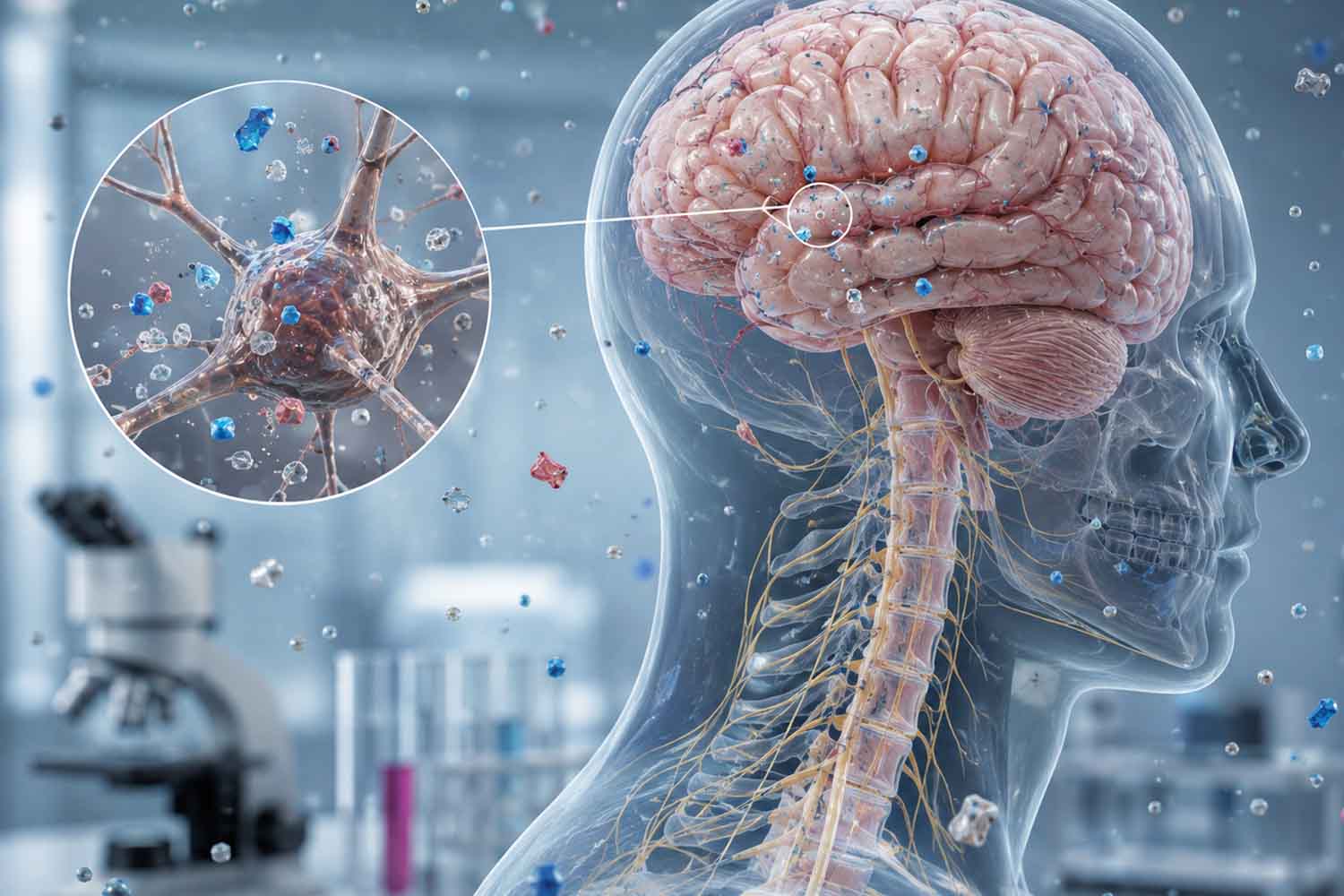
One milliliter of cerebrospinal fluid, the one that envelops the brain and spinal cord, produced a notable difference. In the 24 patients with amyotrophic lateral sclerosis examined by researchers from the University of Modena and Reggio Emilia, the median concentration of nano- and microplastics was 1,022 particles per milliliter. In the 20 checks it stopped at 532.1. Almost half.
This is what emerges from the study Central nervous system concentrations of nano- and microplastics and risk of amyotrophic lateral sclerosispublished on Brain Communications. For the first time, researchers quantified these particles directly in the cerebrospinal fluid of people with ALS, finding higher concentrations than in the comparison group.
More particles in the fluid surrounding the brain and spinal cord
The study involved 44 people from the provinces of Modena and Reggio Emilia: 24 with a recent diagnosis of ALS and 20 who underwent lumbar puncture for suspected neurological disorders which were subsequently excluded.
The most obvious difference appeared precisely in the liquor. In patients with ALS the median concentration reached 1,022 particles per milliliter versus 532.1 in controls. Even in the blood the values were higher: 1,513.7 versus 1,278.7 particles per milliliter.
And blood and nervous system seem to talk to each other. The researchers observed that as serum concentrations increased, those in the cerebrospinal fluid also tended to increase.
The analysis focused on particles between 0.1 and 10 micrometers, therefore on nanoplastics and smaller microplastics. A scale that is difficult even to imagine: the diameter of a human hair is dozens of times larger.
The possible link with ALS
Analyzing the data, the group coordinated by Marco Vinceti and Jessica Mandrioli also observed an association between higher particle concentrations and ALS. In blood the relationship became more evident especially above approximately 2,500 particles per milliliter, while in liquor the trend appeared more gradual.
Another element involves neurofilament light chain, NfL, a protein used as an indicator of axon damage. In ALS patients, higher concentrations of microplastics in the blood were also associated with higher levels of NfL.
This gives rise to one of the hypotheses that researchers want to investigate further: such small particles could directly exert toxic effects or transport other potentially harmful substances to the central nervous system.
“If and to what extent these new contaminants represented by nano and microplastics are responsible for toxic effects on the nervous system remains to be conclusively ascertained”, explained Vinceti in the press release from the University of Modena and Reggio Emilia.
Caution is needed, but without burying the result under a mountain of asterisks: in the small group studied, people with ALS had many more particles in the cerebrospinal fluid. Now we need to understand why.
Microplastics have managed to get there
The interesting result actually surpasses ALS. The analyzes show that nano- and microplastics can also be detected in a compartment closely connected to the brain and spinal cord, adding another piece to the research on the spread of these contaminants in the human body.
To measure them, the samples were treated in the laboratories of the University of Catania with a technique based on scanning electron microscopy and X-ray microanalysis. The study was born from the collaboration between Unimore, the University of Catania and Boston University School of Public Health.
The number of participants remains small and larger studies will be needed to verify the association and understand its direction. This time, however, the scientific question has already changed direction: microplastics are not only looked for in the blood, lungs or organs. They have also been found in the liquid that bathes our central nervous system. And in the ALS group they were almost double.
