
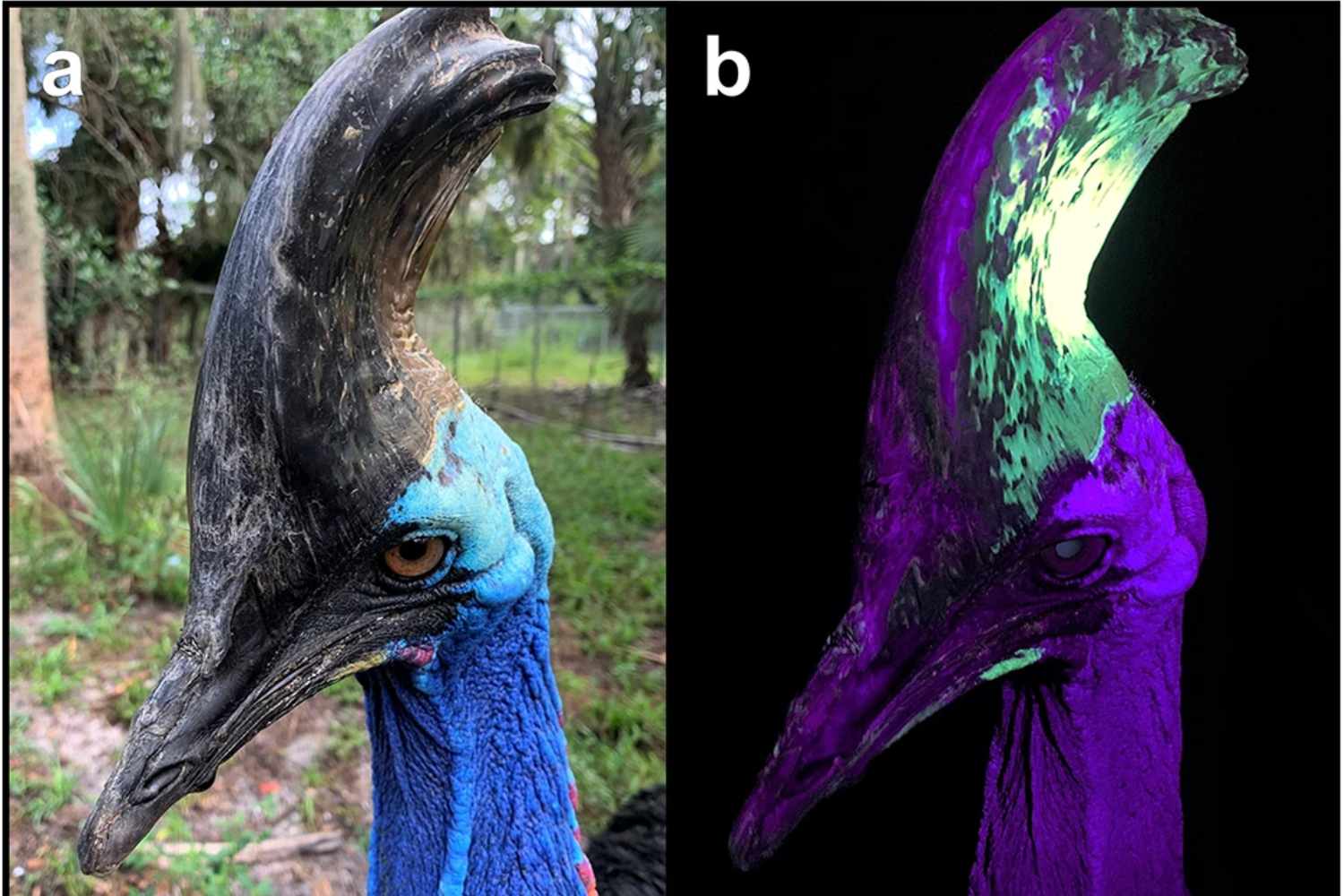
Known in the collective imagination as the most dangerous bird on the planet due to its imposing size and a dagger-like claw up to twelve centimeters long on the inside toe, the cassowary continues to amaze zoologists. This large flightless bird, widespread in the tropical forests of New Guinea and northern Australia, hides an unexpected physical property right on its head. Research published in the prestigious journal Scientific Reports has in fact revealed that the voluminous bony protuberance called helmet or crest reacts to ultraviolet light by emitting a clear fluorescence.
@TL Green
How the keratin covered helmet works
To the human eye the structure appears gray and completely opaque, but the light spectrum invisible to us reveals a completely different scenario. The outer covering of the cranial appendage, made entirely of keratin, absorbs UV rays and re-emits light. The investigation carried out by Green’s group highlighted an even more fascinating detail: the three existing cassowary species show a different fluorescence pattern from each other, creating a sort of distinctive color signature. Since bird vision includes ultraviolet wavelengths, cassowaries are perfectly capable of picking up these nuances that are invisible to our species.
Visual communication, territory and intimidation
The discovery adds a fundamental piece of information on the functions of the helmet, until now hypothesized as a tool for navigating vegetation, regulating body temperature or amplifying sounds. Scholarly work suggests that luminescence plays a crucial role in interspecific visual communication. The combination of shape and bright emission increases the perceived height of the animal, turning the crest into a means of territorial intimidation towards rivals or a channel of individual recognition when choosing a mate. In a habitat as intricate as the rainforest, such a clear visual signal can make all the difference in defending your home range.
An open window on the world of dinosaurs
The impact of the research goes far beyond the understanding of modern ethology. Since birds are the direct descendants of non-avian dinosaurs, discovering that a keratin appendage can emit light signals offers a new understanding of the fossil record. Many extinct species in fact had imposing cranial crests or cornucopias whose practical usefulness was unknown. Understanding how the cassowary uses its fluorescent crest allows us to hypothesize that even the protuberances of giants of the past served to convey complex social and behavioral signals, shedding new light on the evolutionary history of the Earth.
