
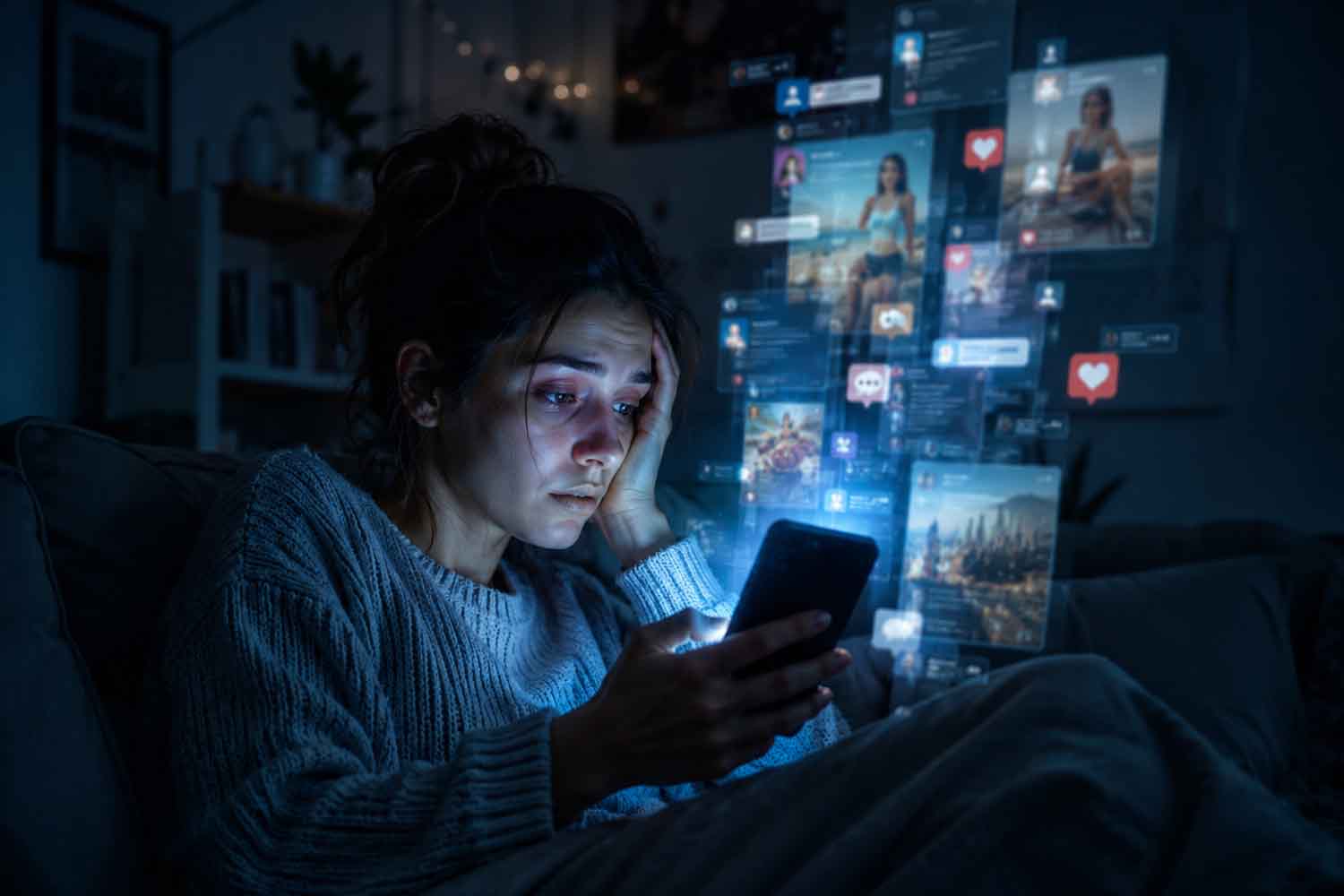
Before even putting their feet out of bed, more than one Italian in two has already checked their notifications. The 51.3% they do it as soon as they wake up and the same percentage returns to the phone during the day even when no alert has called. The 66.7% use your smartphone in bed, before sleeping or when waking up; 55% take it to the bathroom, 49.7% consult it when they go out with friends. The telephone has now gained free access practically everywhere.
It is one of the results of the new Eurispes investigation on digital technologies and mental health, published on 1 September 2026. Eurispes survey “Digital technologies and mental health” The study photographs habits, perceptions, self-regulation difficulties, relationships with social media, technostress and strategies implemented to defend some offline space. The attached summary focuses attention on three aspects: passive scrolling, social comparison and poor use of self-regulation tools.
The smartphone is used regularly by 94.3% of those interviewed. On weekdays, 24.1% use more than three hours for leisure; among 18-24 year olds the share rises to 52.4% and reaches 60.5% during public holidays. They are data declared by the interviewees, therefore they describe reported behaviors and perceptions, without measuring a diagnosis of digital addiction.
We shrug even when we have nothing to say
We do many useful things digitally: 76% use it to get information, 73.2% to maintain relationships, 61.9% for work or study. 53.6% also consider it a way to relax. Then there is that particular activity in which an inch is enough.
The 79.8% scroll through feeds and content without interacting at least sometimes and 78.3% look at other people’s profiles and activities without intervening. Among 18-24 year olds, passive scrolling reaches 96.5%, while 98.8% observe the profiles of others without interaction. This coexists with equally intense participation: in the same age group, 97.7% publish content and use private chats, while 86% comment on other people’s posts.
So kids are on social media both talking and watching. And to look long means to be exposed to a practically infinite succession of bodies, holidays, relationships, careers, dinners, gyms and lives carefully selected before being delivered to the feed.
The investigation records here one of the most delicate data. Among 18-24 year olds the 45.1% say they feel inferior compared to the life shown by others; 74.4% lose track of time, 67% get nervous if they can’t connect and 59.7% feel a continuous need for connection. At the same time, 53.7% say that social media makes them feel less alone and 65.8% more free to express themselves. The same platform can therefore become a place of belonging and a ground for social comparison, often in the same evening and on the same screen.
Eurispes does not demonstrate that scrolling alone causes anxiety or low self-esteem. However, it notes the co-presence of intense use, automatisms, comparison and perceived discomfort. An important distinction, because a correlation collected through an investigation does not allow us to establish who turned on the mechanism first.
For younger people, the telephone is also a regulator of emotions
The generational difference can be seen clearly when the telephone stops being just a tool. Among 18-24 year olds the 56.9% attach importance to seeking approval and positive feedback online67.5% to the expression of one’s identity and 70.9% to the possibility of distracting oneself from problems.
91.9% of younger people also declare that they have used social media at least sometimes to alleviate negative emotions. In the same range, 86% check their phone as soon as they wake up, 80.3% check for updates even without having received notifications and 58.1% interrupt other activities to look at it. Attempts to reduce use without success exceed 40% among 18 to 34 year olds.
There is also the algorithm, an invisible presence that younger users seem to perceive quite well. 91.9% of 18-24 year olds believe that platforms show them content consistent with their interests and 60.5% think they can influence opinions or moods. In the overall population this last percentage drops to 29.7%.
In short, awareness is there. The problem comes a few centimeters later, when you have to transform it into a telephone left on the table.
Work ends, notifications much less
The border is also thinning outside of social media. Among those who work, the 77.3% check professional emails or messages after hours at least sometimes and 75.2% respond during their free time. 68.1% also do it during holidays.
Almost three out of four workers say they have had difficulty mentally disconnecting from work and 37.6% experience them often or always. In the six months preceding the survey, 68.6% reported at least some episode of stress or fatigue related to professional technologies, including headaches, eye strain, anxiety and other disorders; for 33.8% it happens frequently.
Here the phone perfectly fulfills the task for which it was built: it makes you reachable. Except that being technically reachable at 10.47pm doesn’t necessarily mean having to respond at 10.48pm.
We know we exaggerate, much less often we do something
Perhaps the most curious aspect of the investigation lies in the distance between perception and behavior. THE’88.8% do not accurately monitor how much time they spend online: 11.2% regularly use monitoring tools, 52.9% proceed by eye and 35.9% simply don’t know how to quantify it.
The group that tries to intervene is even smaller: only the 12.7% have adopted at least one self-regulation strategy. Another 30.4% admit they don’t do it even though they think they should. Among those who have already tried, the most common solutions are much less exotic than a week in a cabin without Wi-Fi: 27.9% have turned off notifications, 27% use timers or application limits and 16.7% establish meals or other moments without devices.
And they seem to work at least according to those who use them: 36.3% say they have achieved their objectives and 44.4% say they have succeeded at least partially. Applications dedicated to “digital well-being”, however, remain marginal. Interestingly, to get away from your phone it doesn’t seem essential to download another app on your phone.
Eurispes concludes by shifting part of the responsibility onto the platforms as well: infinite feeds, notifications, personalized recommendations and approval metrics are built to prolong user engagement. The proposed response therefore also includes greater transparency of algorithms, protection for minors and simpler control tools.
The public summary of the survey does not report the size of the sample nor the complete details of the sampling design, elements necessary to fully measure the statistical significance of the results. However, it offers a rather concrete snapshot of the declared behaviors. The phone is in bed, on the table, during a walk, on vacation and often in the first few seconds after waking up. Taking back a few centimeters of the day, it seems, can start with something very low-tech: .
