
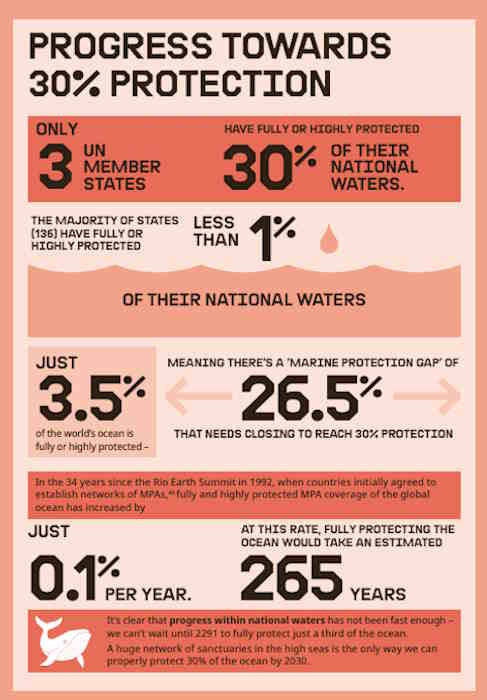
We should get there by 2030. In fact, if we continue at this rate, it could take another 265 years. This is the alarming fact that emerges from the new Greenpeace International report on ocean protection, published on the occasion of the opening of COP17 on biodiversity in Yerevan, Armenia.
A huge gap between the commitments made by governments and concrete actions to safeguard marine life. According to Greenpeace, in fact, just 3.5% of the planet’s oceans today enjoy complete or high protection from destructive human activities, while the international goal is to reach 30% by the end of the decade.
COP17, scheduled until 30 October, represents a particularly important event: for the first time the countries gathered under the UN Convention on Biological Diversity will collectively evaluate the progress made towards the 23 objectives of the Kunming-Montreal Global Biodiversity Frameworkthe agreement approved in 2022 to halt and reverse biodiversity loss. Among the main commitments is the so-called 30×30, that is, protecting at least 30% of the planet’s lands and waters by 2030.
And the first assessments are not encouraging: according to the assessments presented in view of the conference, the world remains far from numerous goals, due to insufficient financing, unsustainable production activities and delays in the implementation of the agreed measures.
Oceans increasingly vulnerable
In the new report Well ConnectedGreenpeace focuses attention on the high Atlantic seas, i.e. international waters outside national jurisdictions. It is here that, in 2025 alone, industrial fishing vessels accumulated approximately 1.6 million hours of fishing, equivalent to over 180 years of continuous activity.
And precisely in the high Atlantic seas, according to the organization, there are currently no completely or highly protected areas capable of offering marine species an effective refuge from industrial activities. The consequences particularly affect migratory animals, such as humpback whales and leatherback turtles, which cross enormous distances to feed and reproduce, encountering fishing nets, commercial boats and other dangers along the way.
To reverse the trend, Greenpeace proposes a network of 17 connected marine reserves, capable of covering over 31% of the high Atlantic seas. According to the analysis contained in the report, this network could protect almost 45% of the areas considered at risk for humpback whales and more than 35% of the sensitive areas for leatherback turtles, classified as vulnerable in the IUCN Red List.
@Greenpeace
It would therefore not be a question of simply establishing new protected areas on paper, but of creating real marine ecological corridors, in which animals can move between fundamental habitats without being continually exposed to the pressures of industrial fishing.
Governments are moving too slowly in protecting our oceans. They must urgently create a network of reserves on the high seas to reach the 30×30 goal and make up for the time lost so far, denounces Lukas Meus, head of the oceans campaign at Greenpeace International.
One of the most important changes compared to previous conferences is the entry into force, on 17 January 2026, of the Global Treaty on the Oceans, also known as the BBNJ agreement, adopted by the United Nations in 2023. The treaty provides an international legal framework to protect biodiversity in waters beyond national jurisdictions, including through the establishment of marine protected areas and the assessment of the environmental impact of human activities.
But the existence of an agreement does not mean that reserves have already been established or that biodiversity is automatically safe. It is necessary to transform commitments into operational measures, define the areas to be protected and guarantee effective rules.
Greenpeace therefore asks the governments gathered in Armenia to accelerate the implementation of international objectives and also invites Italy to complete the ratification of the Global Ocean Treaty. Our country signed it in 2023, but had not yet concluded the internal procedures according to the information available at the time of the opening of COP17.
And also pay attention to a fundamental aspect: the 265 years indicated are not a scientific prediction about the future, but a projection based on the historical rate of growth of completely or highly protected marine surfaces, equal to approximately 0.1 percentage points per year since 1992. A calculation that makes clear how necessary it is to accelerate compared to the results obtained so far.
@Greenpeace
And meanwhile the Biodiversity Parliament is born at the MUSE in Trento
What if, while governments discuss biodiversity, species that risk disappearing could also speak? It is the scientific and cultural provocation at the center of the Parliament of Biodiversity, the new immersive exhibition inaugurated at MUSE – Trento Science Museum in conjunction with COP17 and open to visitors from 17 October 2026 to 6 June 2027.
The Agora space is transformed into a plenary assembly with 93 stations and 186 species represented, divided into nine large biomes, from tropical forests to oceans, from the poles to the mountains. Animals, plants, fungi and microorganisms symbolically become political delegates of the ecosystems they inhabit, presenting their needs, complaints and proposals through installations and interactive tools. Among the protagonists are the okapi, the narwhal, the walrus and even the thylacine, a now extinct marsupial. Also Homo sapiens finds a place in the assembly, but without being the only protagonist.
An experiment that invites visitors to change perspective and question what it means to make decisions while also taking into account other forms of life.
The Parliament of Biodiversity gives us the opportunity to sit and feel, at least for once, like all living things, explain the curators of the exhibition.
Let’s think about it: perhaps this is precisely the message that should also accompany international negotiations: biodiversity is not just a set of numbers, percentages and objectives to be achieved, but a living community of which we are part. And protecting it inevitably means protecting our future too.
HERE is the complete Greenpeace report.
