
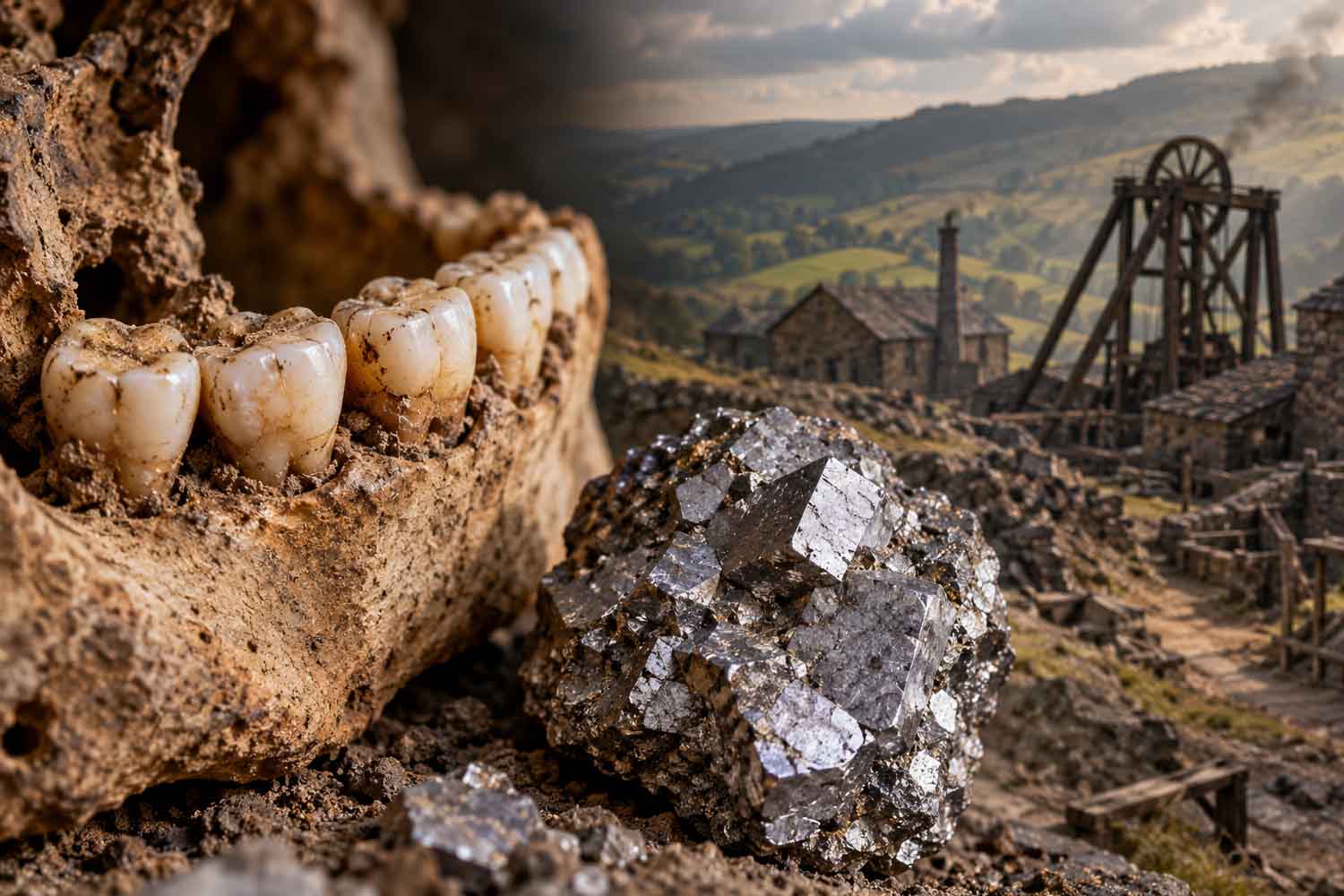
Lead from medieval mines remained in the teeth of those who lived nearby. And, apparently, not even a thousand years ago did pollution affect everyone in the same way. In the Peak District, a region of central England, archaeologists found elevated concentrations of lead in the tooth enamel of 14 out of 15 medieval people analyzed. In some cases, however, the values were much higher than in others. The differences appear to have something to do with social position and, perhaps, even gender.
This is suggested by a study published in the scientific journal Antiquitiescoordinated by Christopher P. Loveluck of the University of Nottingham. The researchers examined the remains of 17 people: 15 who lived in the Middle Ages and two Iron Age individuals used as a comparison. A rather small sample, of course, but enough to find traces of mining activity much older than what has been documented so far. The interesting detail is that those people had absorbed lead when they were still children. Their teeth have preserved for centuries what they breathed and ingested as they grew.
Teeth retain the pollution of childhood
The Peak District, in Derbyshire, has been one of Europe’s main lead mining territories for centuries. A profitable activity, evidently, given that the materials produced were recovered and melted again, erasing most of the traces of the older processes. Archaeologists then looked elsewhere. Precisely in the mouths of people who died hundreds of years ago.
Tooth enamel is formed during childhood and, once completed, remains essentially stable. Unlike bones, which continue to renew themselves, it can retain traces of the substances absorbed while it was growing. A kind of personal archive, with the advantage of not being able to be rewritten. The researchers analyzed molars and premolars, measuring lead through sophisticated chemical analysis. They also studied some isotopes present in the teeth to reconstruct, where possible, the geographical origin of the individuals.
The results show notable differences. In the Wigber Low cemetery, dating back to the 7th century, the five people examined had concentrations ranging between 2 and 69.1 parts per million. At Joule Yard, near Castleton, the values fluctuated between 25.5 and 54.1 parts per million. In the more recent remains of Spital Field, also in Castleton, it reached up to 68.4.
For reference, the authors consider concentrations above 10 parts per million indicative of strong lead exposure attributable to human activities. As many as 14 of the 15 medieval individuals exceeded this threshold. Be careful, though: these measurements concern tooth enamel and cannot be compared directly with blood lead values used today to assess exposure and health risks.
Those with higher social status seemed to absorb less lead
The most interesting part comes when looking at the Wigber Low burials. Two men, believed to be from the area and buried with weapons, had respectively 10.9 and just 2 parts per million of lead in their teeth. A third man, buried without grave goods and perhaps raised elsewhere, reached 29.5. Even between the two women examined the differences were marked: one had 13.2 parts per million, the other even 69.1. The first was buried with relatively prestigious objects, including an amulet with a crystal ball. Five people, five stories and one possible explanation.
According to the researchers, lead exposure may have been influenced by social position and division of labor. Poorer families may have performed the more dangerous tasks, such as preparing and processing ore, while people of higher status were more likely to avoid them. Women may also have been involved in particularly contaminating activities.
Of course, a grave goods are not the same as a medieval tax return. It offers indications on the status of a person, without allowing us to reconstruct with certainty their daily work. And five individuals are too few to determine how an entire community was organized. Evidence, however, suggests that those who benefited from mining production may have been able, at least in some cases, to stay further away from its consequences.
The situation seems to change as mining activities become more intense. At Joule Yard, between the late 7th and 8th centuries, all five individuals analyzed exceeded 25 parts per million. The lead had probably spread enough in the environment to reach even those who did not work directly in the mines. In short, when pollution becomes widespread enough, even staying away from the dirtiest work may not be enough.
The women died young, but lead may be only part of the story
Among the analyzed remains another rather disturbing fact appears: all three women in the medieval sample died between the ages of 17 and 25. Two had been buried near young children. A circumstance that has pushed scholars to also consider the possible consequences of exposure to lead during pregnancy.
The link has a scientific basis. As the World Health Organization reminds us, lead is a toxic substance that can damage various organs and systems, including the nervous and reproductive systems. During pregnancy, that accumulated in the mother’s bones can be released back into the blood, also exposing the fetus. Consequences may include an increased risk of miscarriage, premature birth and problems with the baby’s development.
This does not mean that the three medieval women died of lead poisoning. The study does not allow us to establish this, nor to reconstruct how much metal they had in their blood at the time of death. The data therefore remains a hypothesis to be explored further. It would be necessary to analyze many more burials, possibly comparing men, women and children belonging to different social groups.
The lead in the teeth also tells us when the mines worked harder
The research also allowed us to reconstruct a piece of English economic history. Analyzes indicate that lead production in the Peak District had already resumed by at least the mid-7th century, anticipating the documentary evidence available to date. Then, around 1200, the traces become particularly consistent. The two individuals from Spital Field with the highest concentrations date back, according to dating, to a period between 1175 and 1270. Precisely in those years, between approximately 1180 and 1215, English tax documents record one of the peaks of medieval lead production in the region.
And they are not the only witnesses. Traces of the pollution of that period also appear in the sediments of some Scandinavian lakes and in the ice of Colle Gnifetti, on Monte Rosa, where the layers accumulated over time preserve particles transported by the atmosphere. On one side there are the tax records. On the other, the Alpine glaciers. In the middle, the teeth of people who would hardly have imagined contributing, more than a thousand years later, to the reconstruction of the medieval economy. The study is of course about historical pollution and does not describe the current environmental situation in the Peak District.
However, there is one aspect that runs through the entire research. The mines produced a precious raw material, used in numerous economic activities, while exposure to toxic substances could be distributed very differently among people who inhabited the same territories.
Today, a large part of the mining structures of that era have disappeared. The waste was recovered, remelted, dispersed. Very little evidence remains of some processes. The lead absorbed by those children, however, is still in their teeth. And he could also tell who, even then, paid the highest price.
