
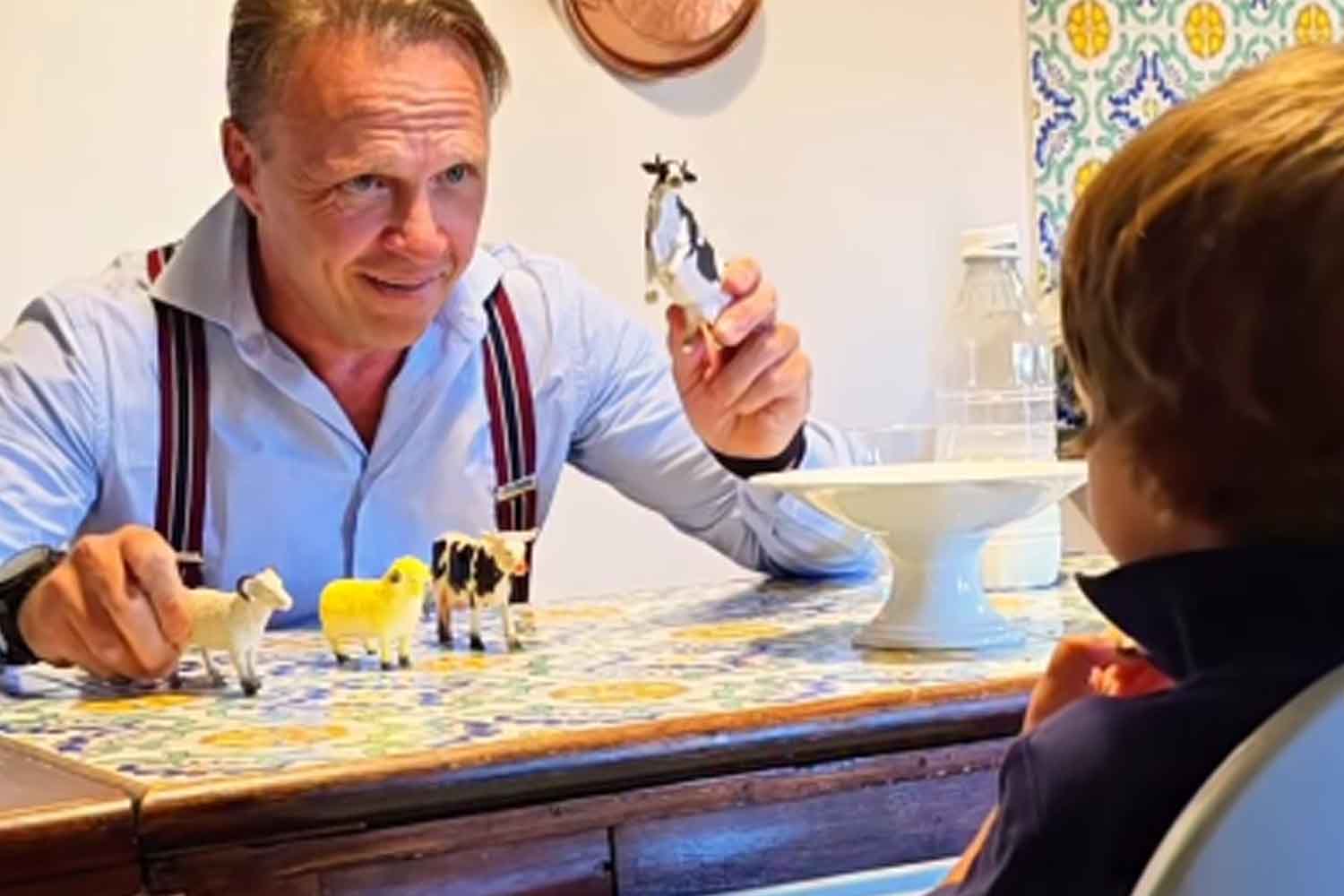
On the table there are three plastic animals. Francesco Lollobrigida takes them one at a time and presents them to a child seen from behind: “this is the goat, this is the cow and this is the sheep”. Then she hands him a glass of milk. It is the video published by the Minister of Agriculture to anticipate a new institutional campaign dedicated to Italian milk, announced on public service channels. The zoology lesson lasts a few seconds. The Internet, of course, had more time.
And in fact the protagonist of the commercial quickly became the protagonist of the comments too. There are those who announce:
I decided right now to go vegan!
Who already looks beyond Palazzo Chigi with a dry:
How much material for Crozza…
Who asks the minister to worry about the prices paid to farmers. Then comes the animal rights criticism, with users asking why, together with the toy cow, the conditions of animals in intensive farming are not also shown. Milk had to be the protagonist. For a few hours he had to give up his glass to teasing.
Lollobrigida accompanies the video with a more solemn message: “We grow, we change, we grow up”, while some flavors continue to accompany us. He thanks the farmers and the entire supply chain, defining Italian milk as excellent. The problem with the scene chosen to tell it is that between the plastic animal and the finished product practically everything that makes it possible to fill that glass disappears.
The jokes make you laugh, the calf a little less
Let’s just take the cow. To produce milk she must have given birth. On conventional European dairy farms, according to scientific advice from the European Food Safety Authority, EFSA, the vast majority of farms separate cow and calf immediately or shortly after birth. It is the artificial breeding system still commonly adopted in dairy production.
The practice allows the feeding of the calf and the milking of the mother to be managed separately, but involves the loss of the benefits linked to contact. EFSA experts have found positive effects already in the first hours spent together and recommend that the calf stays with the mother for at least around 24 hours, progressively increasing the adoption of systems that allow longer contact. The objective indicated in the opinion would be to achieve, in the future, maintaining it for the entire period prior to weaning.
It is an important distinction also to avoid the opposite, equally convenient version, in which every farm automatically becomes a circle of hell. Systems and companies can be very different and from the commercial we do not know which companies are involved in the campaign. Early cow-calf separation, however, is not an animal rights fantasy: it is a practice described as majority by the European Union scientific body that deals with food safety and animal welfare. In the video the path is much quicker: cow, glass, milk. The calf does not enter the frame.
Intensive farming doesn’t look good on the coffee table
Even the reference that appeared in the comments to intensive farming deserves something more than an exchange of words. There is no single dairy farming model and it would be incorrect to attribute the worst conditions observable in the sector to all Italian production. The problem of the welfare of cows raised for milk production, however, is concrete enough to have led EFSA to publish a specific opinion in 2023.
In Europe, cubicle housing is the most widespread system and in several Member States the number of farms allowing cows access to pasture has decreased over the last decade. Among the problems identified by experts are lameness, difficulty moving and resting, mastitis and metabolic disorders. EFSA recommends at least 9 square meters of internal space per animal, adequate resting surfaces and access to well-managed pastures; it also considers the welfare of cows kept permanently tied to the post to be compromised.
None of this proves that the farmers thanked by Lollobrigida adopt those practices. However, it says a lot about the distance between the real supply chain and the one chosen for the commercial. The first is made up of animals, births, milking, stables, pasture when there is, vets, costs and welfare problems. The second fits comfortably on a table and can be placed in a box as soon as the shoot is finished.
Meanwhile, farmers are discussing prices, not animals
Then there is the other piece that ended up in the comments: the economic one. The promotion of milk was not born in a particularly peaceful moment for those who produce it. The Ministry itself had convened a supply chain table in January to address the drop in prices and support a sector that Masaf described as being in difficulty.
In June, producers and processors reached a new agreement with the Ministry on the price of milk, valid for six months and indicated by Masaf as an improvement compared to the previous quarter. Thanking the farmers in the commercial, therefore, comes after months in which those same farmers discussed above all how much they get paid for what they produce.
And the Ministry is also investing directly in promotion among children. The 2026-2027 “Milk in schools” program has 6.2 million euros and includes distribution of milk, yogurt and cheese in primary schools, as well as workshops, tastings and visits to farms and dairies. The declared objective is to introduce food and production systems to the little ones.
And it is perhaps precisely this that makes Lollobrigida’s teaser curious. If we want to explain to children where milk comes from, recognizing a cow is probably the easiest part.
The milk spilled to the edge of the glass
The teasing remains the most immediate part of the story, because the video already offers a lot of material without needing to add to it. A minister, three plastic animals, a child and the explanation of what a sheep is. Social media simply did their job.
But underneath the jokes a less funny question appeared: how much of animal production do we want to show when we tell it to children?
The campaign can legitimately promote Italian milk and can do so without turning a few-second commercial into a zootechnical documentary. But if you choose to start with the animals, reducing them to three puppets produces a very comfortable story. We see the silhouette of the cow, the glass of the milk. Between the two there is a birth, often a calf separated early from its mother, very different farming systems, welfare problems recognized by European authorities and farmers who have to deal with prices.
We have now recognized goat, cow and sheep. To really tell where the milk comes from, a few more stickers would be needed.
View this post on Instagram
