
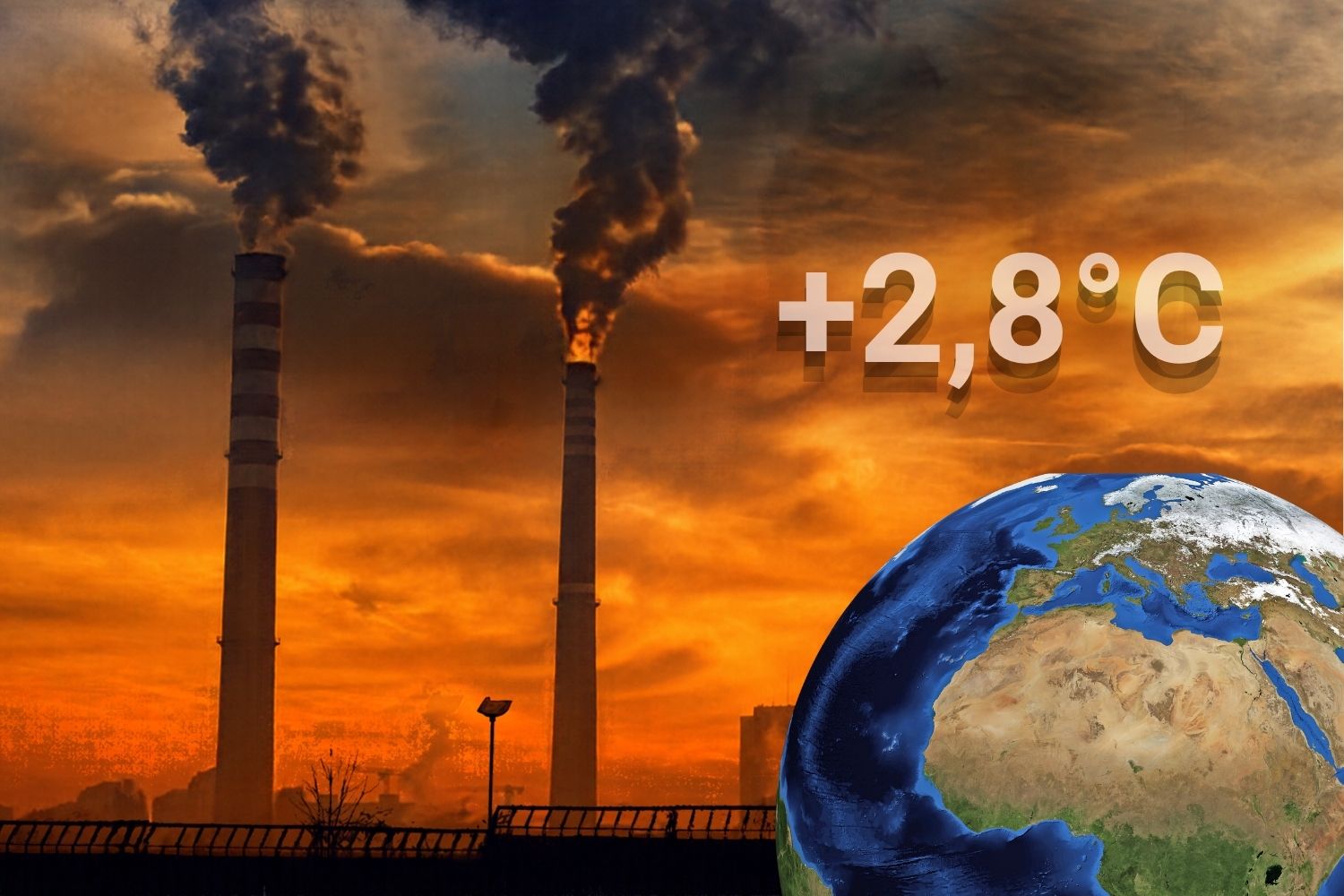
The Earth is warming and, if we continue with current climate policies, the average global temperature could increase by 2.8°C by the end of the century compared to pre-industrial times. A worrying prospect, especially since the 1.5°C threshold set as an objective by the Paris Agreement is now destined to be exceeded.
This is stated in the Emissions Gap Report 2026, published on 21 October by the United Nations Environment Program (UNEP). The document analyzes the distance between predicted greenhouse gas emissions and those we should achieve to contain global warming. And he explains to us that we can still avoid the worst scenarios, but only if we reduce emissions much faster than we are doing.
View this post on Instagram
How much we need to reduce emissions
According to UN experts, to limit the exceeding of 1.5 °C as much as possible, it is necessary to cut global greenhouse gas emissions by 18% by 2030, by 45% by 2035 and by 69% by 2040, taking 2025 levels as a reference. Governments, however, have promised much less. Even if all national climate commitments were met, emissions would only decrease by 11-15% by 2035.
The problem also emerges from the most recent data. In 2025, global emissions reached approximately 58.4 billion tonnes of CO₂ equivalent, a value essentially stable compared to the previous year. This unit of measurement allows you to add the impact of different greenhouse gases, including methane and nitrous oxide. The stability of emissions, however, is not enough. To slow down global warming, significant and lasting reductions are needed.
What happens if we exceed 1.5 degrees
The report introduces an important element: exceeding 1.5°C does not mean that all climate scenarios are the same. With immediate and particularly incisive interventions, according to UNEP it would still be possible to limit the peak of warming to 1.7-1.8°C around the middle of the century, and then bring the temperature back to 1.5°C by 2100. The latter result would have a probability of around 50%. But every tenth of a degree counts. Higher temperatures increase the risks of extreme heat waves, floods, fires and damage to ecosystems. The longer the planet stays above 1.5°C, the greater the chance of irreversible changes will also be.
Then there is another difficulty: to return below this threshold, approximately 320 billion tons of CO₂ would have to be removed from the atmosphere over the course of the century, conserving them stably. An enormous undertaking, which also depends on technologies and removal systems that are still difficult to develop on this scale.
“Every additional fraction of a degree and every additional year of warming above 1.5°C increases climate impacts and risks, such as the deadly floods, heat waves and forest fires that have plagued many nations this year,” said Inger Andersen, UNEP Executive Director. “Therefore, we must do everything we can to minimize peak warming and get back to 1.5°C by the end of the century. This is possible. We have a wide range of successful examples that demonstrate how emissions can be reduced rapidly. Now it is up to nations to urgently put in place policies that trigger rapid, deep and lasting emissions reductions, and that put the world on the path to a more stable climate and more stable economies and societies.”
Renewable energies are growing, but more needs to be done
There is also some encouraging news from the report. Over the last ten years, the spread of renewable energy has exceeded many predictions, especially thanks to photovoltaics. And several climate policies have already proven to work. UNEP examined more than 220 evaluations of public interventions, finding that policies applied to the electricity sector produced average emissions reductions of 9%. To achieve sufficient results, however, this progress must accelerate.
By 2035, for example, global electricity production from coal is expected to decline by at least 75% compared to 2025. Actions are also needed to improve energy efficiency and reduce methane emissions. The next opportunity for discussion will be COP31, the UN climate conference scheduled for November. Governments will have to deal with a fact that is difficult to ignore: current commitments lead to a much warmer planet, while the technologies and policies capable of reducing emissions are already available. The difference, according to the report, will depend above all on how quickly they are adopted on a global scale.
