
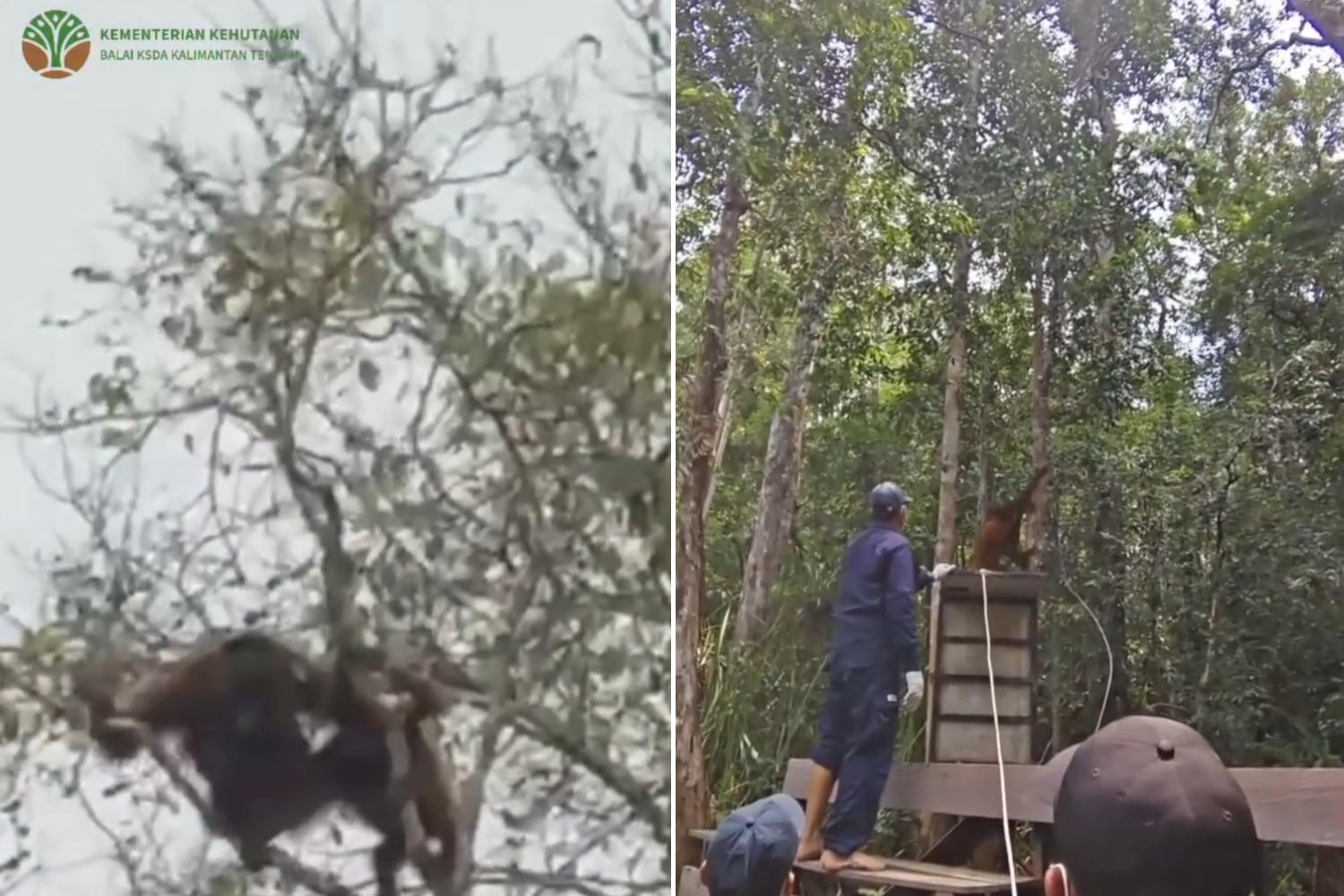
Between September 3 and 4, rescue teams from the KSDA Center of Central Kalimantan (Region II section) and the Orangutan Foundation International (OFI) organization carried out a delicate rescue operation in the village of Sandul, located in the Seruyan regency in Borneo. The alarm was raised following reports from local residents, who had spotted a female orangutan perched on the top of a tree to escape the thick smoke caused by forest fires.
Supported by the Batu Ambar police, the subdistrict authorities, the Babinsa forces and the local population, veterinarians and rescuers located the animal and discovered that it was carrying a baby. The specimens were identified with the names Sandul (also known as Raya) for the twenty-year-old mother, and Sekutai (or Rayu) for the one-year-old cub.
View this post on Instagram
The medical tests and the transfer to the Lamandau Sanctuary
Health checks conducted on site by staff from Indonesia’s Ministry of Forestry found that neither the mother nor the calf suffered direct burns, although the cub showed typical symptoms due to smoke inhalation. Once their health conditions were stabilised, the doors were opened for the two primates to be released into the wild into a protected habitat.
On 5 September, operators began the transfer of Sandul and Sekutai inside the Lamandau Wildlife Sanctuary, a vast green area spared from the flames which will guarantee their reintegration into nature. The case does not represent an isolated event: in the previous month alone, rescue teams had already rescued seven other orangutans who had been stranded by the fires in the province of West Kalimantan.
The environmental drama of fires and the health emergency
The devastation caused by the agricultural practice of deforestation through fire destroyed over 200 thousand hectares of land between January and July. This ecological emergency puts a strain on the survival of the species, whose population counted in 2016 numbered around 57 thousand specimens in Borneo and only 11 thousand in Sumatra, the latter further decimated by the serious floods of late 2025.
The impact of the fumes has crossed national borders, reaching Malaysia and forcing the closure of schools due to levels of air pollution considered dangerous. To combat the fires, the disaster agency BNPB used over four million liters of water and coordinated cloud-seeding operations, with the dispersion of 8 thousand kilograms of salt in the clouds to cause artificial rain. On the health front, Deputy Health Minister Dante Saksono Harbuwono confirmed that around 13,500 people were treated for respiratory infections between July and August, prompting the government to distribute more than five million masks to the population.
