
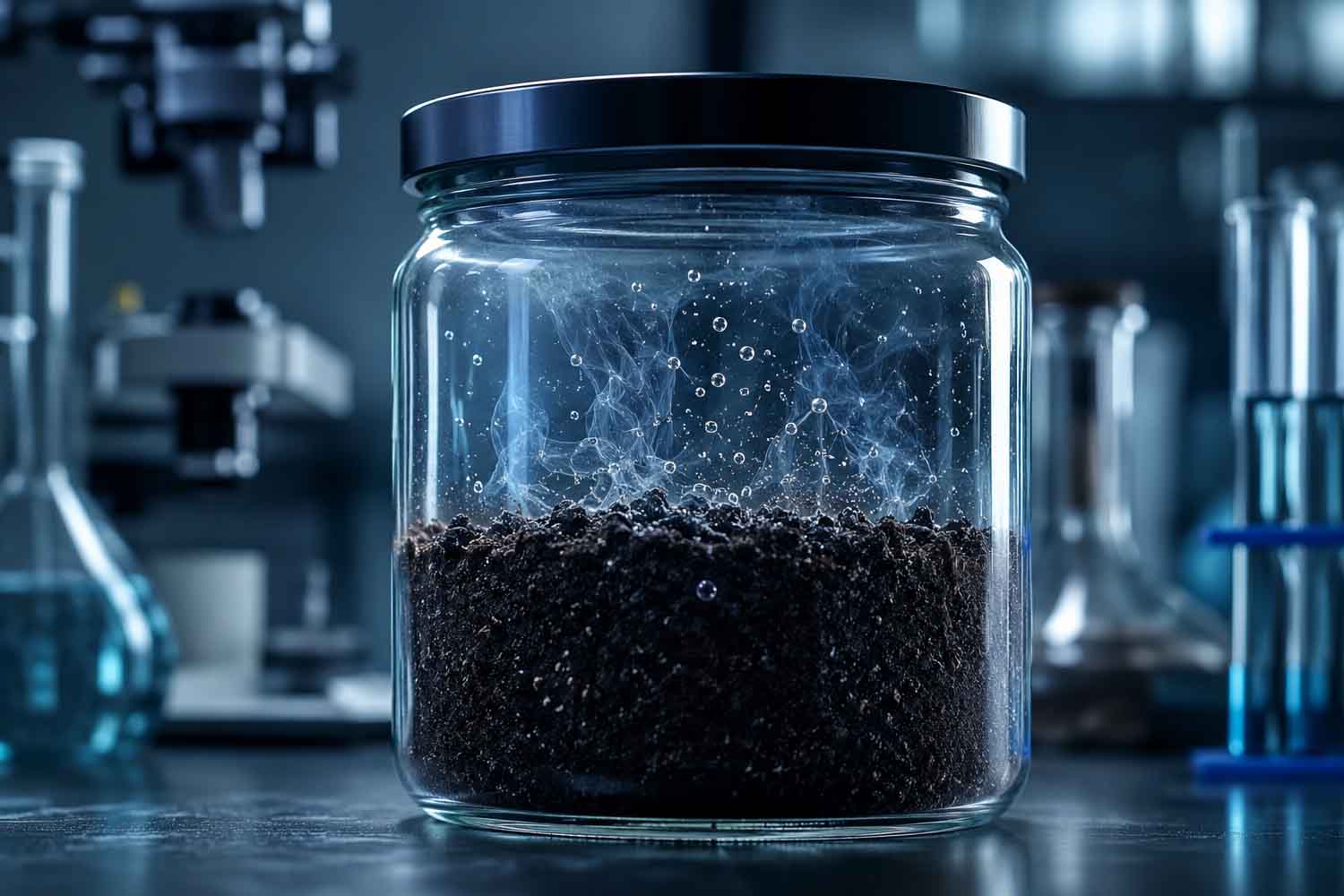
A jar full of soil, closed in the laboratory, seems like a rather boring thing. Even more so if that land has been bombarded with gamma radiation, a treatment used to eliminate microorganisms, bacteria, fungi, any detectable life form. And instead that sample continued to do a very precise thing: it consumed oxygen and released carbon dioxide.
This is where the fascination of the study published on comes from Science Advanceswhich talks about non-living breathing: a formula that sounds almost poetic, while describing a very concrete phenomenon. The sterilized soil, left in sealed microcosms and observed over time, continued to emit CO₂ for a very long period, exceeding six years of monitoring. Life in there had been removed. Chemical reactions, it seems, still had something to do.
Barren land, lively reactions
The first thing to clarify is this: breathing soil is not a hidden organism. No creatures surviving in secret, no return of spontaneous generation, no fairy tales disguised as science. The land remains barren. What moves are the molecules left in the soil, together with the minerals and organic substance that make up that very complicated matrix that we trample on every day without thinking too much.
The researchers sterilized the samples and placed them in airtight containers. Then they measured the gases present over time. Usually, when a soil produces CO₂, we immediately think of microbial respiration: microorganisms that degrade organic matter and release carbon dioxide. Here the picture changes. After irradiation, detectable biological activity was quenched, yet emissions decreased without disappearing. In some samples they were still detected after 1,606 and 2,442 days. More than six years.
The detail of the glucose makes the picture even more interesting. In one part of the experiments, glucose, a simple sugar, was added to the medium. The spiked samples showed higher emissions than those without spiking, suggesting that some organic carbon transformation reactions could continue even without live cells orchestrating the process.
The chemistry under your feet
To understand what was happening, the scientists looked into the chemistry of the soil. They used isotopic analysis, spectroscopy and experimental systems capable of detecting the passage of electrons. In practice, they tried to understand if that sterilized earth was still capable of supporting reactions similar to those that, in cells, serve to transform organic molecules and release energy.
The word “similar” matters a lot here. In cells, processes such as the Krebs cycle are part of metabolism, a very fine machine made of enzymes, intermediate steps, electron exchanges and oxygen consumption. Sterilized soil lacks the cell that coordinates everything. Yet the soil seems to offer a kind of chemical scaffold: mineral particles, organic compounds, molecular residues and possibly enzymes released from dead cells can keep some transformations active.
It’s not a discovery that came out of nowhere. Already in 2013 a study published on Biogeosciences had proposed the existence of an extracellular oxidative metabolism, called EXOMET, linked to enzymes released by dead organisms and stabilized by soil particles. In that study, this process could contribute significantly to the CO₂ emitted by the analyzed soils, with an estimated share between 16% and 48%.
The new work lengthens the temporal perspective. We are no longer talking about residual activity observed for a few days, easy to dismiss as a temporary wake of a newly sterilized system. Here the phenomenon remains measurable for years. And it is precisely this duration that makes the result so difficult to ignore.
Life and matter, less comfortable boundaries
Soil is one of the most complex environments on Earth. Within a few grams, minerals, water, air, roots, bacteria, fungi, fresh organic matter and ancient organic matter coexist. When we remove the life from this mixture, we tend to imagine a still matter. The experiment suggests something dirtier, more concrete, less linear: Even without active cells, some molecules can continue to react.
Part of the scientific community urges caution. Some researchers point out that enzymes released by dead cells may remain present longer than expected. Others call into question the role of minerals, such as iron and aluminum oxides, capable of promoting chemical reactions in organic compounds. The two hypotheses can also coexist. The soil, moreover, rarely allows itself to be reduced to a clean explanation.
This makes the discovery even more useful. Because it forces us to treat the terrain as an active system even when visible biology is removed. The sterile soil becomes a miniature natural laboratory, where chemistry continues to work with what it finds: sugars, organic residues, minerals, oxygen, electrons.
Because it’s also about the climate
Soil respiration is one of the big players in the global carbon cycle. Every day soils exchange enormous quantities of CO₂ with the atmosphere, especially through the activity of roots and microorganisms. Better understanding how much of this exchange depends on living cells and how much on extracellular or non-cellular processes can help to read more precisely the behavior of soils in a changing climate.
Temperature, humidity, drought, oxygen availability, and amount of organic matter alter how soil holds or releases carbon. If there are chemical reactions capable of continuing even in the absence of active life, the picture becomes less automatic. The soil is not just a warehouse, nor a simple surface under the crops. It is a slow, porous machine, full of invisible exchanges.
Then there is another consequence, older and more fascinating: the origin of life. If some metabolism-like reactions can occur outside cells, then some of the chemistry now associated with living organisms may have appeared before actual cellular life. It does not mean having solved the problem of how life on Earth arose, but having one more clue: certain reactions could belong to raw material rather than to organized biology.
The discovery, therefore, does not mean that the sterilized soil is alive. It says something more subtle and perhaps more interesting: the chemistry of life can leave traces, movements, molecular habits even where the cells no longer exist. A jar of earth, at that point, stops seeming like a firm thing. It’s closed there. And he still works.
You might also be interested in:
