

A new laboratory test turns the spotlight on the presence of cadmium in spaghetti. Among the Italian brands under examination also Barilla, De Cecco and Rummo, with very different results depending on the reference.
Pasta is one of the most present foods on our tables, but what do we really find inside a pack of spaghetti? He tried to answer this question 60 Millions de Consumerswho brought several packages of pasta to the laboratory and subjected them to a wide series of analyses.
The French magazine’s experts looked for heavy metals, pesticides and mycotoxins, but also evaluated the nutritional profile, composition and behavior of the pasta after cooking. The most striking result is that relating to cadmium, detected in most of the products analyzed.
A presence which, it should be noted, does not automatically mean that the pasta is dangerous or does not comply with the law. In fact, all the cadmium levels found remained below European regulatory limits. The problem, according to the magazine, mainly concerns the rather marked differences between one product and another and the fact that cadmium tends to accumulate in the body.
Why is cadmium so concerning?
Among the substances researched, cadmium is the one that has attracted the most attention of experts. It is a heavy metal classified as carcinogenic, mutagenic and toxic for reproduction, which can be present naturally in soils and reach foods through crops.
According to the French agency ANSES, cited by 60 Millionsfor people who do not smoke, food represents the main source of exposure to cadmium, accounting for up to 98% of total exposure.
Among the foods that can contribute to the intake of this contaminant there are various cereal-based products, including bread, rice and pasta. The problem is not represented by a single portion of spaghetti, but by repeated exposure over time. Cadmium, in fact, tends to accumulate in the body.
Why can pasta contain cadmium?
The answer is that durum wheat is particularly affected by the presence of this metal. The group monitoring cadmium in the French food supply chain found an average content of 0.056 mg/kg in durum wheat, a value which is still much lower than the European limit of 0.18 mg/kg set for wheat. However, the comparison with soft wheat is significant: the latter has an average value of approximately 0.034 mg/kg. One of the reasons why durum wheat pasta can represent a source of exposure to cadmium is therefore linked to the plant’s ability to absorb this element from the soil.
The spaghetti with the most cadmium
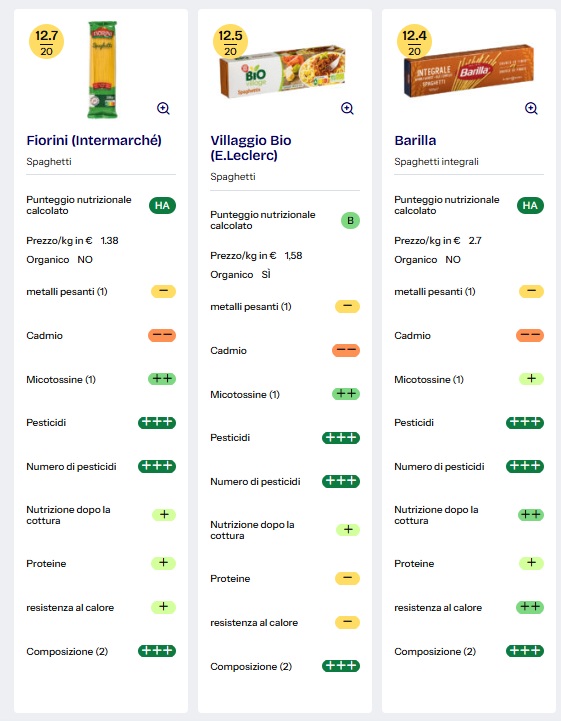
Among the 18 spaghetti analyzed, the highest result for cadmium concerns Barilla wholemeal spaghetti, in which 60 Millions detected 0.071 mg/kg. It is a fact that the magazine considers particularly significant.
Why might wholemeal pasta have higher levels? The explanation is linked to the structure of the grain. In fact, cadmium tends to accumulate especially in the outermost layers of the cereal, which are partly eliminated during refining but remain in the wholemeal flour.
This does not mean that wholemeal pasta should be avoided: from a nutritional point of view it has important advantages, especially due to the higher fiber content. However, the test result shows that even a food that is generally considered healthier can contribute to exposure to certain contaminants.
@60 Millions de Consumers
@60 Millions de Consumers
@60 Millions de Consumers
@60 Millions de Consumers
What does it mean for those who eat pasta every day?
60 Millions gives a concrete example. According to the magazine’s calculations, a child of around 12 years old, weighing 40 kg, who consumed five weekly portions of 60 grams of dry pasta with the level of cadmium found in Barilla wholemeal spaghetti would consume around 21 micrograms of cadmium per week. This is more than a fifth of the tolerable weekly dose indicated by the European authority.
However, it is important not to interpret this data as a threshold beyond which pasta automatically becomes dangerous: pasta is only one of the numerous possible food sources of cadmium and the overall exposure depends on all the foods consumed.
The results of Italian spaghetti
Among the spaghetti analyzed we find various Italian products of the Barilla, De Cecco and Rummo brands, with different results depending on the reference.
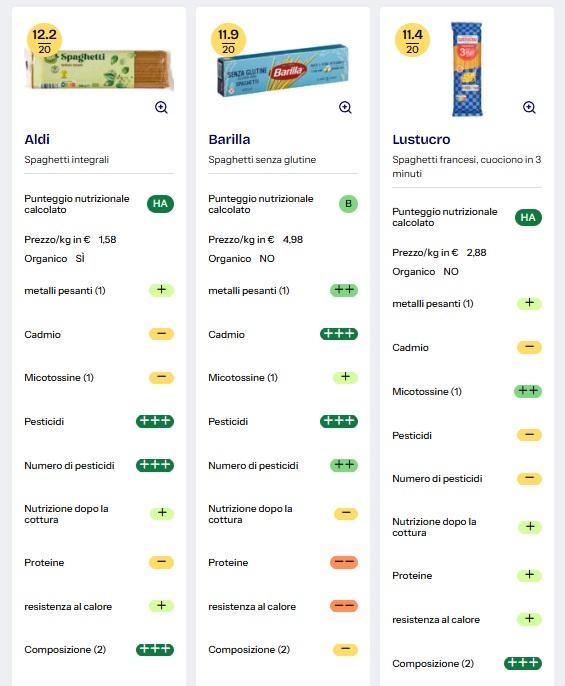
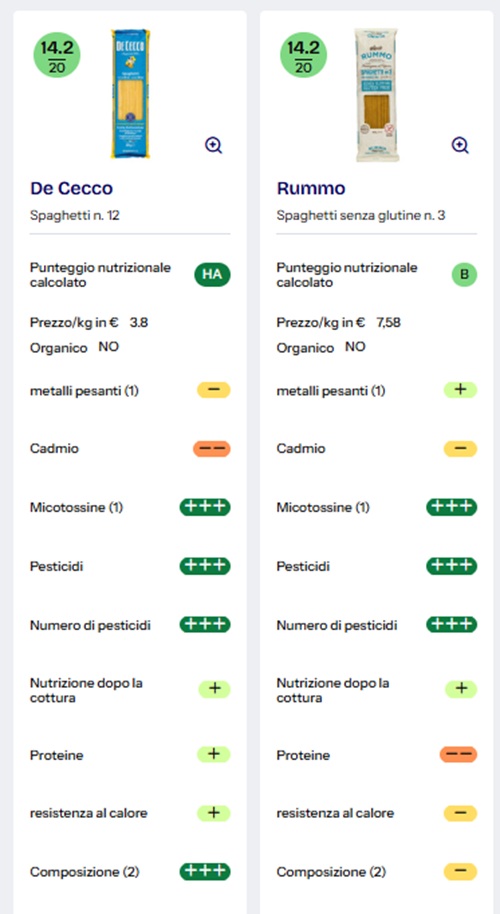
De Cecco spaghetti n. 12 obtained an overall score of 14.2/20, placing them at the top of the ranking considering all parameters. Regarding cadmium specifically, however, they received a very negative rating (–).
The Barilla Protein+ spaghetti instead reached 15.2/20, gaining one of the best positions in the test. The product stands out above all from a nutritional point of view for its high protein content and, for cadmium, it has obtained a very positive rating (+++).
The picture for Barilla wholemeal spaghetti is more complex: despite offering a nutritional advantage in terms of fibre, they recorded the highest cadmium value of all the spaghetti analysed, equal to 0.071 mg/kg, receiving a very negative rating for this parameter (–).
Barilla gluten-free spaghetti instead obtained an overall score of 11.9/20, but a very good rating for cadmium.
Rummo gluten-free spaghetti n. 3, finally, reached the score of 14.2/20. For the latter, 60 Millions in addition to a negative opinion on cadmium, it also indicates the presence of arsenic, one of the other contaminants sought in the test.
What about pesticides?
Good news instead comes from the pesticides front. The magazine looked for 728 molecules in the samples analyzed. Approximately two-thirds of the pasta had no detectable residues, regardless of whether it was conventional, wholemeal, organic or gluten-free. Among these also Italian pastas, which obtained the highest rating in terms of pesticides. In some cases, however, multiple substances have been identified at the same time. Among the molecules detected include piperonyl butoxide, used as a synergist of some pyrethroid insecticides, deltamethrin and clopyralid.
The levels found, the magazine specifies, were still below the maximum limits allowed. The experts also looked for mycotoxins, substances naturally produced by some molds that can develop on agricultural crops before harvest or during storage. Among the most problematic ones are aflatoxins, ochratoxin A, fumonisins, deoxynivalenol (DON) and T-2 and HT-2 toxins. Overall, the test did not highlight a particularly alarming situation, but it confirms how different the results can be from one product to another, even between spaghetti belonging to the same brand.
