
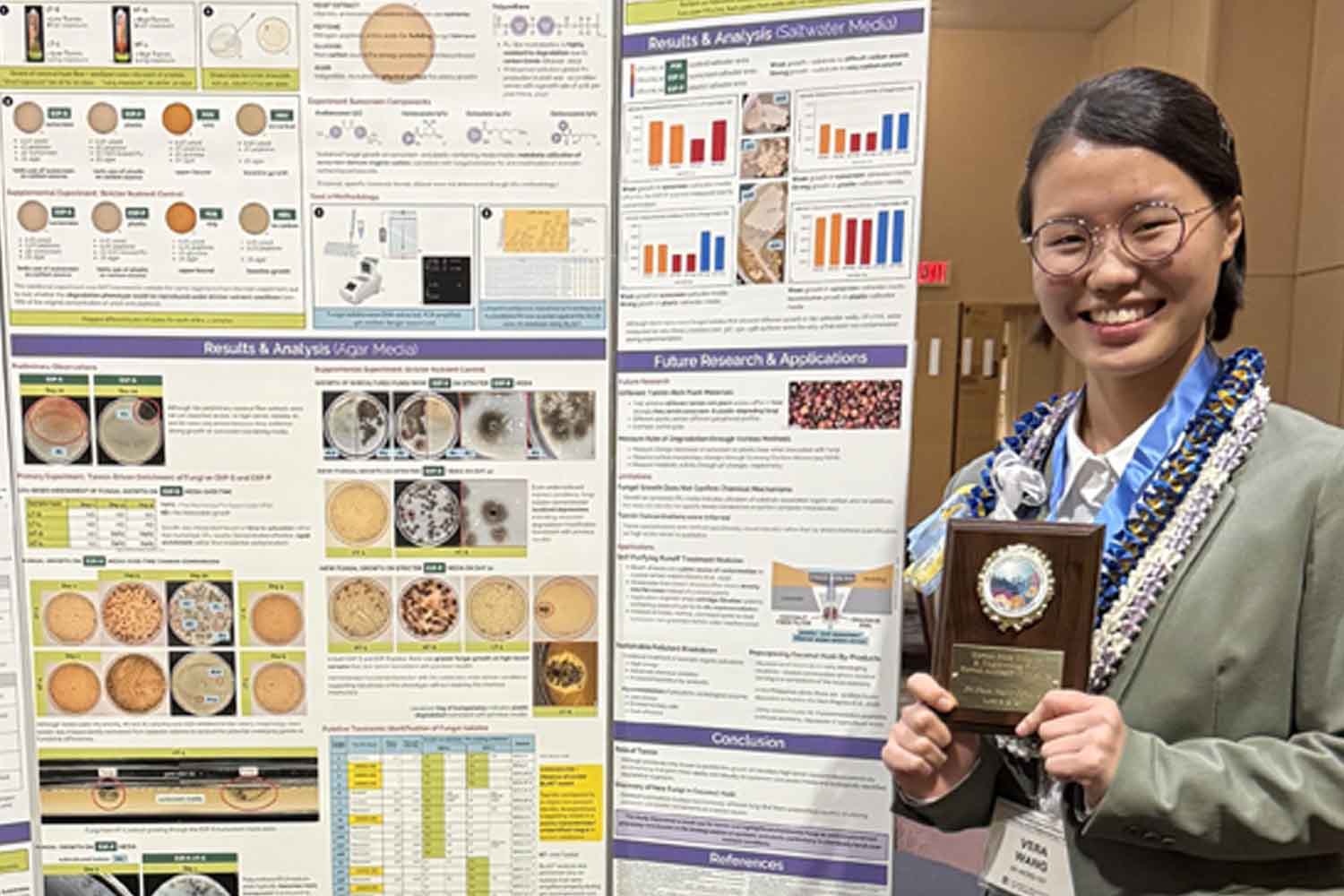
He stopped looking at the coconut shell only as a filter and began to wonder what lived on it. From that question Vera Wang, a student at Kaiser High School in Honolulu, came to identify fungi naturally present in coconut fibers capable of degrading plastic and sunscreens in the laboratory. A work conducted in the Amend Lab ofUniversity of Hawaii in Mānoa and honored at the 2026 Hawaiʻi State Science & Engineering Fair.
The project Bioprospecting of Novel Sunscreen- and Plastic-Degrading Fungi in Tannin-Rich Coconut Fiber won first place in the Microbiology category, third place overall and several special prizes.
First the coconut filter, then the mushrooms
The story had begun two years earlier. During his sophomore year of high school, Wang had designed a seawater filter made from coconut by-productsalso taking inspiration from traditional Polynesian weaving techniques. The device was designed to remove microplastics and sunscreen residues from the surface of the water. Capturing them, however, left open a rather cumbersome question: once removed from the water, what to do with them?
Wang then shifted focus to the fibers themselves. Their porous structure promotes the passage of air and water and can create an environment suitable for microbial growth. Hence the idea of studying the fungal communities naturally present on coconut shells and check how they grew on soil containing plastic and sunscreen. In Anthony Amend’s laboratory, with the support of marine biologist Kaylee Christensen, the student also worked on the analysis of the DNA of microorganisms.
The tests identified fungi capable of biodegrading the materials examined. The team also noted that a tannic compound can be used to detect fungi with these abilities; according to Christensen, the tannins naturally present in the fibers could favor the growth of microorganisms capable of attacking complex compounds. It is still a hypothesis to be explored further.
Some fungi may be as yet uncharacterized species
Then there is a detail that makes the project even more interesting. By comparing the collected genetic material with one of the largest international databases of genes and genomes, some samples returned no matches. This suggests that among the fungi analyzed there may be species not yet characterized by science. It suggests, in fact: to formally describe a new species, much more in-depth taxonomic analyzes are needed.
Prudence is also needed in the rest. The University of Hawaii communications describe laboratory experiments and do not provide sufficient data to determine how quickly these fungi degrade different materials, under what conditions they can do so outside of plates, or whether the system can be scaled up to an environmental scale. We are a long way from being able to fill bags of coconuts and send them to clean up the Pacific.
The research direction, however, already exists. In the same laboratory at the University of Hawaii another group had studied marine mushrooms collected along the coasts of Oʻahu and their ability to degrade polyurethane. According to the results communicated by the university in February 2025, over 60% of the fungi tested showed some ability to attack that material and some strains, after three months of experimental selection, had increased the speed of degradation by up to 15%. Researchers are now also studying harder-to-degrade plastics, including polyethylene and PET.
A waste material that already hosts part of the solution
Wang’s work therefore fits into a broader trend of bioremediationthat is, the use of living organisms to transform or remove pollutants. The peculiarity lies in the starting point: a plant by-product abundant in tropical islands that first intercepts pollutants and then hosts microorganisms capable, at least in tests, of degrading some of them.
For now, the coconut shell remains much closer to a laboratory bench than to an ocean cleanup facility. But inside those fibers Wang found something that previously easily went unnoticed: a small community of fungi with a decidedly unconventional appetite.
