
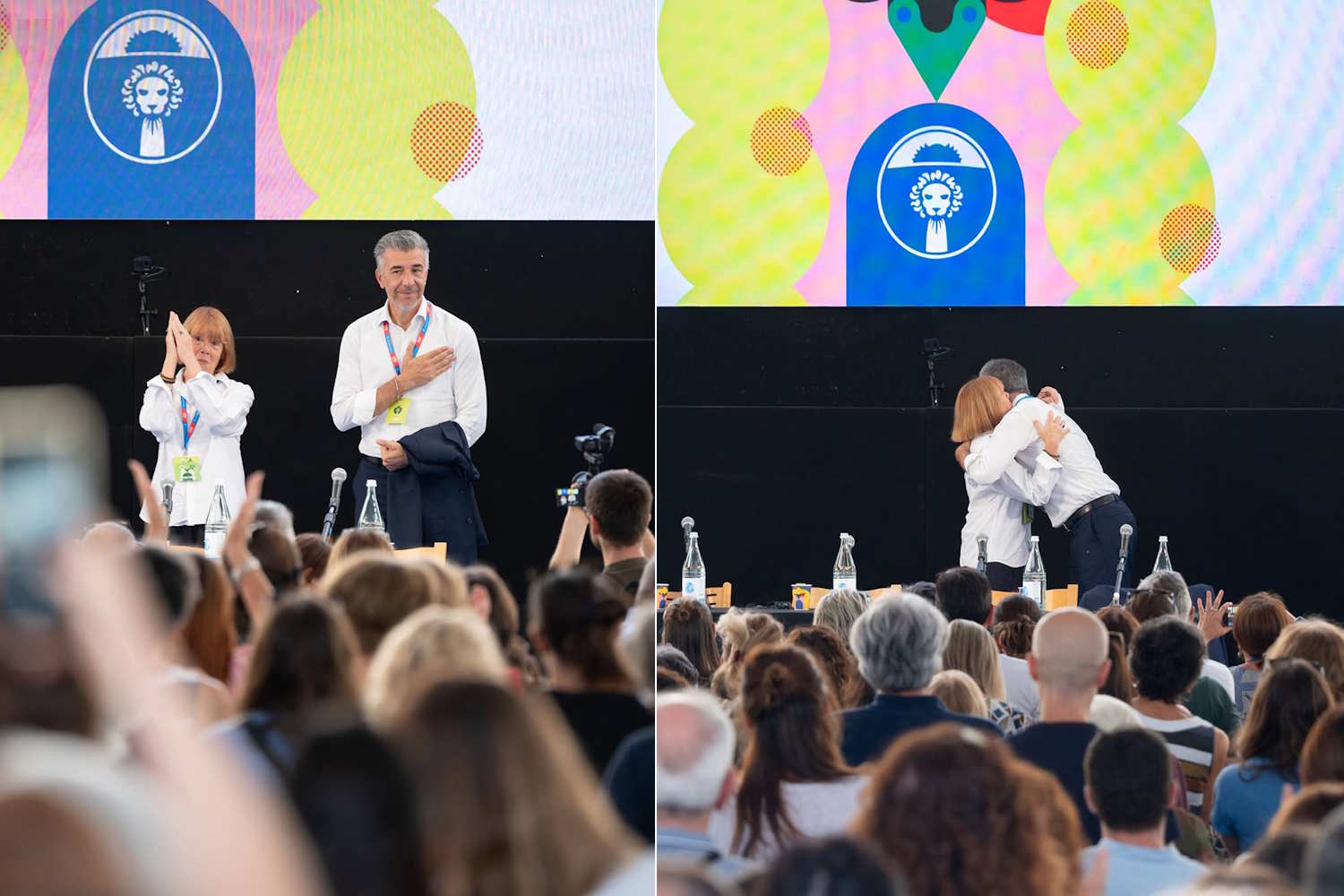
She was raped for years by dozens of men. He lost his daughter, Giulia, killed by a violent man. Two stories that arise from very deep wounds and that no one should ever be forced to tell.
Yet, in Mantua, Gisèle Pelicot and Gino Cecchettin chose to transform pain into a public voice, meeting on the stage of the Festivaletteratura to talk not only about what happened to them, but above all about what concerns each and every one of us. And melting into a magnificent embrace.
Gisèle Pelicot has chosen to face the open trial against her husband and the men accused of the abuse she suffered for years. A decision that required enormous strength, born from the desire to break the silence and give a message to other women: there is no shame in the violence suffered, the shame belongs to those who commit it. Gino Cecchettin, after the murder of his daughter Giulia at the hands of his ex, chose instead to question what often comes before extreme violence: the culture of possession, the inability to accept rejection, the distorted idea according to which a person can belong to another.
Two different paths, but a common point: violence against women does not arise suddenly, but is the result of a culture that too often normalizes control, oppression and inequality.
“Love is not possession”
During the dialogue at the event entitled “Shame must change sides”, moderated by Ilenia Caito, Cecchettin brought attention to a key word: possession. Many tragedies start right there, from the sick idea that the other person is not free, but something to be controlled. A cultural error that can hide behind apparently harmless phrases, jealousies mistaken for love, behaviors justified as demonstrations of affection.
Pelicot also spoke about the need to change the way society interprets violence. Because those who commit violence often try first of all to erase the other person’s identity, transforming them into an object.
Both also experienced the weight of public judgment. Pelicot said she received thousands of criticisms, amidst – fortunately – just as many messages of solidarity from women who found the courage to recognize themselves in her story.
I am aware of the strength that I have been able to transmit to many women and I hope to continue to do so – she said. I would like to encourage them to never doubt, not to wonder whether the decision is right or not and to follow their own drive to move forward. There is no victim different from the others. Every victim must have the right to speak and above all to have confidence in themselves, this is the fundamental thing.
Cecchettin has also chosen the path of testimony through the book Dear Giuliatransforming private mourning into an opportunity to speak to the new generations.
For both, writing and telling does not mean remaining anchored to the pain, but trying to transform it into something that can help others.
The message to young people
The most important part of the meeting was the one aimed at the future. Pelicot and Cecchettin reminded us that change cannot come only after a tragedy. It must start first: from education, from relationships, from the way we learn to see each other. A society free from violence is not only built in courtrooms, but also in families, schools, friendships and the words we choose every day.
In Mantua two people marked by immense pain met to tell what they lost and to talk. Talk about what we can still change. Perhaps this is precisely the deepest meaning of their presence together: pain can break a life, but it can also become a collective responsibility.
