
PFAS are among the most difficult pollutants to address because once they enter the environment they can remain in water and ecosystems for a long time. For this reason, in addition to trying to prevent them from entering the water cycle, it becomes essential to understand how to intercept them when they are already present and separate them from the water to be able to manage and remove them more easily from the environment.
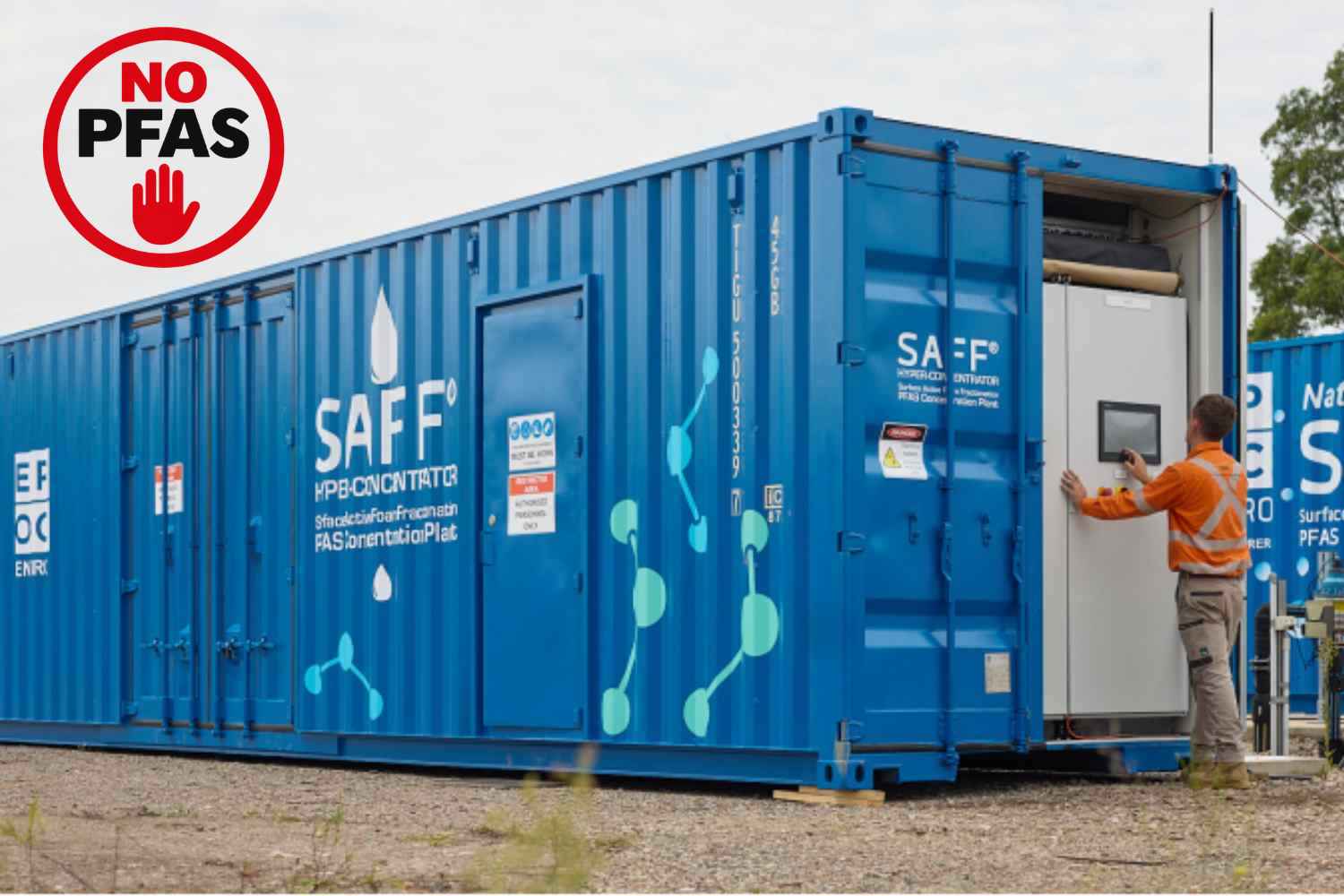
This is what Acqua Novara.VCO is doing, which at the Novara purifier has started the first industrial experimentation in Italy of the SAFF®40 technology, a system developed in Australia that uses a rather particular principle: instead of using a traditional filter, it uses air to separate the PFAS from the water and concentrate them in a foam, making the subsequent treatment of the contaminated fraction easier.
The innovation comes after an initial test phase conducted at the Briga Novarese purifier, which concluded in July. Now the experimentation continues in the Novara plant, under different operating conditions, and the first overall results are expected in November 2026.
Technological experimentation is only part of the strategy implemented by Acqua Novara.VCO. The water service manager has in fact been carrying out a monitoring activity for years to understand where the PFAS come from and through which routes they reach the water system. The objective is to intervene as much as possible before these substances reach the sewer systems.
In 2025, samples from water intended for human consumption, wastewater from purifiers and industrial waste were analyzed. The checks involved 21 purification plants and 120 industrial plants, making it possible to build a database useful for reconstructing the flows and identifying possible sources of contamination.
This is an important step because regular sewage treatment plants are not designed to remove PFAS. Intervening at the source, therefore, remains the first line of defense.
But what happens when these substances have already ended up in wastewater? This is where SAFF®40 comes in.
Australian technology using bubbles to capture PFAS
@Acqua Novara.VCO/ Canva
SAFF means Surface Active Foam Fractionation, i.e. fractionation using surface foam. The principle is simpler than it might seem. PFAS possess characteristics that allow them to concentrate at the interface between water and air. The system exploits precisely this behavior.
Inside the system, the contaminated water is subjected to an aeration process: the air forms a large quantity of bubbles which rise through the water. During this journey, PFAS molecules tend to adhere to the surface of the bubbles.
The bubbles then reach the top of the system, where they form an increasingly PFAS-rich foam.
At this point the separation occurs: the water, which has lost part of the contaminants, continues the treatment while the foam containing the PFAS is collected separately.
The principle of foam fractionation it is recognized as a physical separation technique: the substances that tend to concentrate on the surface of the bubbles are brought upwards and collected in the foam.
Be careful, however, we are not talking about a machine that “destroys” PFAS. Its job is to separate them from the water and concentrate them into a much smaller volume. The advantage is that, instead of having contaminants dispersed in a large volume of water, you obtain a much more concentrated flow which can subsequently be managed with specific treatments. The management of the concentrated part therefore remains a fundamental element of the entire process.
The system used in Novara is not, as one might think, a simple laboratory device. The SAFF®40 is an industrial solution housed inside a 40 foot container and is designed to handle large flow rates. According to the manufacturer’s specifications, it can treat up to 40 cubic meters of water per hour, depending on the characteristics of the water and the operating conditions.
The system includes multiple fractionation stages, precisely to allow moving from the first separation to the subsequent concentration of the contaminants. And this is one of the aspects that the Italian experimentation will have to verify in the field: how the technology behaves when it is not working on water with controlled characteristics, but on the real wastewater of a purification plant.
Why the Novara experimentation is important
SAFF technology has already been used in several countries and the manufacturer reports applications on numerous international sites. But the move to an Italian purification plant serves above all to collect data in concrete conditions. The experimentation therefore aims to verify the performance and efficiency of the system in real operating conditions.
It is therefore not just a matter of demonstrating that the principle works. The real objective is to understand how well an Italian purifier works, on which PFAS it is most effective, with which operating conditions and what management the concentrated contaminant requires.
The definitive results will be available in November but at the moment the manufacturer indicates for SAFF the possibility of high performance on different types of PFAS and, in certain contexts, removal percentages that can reach very high values. Some studies and field applications have also shown reductions close to or greater than 99% for specific compounds.
But it doesn’t mean that 99% is automatically the result obtained in Novara. In fact, the yield depends on the composition of the water, the initial concentration and the type of PFAS present. Furthermore, the technical literature highlights that the foam fractionation may be less effective against some short-chain PFAS, which may require additional treatment.
The real challenge, however, remains at the source
Finally, there is an aspect that risks being overshadowed when talking about new technologies: no system can replace prevention. If PFAS are used and released in production cycles, sooner or later they can reach the environment and water systems. Intercepting them subsequently is much more complex than preventing, when possible, their entry into the water cycle.
It is precisely for this reason that Acqua Novara.VCO is simultaneously carrying out the monitoring of water and industrial waste, the comparison with companies and the experimentation of SAFF®40.
The Novara trial, therefore, does not yet represent the definitive solution to PFAS. Rather, it is a new step in the search for systems capable of intercepting these contaminants when they are already present in water.
