
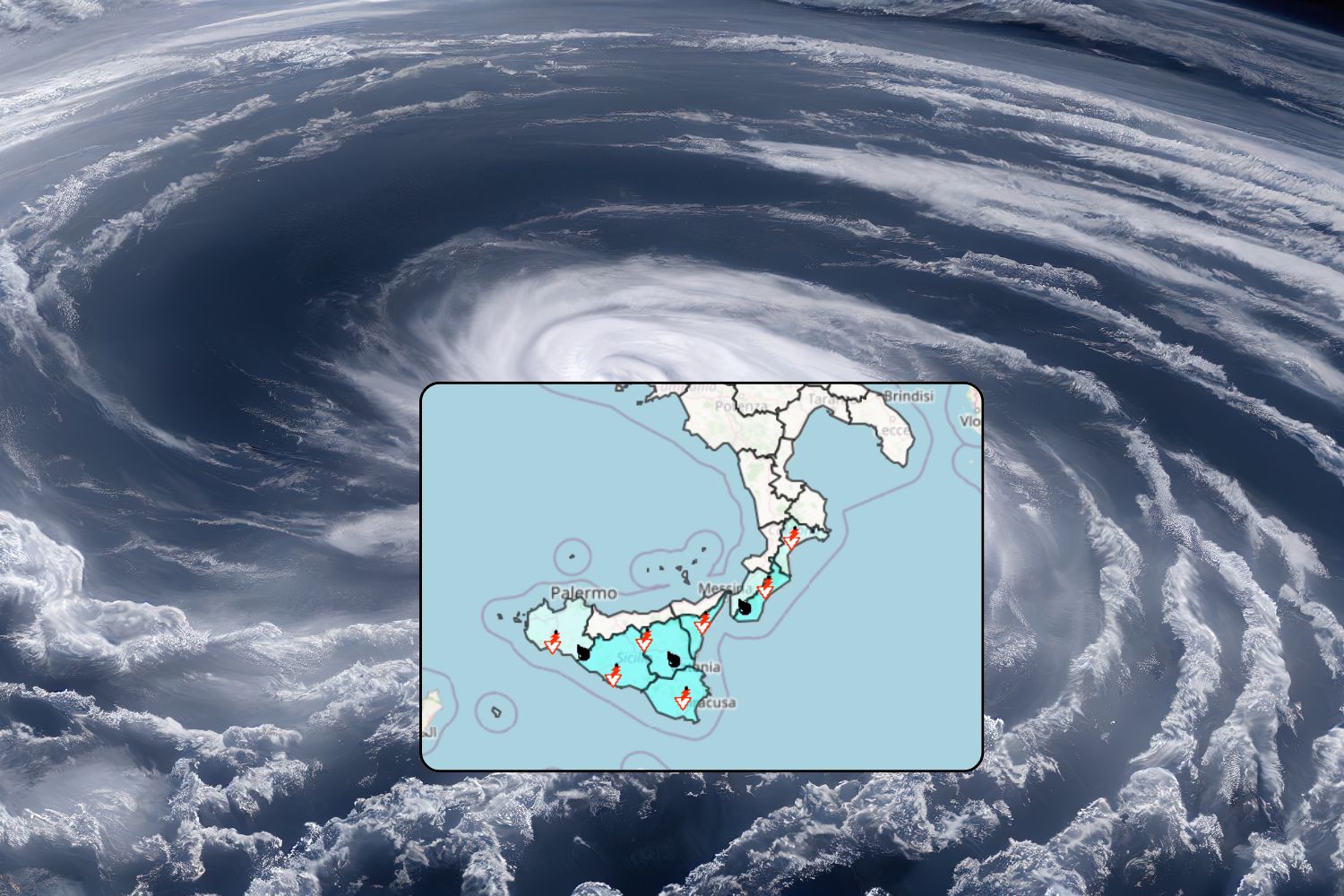
The Mediterranean is preparing for a new phase of instability. This is what meteorologists say, according to which a depression forming between the Sicilian Channel and the lower Mediterranean could take on characteristics similar to those of a Mediterranean subtropical cyclone, the so-called TLC (Tropical Like Cyclone).
In the last few hours, however, the scenario appears less extreme than the first hypotheses: the risk of a real Medicane, i.e. a “Mediterranean hurricane” with a structure similar to tropical cyclones, is not confirmed at the moment.
However, the possibility of a phase of bad weather with intense rainfall, thunderstorms and local hydrogeological problems remains real, especially in the southern regions.
Sicily and Calabria are the most exposed areas
The vortex mainly affects the southern sector of the Mediterranean and will continue its eastward movement in the next few hours. The areas most affected will be Sicily and Calabria, in particular the Ionian and southern sectors, but some phenomena may also affect Basilicata, Puglia and southern Campania.
@Civil Protection
The Civil Protection has issued a yellow alert for some areas of Sicily and Calabria due to storm, hydraulic and hydrogeological risk.
It is therefore not a return of stable summer, but a transition phase in which the contrast between cooler air at altitude and the heat accumulated from the sea can favor the development of locally intense thunderstorms.
What is a Mediterranean cyclone and why can it arise right now
The Mediterranean is not a tropical ocean, but in some conditions it can generate cyclonic systems with characteristics similar to tropical ones. The most favorable period is precisely autumn: after months of heat, the sea surface still retains a lot of energy, with temperatures that in some areas can even exceed 27-28 °C.
When colder air arrives above these relatively warm waters at high altitude, atmospheric instability increases: strong upward currents and organized thunderstorms develop which can fuel the vortex.
In some cases the system can transform into a “hot core” cyclone, that is, a structure in which the center of the depression is warmer than the surrounding environment, a typical characteristic of tropical cyclones.
What is Medicane
The term Medicines was born from the union of Mediterranean And Hurricanebut it does not automatically mean that every Mediterranean cyclone is a hurricane. These phenomena are in fact much smaller and less frequent than the tropical cyclones of the Atlantic. The Mediterranean does not offer the same enormous oceanic spaces nor the same conditions necessary for the formation of classic hurricanes.
In the past, however, some systems have shown surprising characteristics, such as the cyclone Ianoswhich hit Greece in September 2020, developing a structure very similar to that of a tropical cyclone, with a clear central eye.
What to expect in the next few days
The picture remains that of a divided Italy: while the South will have to deal with instability and storms, in the next few days another Atlantic disturbance could reach the country from north to south, bringing more dynamic conditions to the rest of the Peninsula as well.
The situation, therefore, must be monitored above all for the possible intensity of local phenomena: in the Mediterranean, in fact, even systems that cannot be classified as Medicane can produce sudden downpours, hailstorms and strong gusts of wind.
