
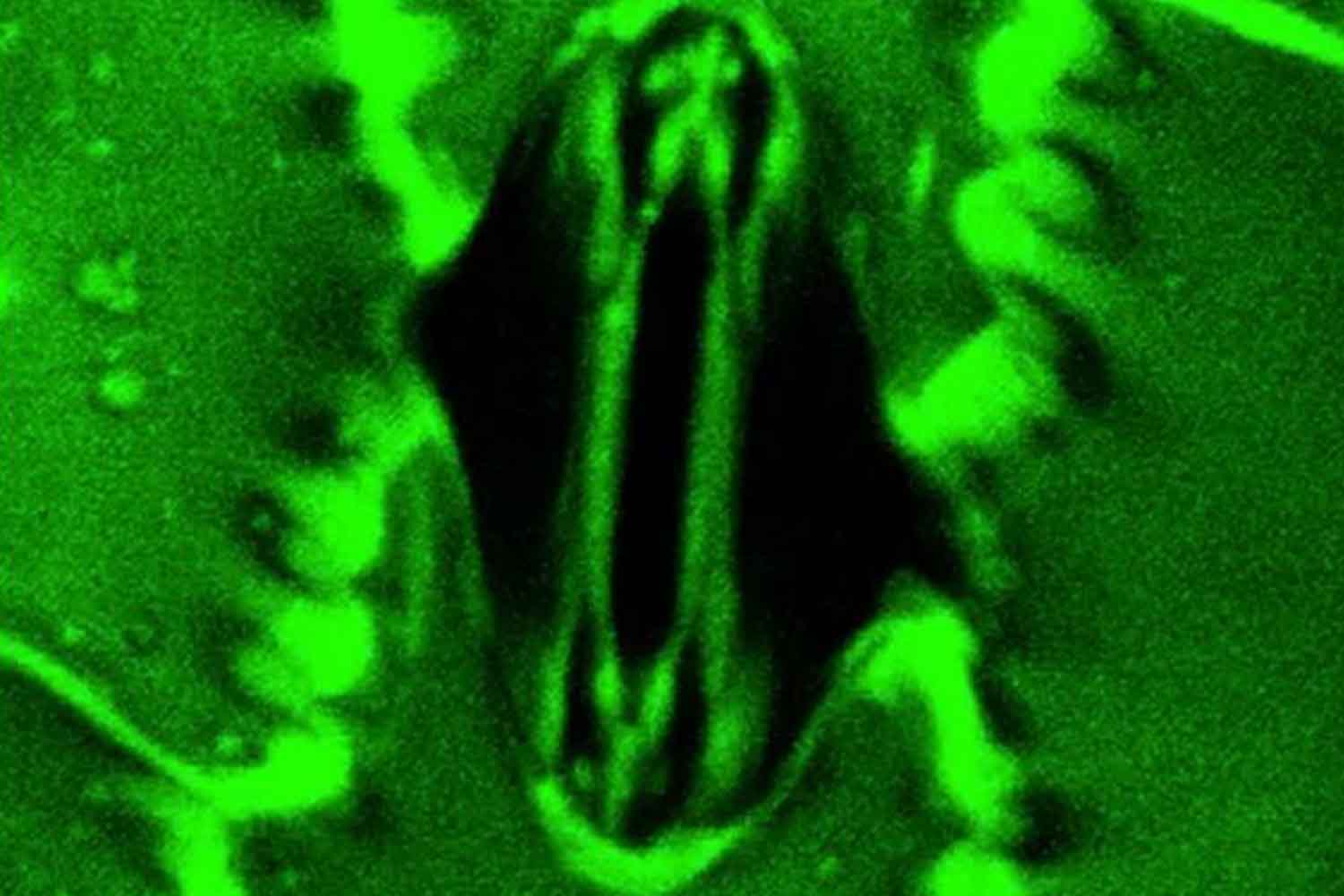
A corn leaf under the microscope, dozens of tiny openings that widen and narrow and, at the same time, instruments that measure how much carbon dioxide enters and how much water leaves. For the first time, researchers at the University of Illinois Urbana-Champaign have managed to follow the behavior of the stomata in real time by directly linking it to the gas exchange of the leaf.
The system is called Stomata In-Sight and is described in a study published in Plant Physiology. In practice it allows you to see those tiny plant “mouths” as they do what plants do all the time: seek a balance between the CO2 necessary for photosynthesis and the water they risk losing every time they open the door.
Stomata are microscopic pores on the surface of leaves. When they open, carbon dioxide can enter plant tissues; at the same time, however, water vapor comes out. The plant must then continuously adjust those openings based on light, temperature, humidity and CO2 concentration. A microscopic negotiation that lasts practically the whole day.
See the stomata as the leaf exchanges gases
Until now, scientists had very effective tools for observing stomata and equally precise ones for measuring photosynthesis and water loss. Putting the two together, at the same time and on the same living leaf, was much more complicated.
Stomata In-Sight brings together a very powerful microscope, instruments that measure gas exchanges and an artificial intelligence system. The leaf remains alive as the researchers monitor light, temperature, humidity and CO2 and observe how the stomata open and close.
During the presentation of the research, Andrew Leakey, professor of plant biology at the University of Illinois and one of the authors of the study, stated:
Traditionally we have had to choose between seeing the stomata or measuring their function.
The group tested the system on corn (Zea mays), subjecting the leaves to different light conditions and CO2 concentrations. In this way he was able to observe how the opening of the stomata physically changed as photosynthesis and transpiration varied.
Machine learning follows dozens of tiny openings
Looking at stomata is one thing. Measuring them one by one for hours is another. For this reason, the researchers trained a machine learning system capable of automatically recognizing pores and stomatal cells in images and calculating their dimensions. The automatic measurements of the pore area showed a strong correspondence with those made manually by the scientists.
The group also discovered that, in the experimental conditions used, observing around 40 stomata already allowed them to obtain a good estimate of the average behavior of the portion of the leaf analysed.
The interesting passage comes immediately afterwards. Using the size, density and depth of the stomata observed under the microscope, the researchers were able to estimate the stomatal conductance, i.e. the ease with which gas and water vapor pass through the leaf surface, obtaining values close to those measured directly by the instruments. The behavior of a handful of microscopic pores thus begins to tell what the entire leaf is doing.
Because it can be useful against drought
Each opening of the stomata involves an exchange: the CO2 necessary for photosynthesis enters, water comes out. Better understanding how different plants manage this balance could help researchers identify useful traits for growing crops that use water more efficiently, an increasingly important goal in agriculture as droughts and heat waves make water availability less reliable.
The same authors indicate among the possible future applications the study of the genetic characteristics that regulate the shape and behavior of the stomata, to understand which combinations allow crops to maintain good photosynthesis while losing less water.
Naturally, we can go from here to corn that grows happily without irrigation. Stomata In-Sight is a research tool, tested so far under controlled conditions, and will be used on other varieties, species and environmental conditions. But it allows us to look much more closely at one of the mechanisms that decide how much water a plant consumes to grow.
A small window on the relationship between plants and climate
Stomata behavior also enters into models that try to describe how vegetation responds to higher temperatures, drought and increased atmospheric CO2. So far, many of these processes are represented through averages and parameters derived from whole-leaf exchanges. Being able to directly observe how individual pores react gives researchers a much more detailed amount of information to test in physiological and climate models.
The University of Illinois has already filed a patent on the technology. The next step will be to use it to compare plants with different anatomies and strategies and understand which ones are able to find the best compromise between carbon and water. Because a leaf, seen from afar, continues to appear perfectly still. Under the microscope he instead spends his time opening and closing tiny doors, continually dealing with what comes in and what he risks losing.
