
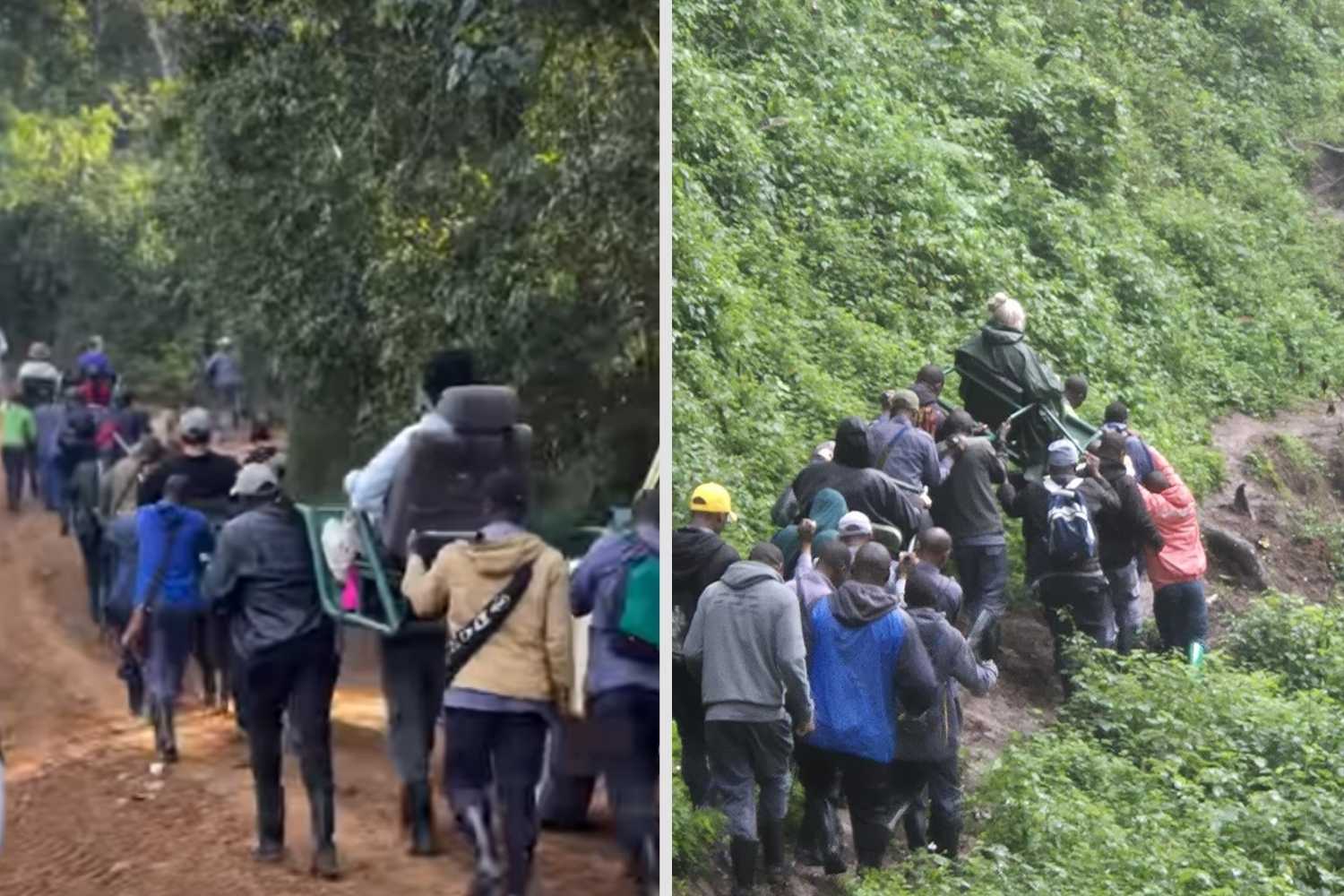
White tourists sitting on a sedan chair, transported into the forest by a group of local men, while around them are the last mountain gorillas on the planet. They are images that, from time to time, make the rounds on social media, sparking debates: is it a service that makes nature tourism more accessible or a scene that revives old colonial hierarchies?
We are in the Bwindi Impenetrable National Park, in southwestern Uganda, a UNESCO heritage forest since 1994 and one of the most important places in the world for the conservation of the mountain gorilla (Gorilla beringei beringei). About half of the world’s remaining population of this species lives here.
To get close to the gorillas, if you really “must” do ityou have to face a challenging route: hours of walking in the forest, steep paths, mud, humidity and difficult terrain. For those who do not have sufficient physical preparation, for elderly people or with mobility difficulties, Ugandans have had a solution for some time: the sedan chaira sort of sedan chair carried on the shoulder.
View this post on Instagram
Local operators call it “African helicopter“: the “African helicopter” and is a service that can cost a few hundred dollars and which involves groups of porters belonging to the communities near the park. For some visitors it represents the only way to live an otherwise impossible experience.
But here’s the point we wanted to get to (beyond the visit that the gorillas didn’t even ask us for, for which you have to travel kilometers and pay good money): is it a mere inclusion service or a luxury for rich white tourists who can afford it? Those who defend it point out that the sedan chair would allow especially people with physical limitations to participate in an experience considered among the “most extraordinary in world nature tourism”. Furthermore, for many local families tourism represents an important source of income: that is, porters are workers from the communities near the park and the money generated by tourist activities contributes to the local economy.
When you hire these carriers, they are supporting five other people in their family, explains Gladys Kalema-Zikusoka, a leading primatologist and founder of Conservation Through Public Health, an NGO dedicated to the coexistence of humans and endangered primates.
________
I trained as a tour guide in Uganda and am Ugandan myself. Our culture allows it and it has nothing to do with exploitation or self-esteem issues; rather it is about respect towards the elderly and infirm people. In the capital, self-employed Ugandan workers carry heavy luggage as porters, both for local citizens and others; always on their own, they transport agricultural products on wooden carts for the same categories of people. The tourism sector has simply borrowed this practice, applying it to its own sphere, a guide also says under a post:
Furthermore, gorilla tourism would also be one of the tools through which Uganda finances the protection of a species that for decades has been threatened by habitat loss, conflicts and poaching.
Why then do the images spark controversy?
Well, because they have a very strong symbolic weight. A Western tourist seated and carried by African workers inevitably recalls images of the colonial past: European explorers, officials and travelers crossing the continent carried by local people. It is precisely this visual element that pushes us to talk about “neocolonial tourismNot so much the fact that the porters are paid or not or that the service is illegal, but rather the type of relationship represented: a visitor with greater economic availability who purchases an experience in which other people make their bodies and their efforts available (so what divides public opinion does not so much concern people who cannot walk for physical reasons).
It is no coincidence that the sociologist John Urry talked about “tourist gaze”, the “tourist gaze”, to indicate the way in which tourism can transform places and people into elements of consumption, creating power relations between those who observe and those who are observed.
The paradox of gorilla tourism
The story of the “African helicopter“contains a greater contradiction. According to the locals, on the one hand tourism has contributed concretely to the survival of mountain gorillas (trekking permits have a high cost and part of the revenue finances the management of parks and conservation programs); on the other, the very success of this tourist tourism cannot fail to create tensions: increased pressure on the territories, inequalities in the distribution of benefits and the risk that local communities become part of the “scenario” offered to visitors.
A study published onAfrican Journal of Hospitality, Tourism and Leisure highlighted how among residents of the areas near Bwindi tourism is perceived in an ambivalent way: a source of economic opportunities, but also a phenomenon capable of modifying culture, social relations and access to resources.
View this post on Instagram
How, therefore, can nature tourism generate benefits for ecosystems and local communities without reproducing relationships of inequality? Gorilla trekking may have demonstrated that tourism can help protect a threatened species, but conservation cannot just concern the animals: it must also include the people who live alongside those territories.
Perhaps the challenge will be to ask ourselves how to make these aspects more equitable: guaranteeing decent conditions for workers, greater participation of local communities in decisions and tourism that does not transform anyone into a simple part of the show.
And no one thinks about gorillas? Well, the question remains whether this tourism is ethical and really does good for these splendid animals. But that’s another story.
