
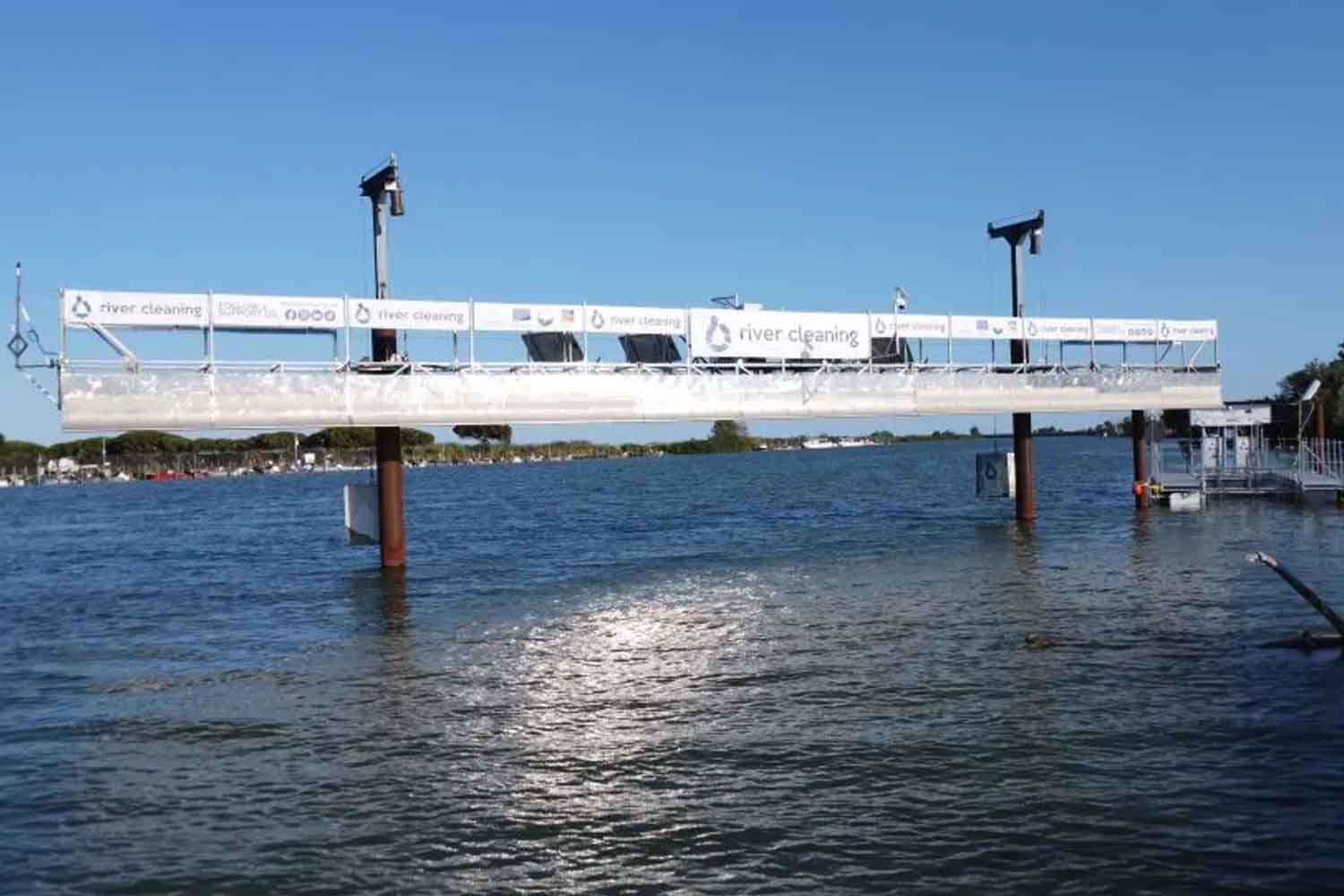
A barrier crosses the Po di Gnocca diagonally and lets the current do part of the work. Bottles, packaging and other floating waste are accompanied towards a collection cell, while cameras and algorithms record what passes. It is now operational in the Po Delta River Cleaning, a 25 meter long automated system designed to intercept waste before it reaches the Adriatic.
The plant was officially inaugurated on 15 September in Porto Viro, in the province of Rovigo, as part of INSPIRE – Innovative Solutions for Plastic Free European Rivers, a project financed by Horizon Europe. The Veneto Region, which co-financed the installation through the regional River Cleaning initiative coordinated by Venice Lagoon Plastic Free, talks about a system intended to intercept plastic and other waste along the waterway before it reaches the sea. Veneto region
The current carries the waste towards the collection
The operation is quite physical. The floating modules are placed obliquely to the flow and they use the current to direct waste towards a lateral collection point. At the site on the Po di Gnocca the system is installed in a fully automated version and is combined with the tank developed by the Greek partner MINDS.
River Cleaning itself explains that the system was designed to continuously block macroplastics and, at the same time, collect information on the materials intercepted through monitoring systems. machine learning. The technology is developed by Mold Srl, a company from Cassola, in the Vicenza area.
The artificial intelligence, therefore, does not fish bottles from the Po. Those move the water and the barrier. Cameras and algorithms are used to count and classify what is interceptedadding to the collection a quantity of data that can be used to understand what the river is carrying.
The system is also powered by solar energy for the automated components. The declared objective is to make it work continuously without creating a complete dam of the watercourse.
Because the Po needs a barrier before its mouth
The location is anything but random. In the national monitoring program conducted by ISPRA on floating macro-waste, the Po was found, together with the Tiber and Sarno, among the waterways which, among those observed, transport the most waste towards the sea. And above all they transport plastic. More than 80% of the macro-waste detected by ISPRA was made up of plastic and about a third of disposable products. Among the identifiable objects there were mainly materials related to food consumption and packaging.
ISPRA also tried to follow up on these refusals. To study their movements, floating containers equipped with GPS, built to behave similarly to macro-waste, were released into the rivers. The trackers showed a long stay in the waterways, with continuous stop and go linked to variations in flow rate. Once they reached the sea, some still traveled several kilometers before beaching themselves. Intercepting a bottle when it is still inside a branch of the Po is decidedly simpler than chasing it when it has already taken off.
River Cleaning is one of INSPIRE’s European tests
The Italian plant is one of the demonstration cases of INSPIRE, a European project launched in 2023 and scheduled until May 2027. The program brings together 26 partners and 20 technologies or actions dedicated to three steps: identifying pollution, collecting waste and plastic already present and preventing it from entering the rivers. The project has a total cost of approximately 11.47 million eurosof which just under 10 million come from the European Union. The National Research Council also appears among the Italian partners, through the CNR-ISMAR.
The boundary of what River Cleaning can do is also important. The INSPIRE project also works overall on microplastics, but the barrier installed in the Po di Gnocca serves above all to intercept floating waste and macroplastics. It does not clean the river of any contaminants present in the water and does not eliminate, on its own, the problem of plastic dispersed upstream.
The barrier could also become an observatory on the Po
The next step concerns precisely what the barrier can tell about the river. During the presentation on 15 September, new possible uses of the technology were indicated, from the monitoring of algal phenomena and hypoxia to the study of the salt wedgethe rise of salt water from the sea which can become particularly critical in the Delta when the flow of the Po decreases.
For now there are further developments. The one already operational is much simpler to see: the waste goes down towards the sea, encounters a 25 meter barrier and is accompanied out of the current. The problem, of course, would be to prevent them from ending up in it. In the meantime, River Cleaning at least tries to catch them before the Adriatic.
