
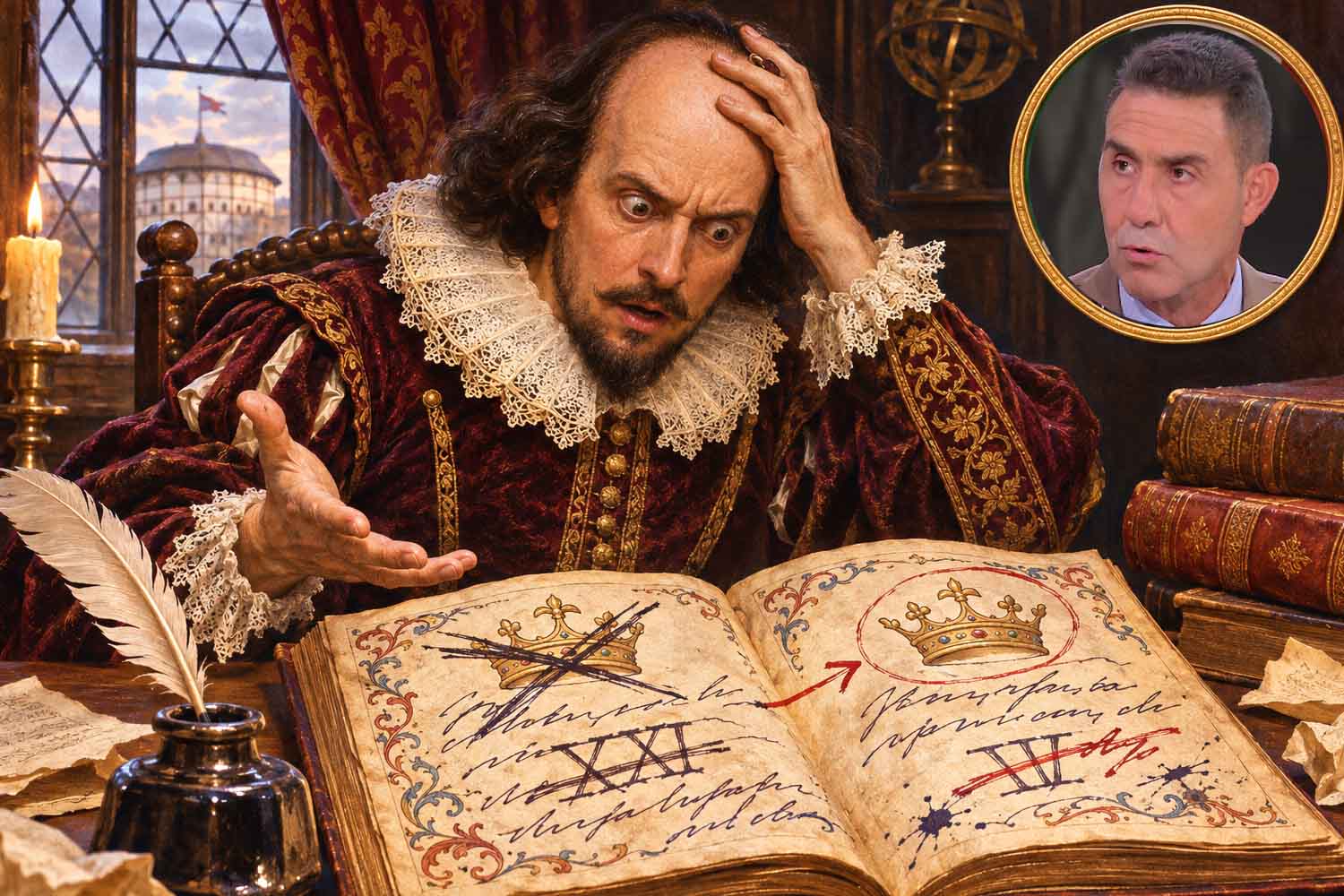
During an episode of Filorossoon Rai 3, former general Roberto Vannacci responded to questions about defections from his party with a chivalrous dismissal, at least on paper. He called Shakespeare into question, attributing to him a non-existent work and a refreshment service which, reading the original text, was not foreseen:
To those who leave Futuro Nazionale I say, quoting Shakespeare’s Charles V, that we guarantee fresh horses and plenty of food.
The reference is toHenry Vwho became “Carlo” for the occasion. Precisely to the famous speech of Saint Crispin, pronounced by the English king before the battle of Azincourt. In the text preserved by the Folger Shakespeare Library, Henry invites those who do not want to fight to leave: they will receive a pass and coins for the journey. Fresh horses and food do not appear. Indeed, the sovereign adds that he would prefer not to die next to those who are afraid of sharing the fate of their companions.
There is an interesting detail: a few days earlier, during a speech in Florence, Vannacci had correctly called into question theHenry Vrepeating, however, the offer of horses and supplies. “Carlo” could therefore have been a television slip. The supplies, however, resist both versions. Shakespeare evidently underestimated the importance of logistics.
Homer also had his moment
Last September, during a speech in Orvieto, Vannacci proposed Ulysses as a model of his “Mediterranean patriarchy”: a man who “does not give in to the beauty of Circe”, resists flattery and returns to his wife.
In the Odyssey, book ten, however, Ulysses resists Circe’s spell thanks to the help of Hermes, then shares the sorceress’ bed and remains on her island for a whole year. At a certain point, his companions remind him that he also has a home to return to. As for his loyalty to Penelope, we can always argue that it was mental. A little less carnal.
With Calypso the matter is different. Odysseus spends seven years on his island, but the fifth book of the Odyssey describes him as unhappy, held against his will and longing to return to Ithaca. He also renounces the immortality that the goddess offers him. The desire to return to Penelope is therefore present in the poem, together with some passages that did not find a place in Vannacci’s story. Details.
Because a famous name weighs on words
Names are enough to give a different tone to a speech. A sentence uttered by a politician may seem like an opinion; attributed to a great author, immediately acquires a certain respectability. Even when the author, reading, would have something to object. Psychology has long studied how we use the prestige of others to orient ourselves. In 2012, Maciej Chudek and colleagues conducted two experiments with three- and four-year-olds, observing how they chose models to imitate. The little ones tended to follow more adults to whom other people had paid attention. In the second experiment this preference also depended on the context in which the model was observed.
The research concerns childhood learning, but it shows an interesting mechanism: perceived prestige can influence who we pay attention to and who we decide to learn from. With Shakespeare the passage is particularly curious. The prestige of the writer derives from his work, but when a sentence is attributed to him he can benefit from that reputation even if it does not belong to him.
Memory, then, does not always help us. In 1992, a group of psychologists conducted four experiments on the familiarity of statements. Participants had to judge sentences associated with more or less credible sources. Previously encountered statements tended to seem truer than new ones even when they had been attributed to unreliable sources, especially if the memory of where they came from was not strong enough.
We can therefore remember a sentence and forget who said it. Or remember the prestigious name associated with the phrase, without worrying too much about the original content. On the other hand, checking a citation takes a few minutes. Repeating it with conviction is much faster.
Another study published in 2015 showed that repeating false statements can increase their perceived credibility even when people have the knowledge to recognize them as false. The phenomenon is known as illusion of truth: something we have already heard appears more familiar and, under certain conditions, more reliable.
The studies above all measure how credible a statement seems and why referring to an illustrious name can be a shortcut to attract attention and give authority to one’s words. Source control requires additional effort. And the original texts, unfortunately for those who misquote them, continue to exist.
The band of brothers also works without horses
The use ofHenry V on Vannacci’s part, net of the incorrect quotation, it has a precise narrative logic. In St. Crispin’s speech the English king rejects the idea of asking for reinforcements. His men are few, but that very condition becomes a source of pride. Fewer soldiers means a greater share of honor for each.
It is the passage of the famous “band of brothers”: a sovereign transforms a situation of numerical inferiority into a story of courage, loyalty and belonging. Whoever stays to fight will go down in history. Whoever leaves will lose that opportunity. Recalling this discourse while talking about defections from a party allows us to present the departure of members as a selection of the most faithful. Those who remain become comrades ready for battle, those who leave have given up on the undertaking.
Literature knows how to build belonging with an effectiveness that a graph of returned cards hardly achieves. Naturally, something changes when the illustrious name is called upon to guarantee a phrase that does not appear in the work. Shakespeare becomes a prestigious signature placed on a text written by someone else. A political consultancy service that the playwright never appears to have offered.
When culture becomes scenography
A good quote adds meaning to a speech. It can clarify a conflict, create an unexpected connection, even make you smile. A citation used only for the name it bears risks instead replacing the topic with a stamp of authority. Shakespeare to give solemnity to a speech on defections, Homer to celebrate marital fidelity. The name is the right one for the desired effect, the content can also be adapted to the needs of the moment. All it takes is for the audience to recognize the reference.
Do we therefore believe more in those who cite great authors? Sometimes yes. The prestige of a name can make a sentence more authoritative in our eyes, and familiarity can make it seem more true. A nice convenience for those who want to convince us, especially when no one checks what the cited author actually wrote. Meanwhile the texts are there, available for consultation. Shakespeare grants money and passes. Vannacci provides the horses and food. The signature, however, continues to be Shakespeare’s.
