
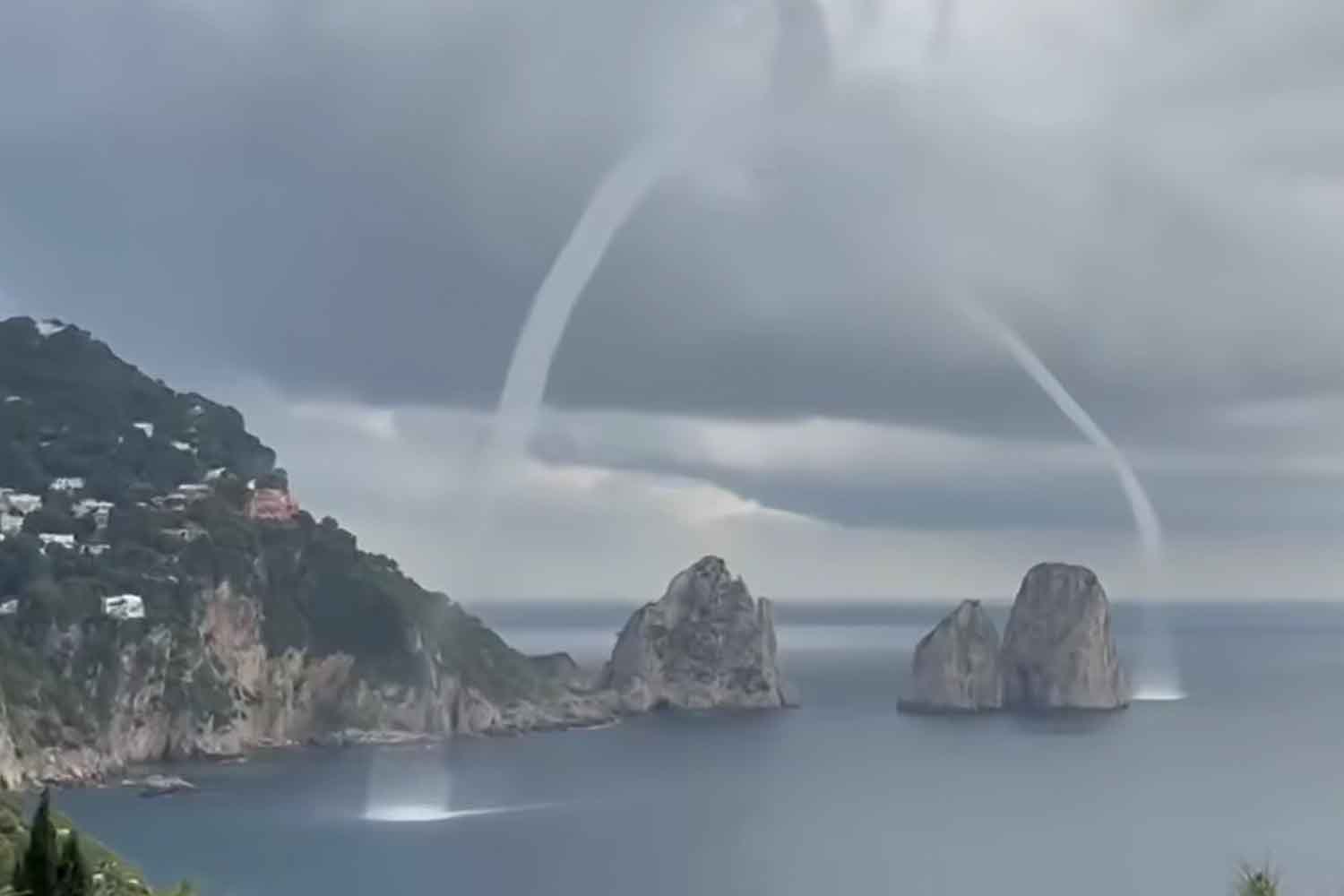
Two waterspouts, the Faraglioni of Capri in the middle and a gray sky from which two long whitish funnels descend. It happened on Saturday 7 November 2026, when two vortices formed simultaneously in front of the famous rocks of the island, drawing a sort of arch over the sea. An unusual sight, captured in a video that in a few hours began to circulate on social media and newspapers, even reaching the BBC.
The images show the two vortices developing a short distance from each other, while the Faraglioni remain in the center of the frame. The phenomenon occurred during a morning of bad weather, with Campania affected by a yellow weather alert for thunderstorms.
Fortunately, the waterspouts remained offshore and no damage was reported. Enough to enjoy the show from the coast, decidedly less advisable for those who were on a boat nearby.
The double waterspout in front of the Faraglioni
The phenomenon was documented already on the morning of November 7th. The images show the vortices descending from the base of the clouds to the surface of the sea.
The peculiarity lies in their simultaneous appearance and position in relation to the Faraglioni. For a few moments the two funnels seem to frame the rock formations, giving the impression of a single large arch. The scene quickly attracted attention outside Italy as well. On November 9, BBC News relaunched the film on its social channels, describing the double waterspout that appeared in front of Capri.
How waterspouts form
They look like columns of water being sucked towards the sky, but what we see is above all a rotating vortex of air, made visible by the condensation of water vapor and spray raised near the sea surface.
Waterspouts develop when particular atmospheric conditions favor the formation of a swirling circulation above the water. They can be associated with intense thunderstorms or form under less turbulent conditions. The National Oceanic and Atmospheric Administration (NOAA), the US agency that studies oceans and the atmosphere, distinguishes betweentornadic waterspouts, associated with thunderstorms, and non-tornadic waterspouts, which are generally less intense.
The presence of two close vortices is possible when atmospheric conditions favor multiple circulations at the same time. In the case of Capri, however, the video does not allow us to precisely establish the intensity of the phenomena nor their classification.
A spectacle to observe from a distance
Waterspouts can have very different durations and intensities. Some dissolve quickly, others move to the surface of the water and, under certain conditions, can even reach land.
For boats they represent a real danger, especially due to the gusts of wind and turbulence associated with the rotation of the air. NOAA recommends keeping your distance and not attempting to cross.
In Capri, fortunately, the two vortices did not reach the coast. They remained in front of the Faraglioni, giving one of the most particular images of this wave of bad weather. The Faraglioni, accustomed to being the protagonists of every photograph, had rather unusual competition for a few minutes.
