
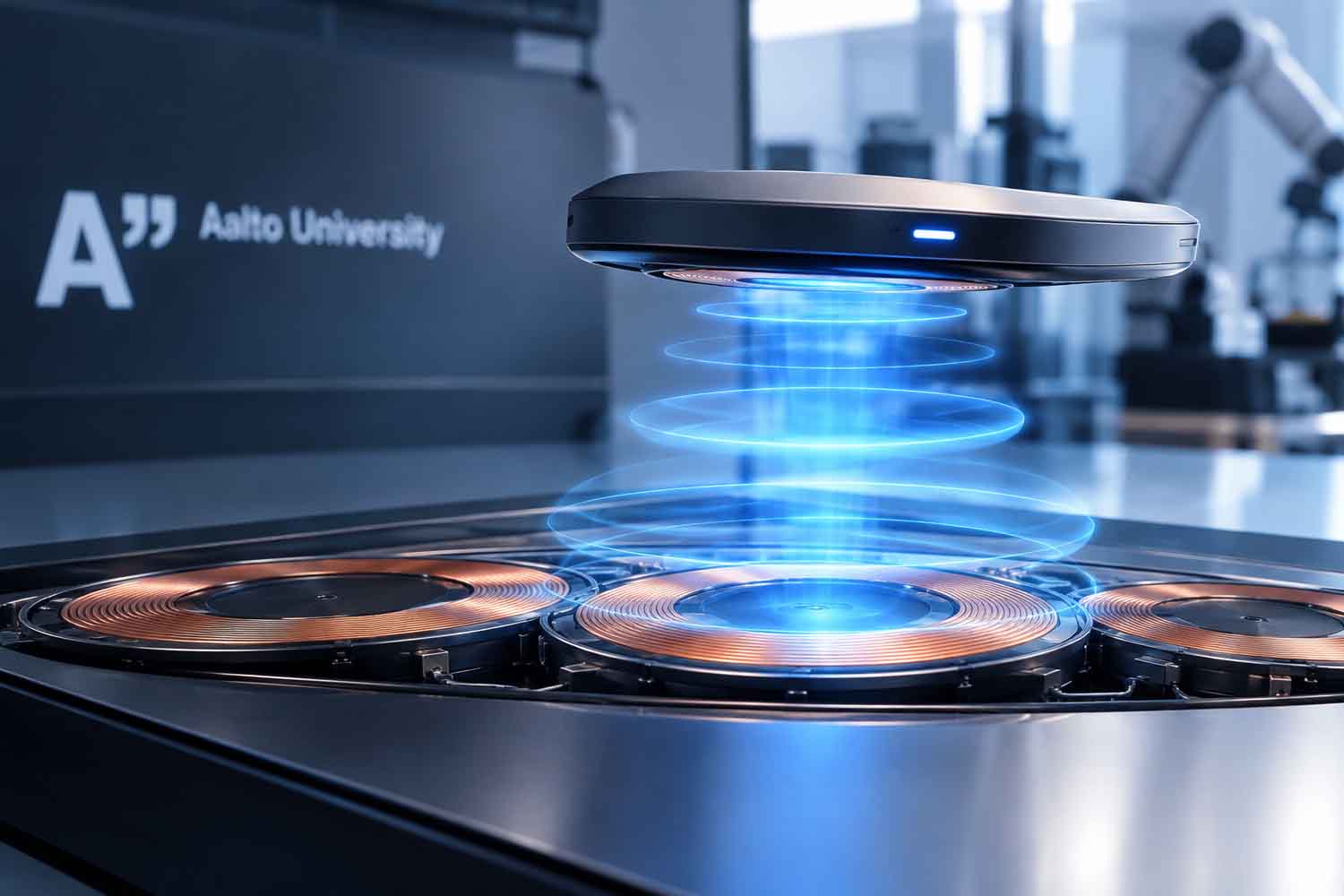
Three coils, a few centimeters of air and a device that receives electricity without being connected to an outlet. In the laboratories of Aalto University, Finlandresearchers have developed a system capable of wireless energy transfer with an efficiency of up to 91%. The peculiarity lies in the surface’s ability to independently identify where the device to be powered is located, without the need for position sensors.
The result was obtained at a distance of 3.7 centimeters between transmitter and receiver, as documented by a study published in IEEE Access. A distance that is still limited, of course, but the progress concerns above all the freedom of positioning. Anyone who’s tried to set a smartphone on a wireless charger knows that little hunt for exactly where charging works. Finnish researchers are working precisely to overcome this constraint.
The technology is called wireless power transferor wireless energy transfer. It has existed for some time, but the most recent developments are leading research towards surfaces capable of powering devices placed in different positions, without having to align them with the transmitter each time.
The surface that transfers energy where it is needed
The prototype created by researchers Masoud Sharifian Mazraehmollaei and Ilkka Laakso uses three partially overlapping transmitting coils, each with a diameter of 18 centimeters. When a device equipped with a receiver is brought closer to the surface, it changes the electromagnetic conditions of the circuit. The closest coils absorb the power necessary for the transfer, while the furthest ones remain essentially inactive.
In practice, the surface recognizes where it should send the energy through the behavior of the circuit itself. Without cameras, position sensors or a separate electronic system in charge of continuously choosing which coil to activate. During the experiments, the researchers measured a transfer efficiency of about 91 percent with a separation of 37 millimeters, which was maintained at around 89 percent when the separation was increased to 45 millimeters.
The researchers also simulated a version with seven transmitters, achieving an efficiency of around 94%, with variations of less than 1% in the positions examined. Another simulation analyzed the transfer to two receivers simultaneously. The possibility of expanding the charging area and powering more devices is especially interesting in industrial environments, where devices move frequently and physical connections can become an obstacle.
From battery chargers to robots that receive energy as they move
Aalto University has been working for several years on wireless charging systems capable of overcoming the limits of traditional induction bases. Already in 2022, the researchers presented a technology also tested on commercial robots, in collaboration with the Finnish company Solteq Robotics. The system allowed energy to be transferred to devices placed in different positions on an equipped surface, maintaining the charge even while moving.
For an automated warehouse, such a solution could be particularly useful. Robots used to move goods and materials must stop periodically to recharge their batteries. A surface capable of feeding them during some phases of their work would reduce these interruptions.
Applications could also extend to hard-to-reach industrial sensors and electronic devices that today require dedicated charging bases. Research has also begun to move out of the laboratories. Willo Technologies was born in 2024, an entrepreneurial initiative developed starting from the technologies of the Finnish university, with the aim of creating wireless charging systems for consumer electronics and industry.
How far can electricity travel without wires?
Distance remains a major challenge. The most common wireless charging systems use variable magnetic fields to transfer energy from one coil to another. They work especially well when the transmitter and receiver are close together. By moving them away, maintaining high performance becomes more complicated. In 2023, another group from Aalto University studied how to improve the energy transfer between two antennas by intervening on the losses associated with electromagnetic radiation.
The experiment used two circular antennas with a radius of 3.6 centimeters, separated by 18 centimeters. The researchers showed how particular configurations of electrical currents can reduce losses and improve efficiency even at distances greater than those of traditional charging bases. This is a distinct line of research from that of the new prototype, but both address one of the fundamental problems of wireless transmission: transferring as much energy as possible where it is needed.
The future of wireless electricity
Applications could also reach electric cars, through parking lots equipped with charging platforms, and certain implantable medical devices, for which replacing a battery can be particularly complicated. The same Finnish study from 2026 indicates heat management, component reliability and evaluation of exposure to electromagnetic fields among the steps still necessary before transforming the prototype into a commercial product.
Meanwhile, the experimental system has demonstrated that it can transfer energy with high efficiency and adapt to the position of the receiver. Without having to search for it with additional sensors. Power grids will continue to need their own cables, just as transmitters will need to be powered. In some applications, it could be the last physical connection that disappears: the one between the device and its energy source. And for a robot working in a warehouse, being able to receive electricity without constantly interrupting activities would already be a big difference.
